


As mega K-pop group BTS returns to the stage after a hiatus of more than three years, one major market is conspicuously missing from its 12-month world tour: China.
The omission of one of the group’s biggest fan bases comes as no surprise. In fact, just the opposite would have been huge news. China has blocked most South Korean entertainment since 2016 under an unofficial ban that also restricts movies and the country’s popular TV dramas. For some Chinese, that means flying to Seoul to see their favorite groups perform — as many were expected to do for three shows opening the tour this week and weekend.
China has long used trade restrictions in geopolitical disputes. The trigger for the entertainment ban was a South Korean decision to allow the US to deploy an anti-missile system on its soil. What sets the ban apart is how long it has lasted, something analysts attribute to government concern about the massive popularity of Korean music and videos. China is a robust defender of its own cultural products.
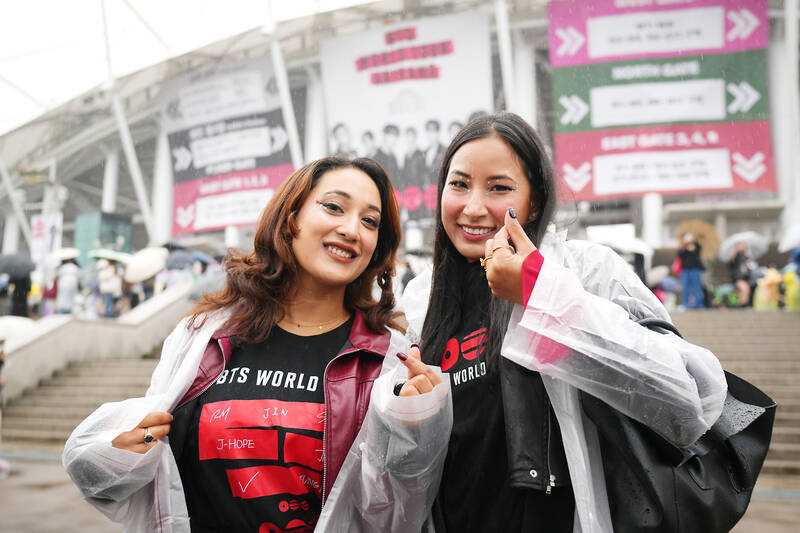
Photo: AP
Rumblings that the ban could be eased — an expectation South Korean President Lee Jae Myung has publicly voiced as he and Chinese leader Xi Jinping (習近平) seek to improve ties — have thrust it back into the news.
China’s use of economic pressure signals the government’s resolve, clarifies what it considers unacceptable and reinforces nationalism at home, said Oh Seung-Youn, a Bryn Mawr College professor who is writing a book on China’s use of informal economic sanctions.
“From China’s perspective, these actions go beyond symbolism,” she said in a written response to questions. “They are strategic tools to shape the international environment.”
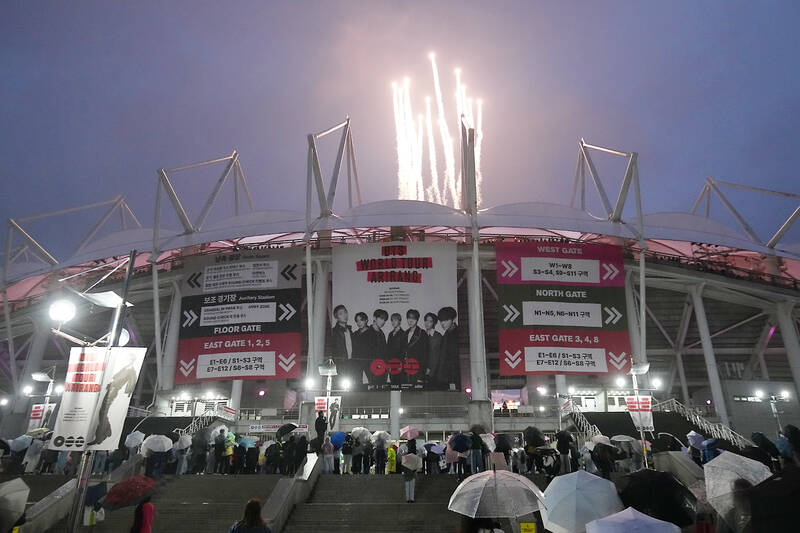
Photo: AP
BAN NOT TOTAL
Many K-pop groups have non-Korean members, and they have been allowed to perform in China. Pop-up stores selling K-pop merchandise attract lines of fans and require advance reservations during peak hours.
For video, the growth of streaming means dramas are accessible to an extent — though the latest ones may be pirated versions. A check of four major Chinese platforms found a limited selection of about 50 dramas, and all at least four years old.
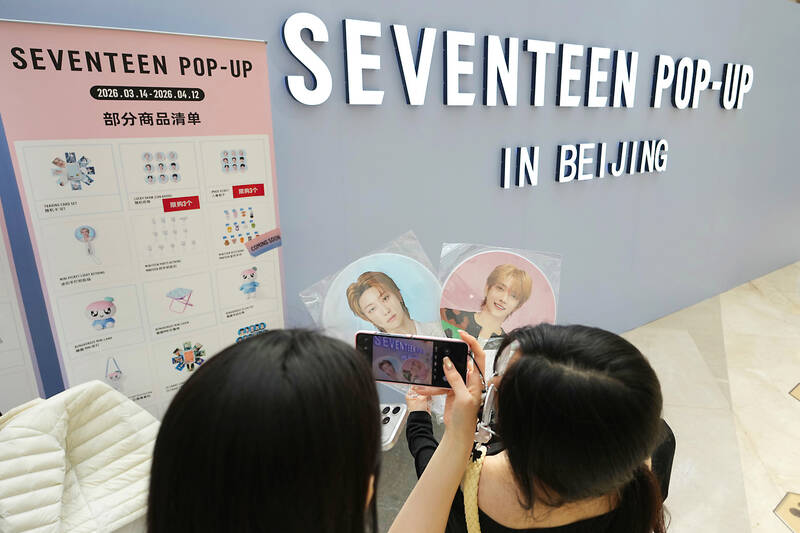
Photo: AP
The ban does not apply in Macao and Hong Kong — where the BTS tour lands next year — because both are special regions in China with their own governments and laws.
“I’m already really grateful that they can perform in places like Hong Kong, Macao and Taiwan,” said Tian Xin, who was in Seoul last month for a free comeback concert ahead of the tour. “The rest is a matter of national policy. Of course, I still hope they can come closer to us — fans always want that.”
The missile defense system, known by the acronym THAAD, is aimed at the North Korean threat, but China said its radar could be reconfigured to peer into its territory. Though the US operates the system, it was South Korea’s decision to allow the deployment that angered China.
Besides the entertainment ban, China also drove out a South Korean supermarket chain. The THAAD system remains — though recent security camera footage and other images have sparked speculation that the US may have shipped some of the interceptor missiles to the Mideast for the war against Iran.
CONCERNS OVER K-POP FANDOM
At first, China welcomed the “Korean Wave” as a cultural import compatible with its political system and a substitute for Western pop culture, the Korea Creative Content Agency, a government group, said in a report earlier this year. But the surging popularity of Korean music and dramas in the 2010s turned it into something that, the report said, needed to be controlled.
“The Chinese government had never experienced anything like that before,” said Kim Dong-ha, a professor at the Busan University of Foreign Studies.
“While the dispute over THAAD happened to coincide with that period, Beijing’s fundamental concern goes deeper,” he said. “It cannot allow foreign culture to shape the thinking of its young people, especially when its government has no control over the content.”
The government banned effeminate-looking men from TV in 2021, a look that Chinese pop stars likely picked up from South Korean and Japanese performers.
China also wants to develop its own pop culture as a form of soft power. Think the Labubu doll craze and the food and drinks chains.
“China wants cultural governance — to grow its own music industry,” said Hyunji Lee, a financial analyst who covers the entertainment sector. “If K-pop floods back in, there’s a direct conflict.”
CHINA MUM ON BAN
China, though, has never acknowledged that a prohibition exists.
“China has never imposed any so-called bans on the Republic of Korea,” Foreign Ministry spokesperson Zhao Lijian (趙立堅) said in 2022. Another spokesperson, Lin Jian (林劍), said last September that China has no objection to “healthy and beneficial” cultural exchange with South Korea.
Hopes for lifting the ban rose after Lee and Xi met twice. During Lee’s visit to China in January, the two governments signed an agreement to expand cultural and content exchange — but only gradually, and starting with just soccer and the traditional board game called go.
Xi quoted two Chinese idioms, according to the South Korean side: “Three feet of ice does not form in a single day” and “Fruit falls only when it ripens.” They suggest that any opening will take time and happen when the conditions are right.
On Chinese social media, some people said that K-pop — with its suggestive dance moves — is not appropriate for children. Others warned that Korean entertainment could overwhelm the domestic industry. Fans looked forward to performances in China that would save them from red-eye flights and the cost of hotel stays abroad.
Yu Sang, a fan and event organizer, flew to Seoul five times last year for K-pop events and organized one for KPop Demon Hunters at a shopping mall in Beijing on New Year’s Eve.
“The fans in China are incredibly devoted,” she said. “If you go to the Arctic, I’ll go to the Arctic with you.”
KOREA LOOKS ELSEWHERE
The ban has reshaped how South Korean entertainment companies see the Chinese market.
Drama producers have felt the loss most acutely and have more to gain from an opening-up than the K-pop industry, said Lee, the financial analyst.
Pirated versions don’t generate income for the producers. The dramas are on small apps and sometimes disappear after a few days, according to reports posted by individuals on social media. Some of the apps themselves disappear, then reappear with slightly altered names.
Netflix and Disney+, which distribute most South Korean dramas globally, are blocked in China. They can be accessed using a virtual private network, which is illegal to do (though enforcement is spotty).
The K-pop industry has restructured so that China is no longer critical. Japan has become the anchor market, while North America has emerged as the primary growth frontier.
“China matters,” Lee said, “but it’s not something companies are desperately waiting on anymore.”

The problem with Marx’s famous remark that history repeats itself, first as tragedy, the second time as farce, is that the first time is usually farce as well. This week Chinese Nationalist Party (KMT) Chair Cheng Li-wun (鄭麗文) made a pilgrimage to the People’s Republic of China (PRC) “to confer, converse and otherwise hob-nob” with Chinese Communist Party (CCP) officials. The visit was an instant international media hit, with major media reporting almost entirely shorn of context. “Taiwan’s main opposition leader landed in China Tuesday for a rare visit aimed at cross-strait ‘peace’”, crowed Agence-France Presse (AFP) from Shanghai. Rare!
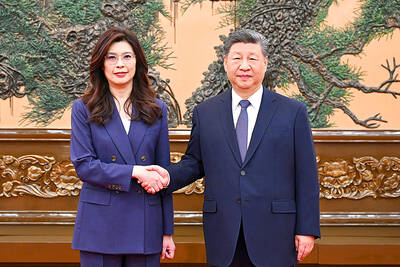
What is the importance within the Chinese Nationalist Party (KMT) of the meeting between Xi Jinping (習近平), the leader Chinese Communist Party (CCP), and Cheng Li-wun (鄭麗文), the leader of the KMT? Local media is an excellent guide to determine how important — or unimportant — a news event is to the public. Taiwan has a vast online media ecosystem, and if a news item is gaining traction among readers, editors shift resources in near real time to boost coverage to meet the demand and drive up traffic. Cheng’s China trip is among the top headlines, but by no means
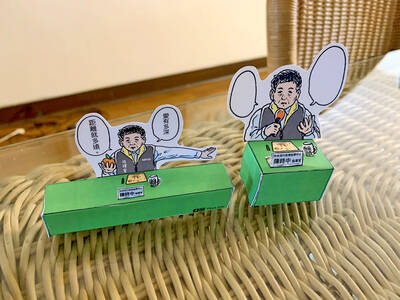
Sunflower movement superstar Lin Fei-fan (林飛帆) once quipped that the Democratic Progressive Party (DPP) could nominate a watermelon to run for Tainan mayor and win. Conversely, the DPP could run a living saint for mayor in Taipei and still lose. In 2022, the DPP ran with the closest thing to a living saint they could find: former Minister of Health and Welfare Chen Shih-chung (陳時中). During the pandemic, his polling was astronomically high, with the approval of his performance reaching as high as 91 percent in one TVBS poll. He was such a phenomenon that people printed out pop-up cartoon
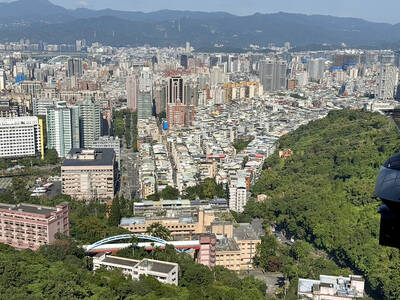
A recent report from the Environmental Management Administration of the Ministry of Environment highlights a perennial problem: illegal dumping of construction waste. In Taoyuan’s Yangmei District (楊梅) and Hsinchu’s Longtan District (龍潭) criminals leased 10,000 square meters of farmland, saying they were going to engage in horticulture. They then accepted between 40,000 and 50,000 cubic meters of construction waste from sites in northern Taiwan, charging less than the going rate for disposal, and dumped the waste concrete, tile, metal and glass onto the leased land. Taoyuan District prosecutors charged 33 individuals from seven companies with numerous violations of the law. This


 RSS
RSS