


The Taichung High Administrative Court has canceled all 45 tickets given to a man for failing to use a turn signal while driving, as it considered long-term surveillance of his privacy more problematic than the traffic violations.
The man, surnamed Tseng (曾), lives in Changhua County and was reported 45 times within a month for failing to signal while driving when he turned into the alley where his residence is.
The reports were filed by his neighbor, who set up security cameras that constantly monitored not only the alley but also the door and yard of Tseng’s house.
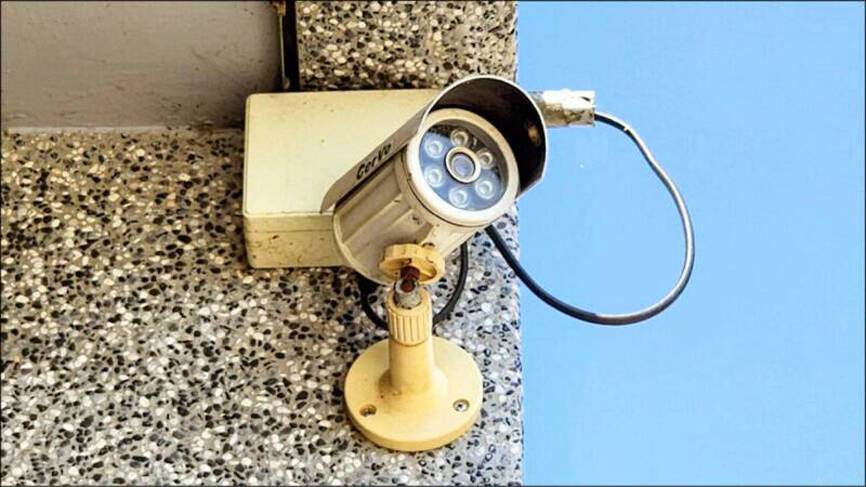
Photo: Taipei Times
The surveillance occurred from July 2023 to August 2023 when the tickets, issued by the police based on the reported camera footage, were initially sent to a woman surnamed Hsieh (謝), who owns the vehicle.
The police later identified Tseng as the actual driver and fined him instead after Hsieh made a complaint.
Tseng then filed an administrative lawsuit, arguing he was likely targeted by someone who intensively reported his behavior.
During proceedings, the court found the complainant lives across from Tseng and the reported footage included private living space.
Such camera monitoring was no different from recording Tseng’s household via long-term surveillance, the court said.
Using surveillance devices for personal security is considered reasonable, but the case went beyond reasonable limits and constituted serious infringement of privacy and right to informational self-determination, it said.
The camera monitoring was self-protective in nature, as it was constant and targeted, with the goal of surveilling people and collecting evidence, the court said.
Although Tseng did fail to signal while making turns, the footage cannot be used as basis for penalization as it was illegally obtained, it said.
Given that the alley is only 2.78m wide with relatively little traffic on regular days, turning without signaling would not much affect road safety or result in substantial harm, the court said.
However, long-term surveillance of the home life of others clearly constituted a more severe infringement, it said, adding protection of privacy should be prioritized over punishment for minor traffic violation in this case.
The reported footage was considered illegally collected information lacking legal legitimacy for administrative authorities to use as a basis for penalties.
The judge concluded that all the tickets should be canceled, as the penalty violated the principle of proportionality and the Personal Data Protection Act’s (個人資料保護法) principle of purpose limitation.
The case was finalized.
When reached for comment about the case, lawyer Lee Hsueh-yung (李學鏞) said the judgement criteria lie in whether it would meet reasonable expectation of privacy.
The right to privacy is not restricted to indoor space, he said, noting that any space of personal living activities that one does not want other people to constantly monitor or record — including a residence’s entrance, yard and access — can be considered private areas.
It could constitute infringement upon privacy and personal information if someone filmed their life for an extended time with a security camera, to the extent that the individuals in the footage can be recognized, he said.
The judgement would be case by case as to the legality of directing cameras only at public roads outside a residence, Lee said.
For example, it is usually considered legitimate when cameras are directed only at public space for anti-theft or self-protection purposes, he said.
However, if the camera angle includes aspects of a neighbor’s daily life or entry and exit of residence for an extended period that form “behavioral data” of the neighbor, then it could be considered excessive collection of personal data despite no other space but roads on the footage, Lee said.

Kenting National Park service technician Yang Jien-fon (楊政峰) won a silver award in World Grand Prix Photography Awards Spring Season for his photograph of two male rat snakes intertwined in combat. Yang’s colleagues at Kenting National Park said he is a master of nature photography who has been held back by his job in civil service. The awards accept entries in all four seasons across six categories: architectural and urban photography, black-and-white and fine art photography, commercial and fashion photography, documentary and people photography, nature and experimental photography, and mobile photography. Awards are ranked according to scores and divided into platinum, gold and

The Chinese Nationalist Party (KMT) caucus yesterday said it opposes the introduction of migrant workers from India until a mechanism is in place to prevent workers from absconding. Minister of Labor Hung Sun-han (洪申翰) on Thursday told the Legislative Yuan that the first group of migrant workers from India could be introduced as early as this year, as part of a government program. The caucus’ opposition to the policy is based on the assessment that “the risk is too high,” KMT caucus secretary-general Lin Pei-hsiang (林沛祥) said. Taiwan has a serious and long-standing problem of migrant workers absconding from their contracts, indicating that

SPACE VETERAN: Kjell N. Lindgren, who helps lead NASA’s human spaceflight missions, has been on two expeditions on the ISS and has spent 311 days in space Taiwan-born US astronaut Kjell N. Lindgren is to visit Taiwan to promote technological partnerships through one of the programs organized by the US for its 250th national anniversary. Lindgren would be in Taiwan from Tuesday to Saturday next week as part of the US Bureau of Educational and Cultural Affairs’ US Speaker Program, organized to celebrate the 250th anniversary of the signing of the Declaration of Independence, the American Institute in Taiwan (AIT) said in a statement yesterday. Lindgren plans to engage with key leaders across the nation “to advance cutting-edge technological partnerships and inspire the next generation of scientists and engineers,”

TRADE-OFF: Beijing seeks to trade a bowl of tempura for a Chinese delicacy, an official said, while another said its promises were attempts to interfere in the polls The government must carefully consider the national security implications of building a bridge connecting Kinmen County and Xiamen, China, the Public Construction Commission (PCC) said yesterday. PCC Commissioner Derek Chen (陳金德), who is also a minister without portfolio, made the remarks in a meeting of the legislature’s Transportation Committee, after Democratic Progressive Party Legislator Hsu Fu-kuei (徐富癸) asked about China’s proposal of new infrastructure projects to further connect Kinmen and Lienchiang (Matsu) counties with Xiamen. China unveiled the bridge plan, along with nine other policies for Taiwan, on Sunday, the last day of Chinese Nationalist Party (KMT) Chairwoman Cheng Li-wun’s (鄭麗文) visit


 RSS
RSS