


China’s “incentives” failed to sway sentiment in Taiwan, as willingness to work in China hit a record low of 1.6 percent, a Ministry of Labor survey showed.
The Directorate-General of Budget, Accounting and Statistics (DGBAS) also reported that the number of Taiwanese workers in China has nearly halved from a peak of 430,000 in 2012 to an estimated 231,000 in 2024.
That marked a new low in the proportion of Taiwanese going abroad to work.
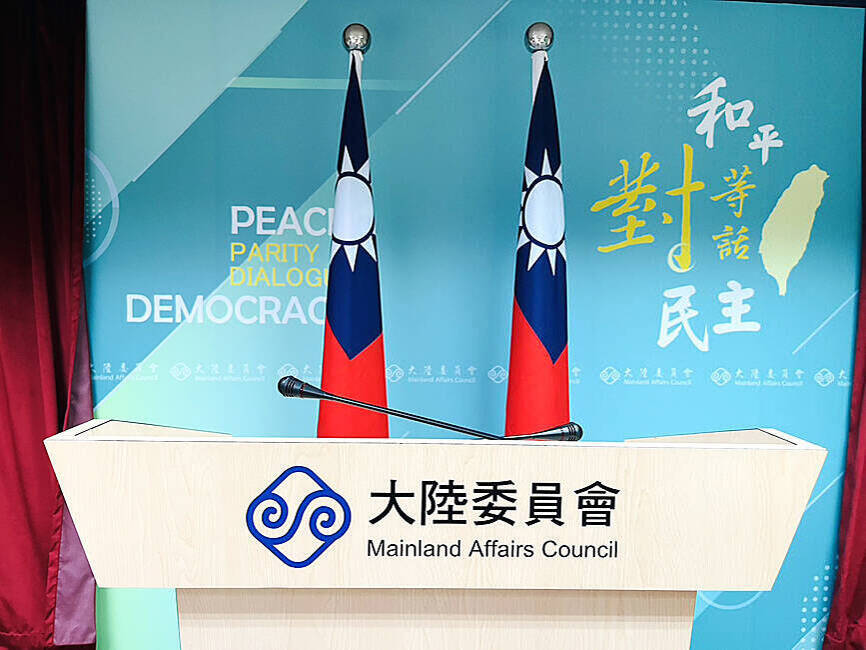
Photo: Chen Yu-fu, Taipei Times
The ministry’s annual survey on “Labor Life and Employment Status” includes questions respondents’ willingness to seek employment overseas.
Willingness to work in China has steadily declined from 7.9 percent in 2016, to 8.3 percent in 2017, and to 7.7 percent in 2018, ultimately dropping to just 1.6 percent last year, the lowest in the survey’s history.
DGBAS data also showed that the number of Taiwanese working in China peaked at 430,000 in 2012 and had accounted for more than 60 percent of the total number of Taiwanese workers abroad.
However, that number sharply declined due to the COVID-19 pandemic, falling to just 163,000 in 2021, or 51.1 percent of the overseas workforce, the data showed.
Although the figures began to recover as COVID-19 restrictions eased, only 231,000 Taiwanese workers were in China in 2024, accounting for 34.7 percent of those working abroad — also a new low.
As for China’s latest 10 “incentive measures” for Taiwan — announced on April 12, the last day of Chinese Nationalist Party (KMT) Chairwoman Cheng Li-wun’s (鄭麗文) China visit — the Mainland Affairs Council (MAC) said it had received numerous complaints from industry groups and people expressing concerns about China pressuring them to support the policy.
The pressure has been disruptive and burdensome, the council said, urging associations to reject being used as tools to coerce the government.
It also called on China to immediately cease such political maneuvers.
The 10 “incentives” include facilitating the sales of Taiwanese agricultural and fishery products, and investments in China, and the full resumption of direct flights across the Taiwan Strait.
China’s Cross-Strait Air Transport Exchange Commission has sent a letter to the Taipei City Air Transport Commercial Association regarding the flights, but the Executive Yuan said that “actual demand for direct cross-strait flights is not as high as previously imagined.”
The MAC said that current flight routes and capacity are sufficient to meet demand, adding that there is “no urgent need to immediately open up additional services.”
Meanwhile, sources said General Chamber of Commerce Chairman Paul Hsu (許舒博) is to hold a news conference tomorrow titled “Industry Perspectives on China’s Recent Pro-Taiwan Policies,” where he would invite representatives from industry associations — those for travel, hotels, food, baked goods, fruits and bus tours — to express their views and pressure the government.
The “incentives” include initiatives that have fluctuated over the past two decades, “sometimes opening, sometimes suspended for unfounded reasons,” the MAC said.
“This has created significant uncertainty for Taiwanese industries, as well as farmers and fishers, resulting in considerable losses,” it said, adding that the government has a responsibility to shield the economy and industries from such arbitrary risks and prevent political interference in elections.
“If China genuinely intends to move forward with such measures, they should be negotiated through the existing mechanisms between the two governments, without political preconditions,” it added.

A signaling system malfunction disrupted high-speed rail (HSR) services beginning at 8am today, with trains temporarily reduced to three northbound and three southbound trains per hour as authorities conduct inspections. The malfunction occurred on a section of track in Miaoli County during pre-operation checks early this morning, forcing northbound and southbound trains to use a single track, the HSR operator said. The regular schedule has been replaced with three hourly trains offering only nonreserved seating in each direction, stopping at every station, it said, adding that business class cars would still have reserved seating. Departures from terminal stations are scheduled at the top

Taiwan is still in the process of assessing the possibility of recruiting workers from Eswatini, the Ministry of Foreign Affairs said yesterday, adding that its goal is to help Eswatini upgrade its vocational training centers. If there are plans to recruit workers from Eswatini, safeguarding national security, protecting public health and ensuring the employment rights of Taiwanese would be prerequisites, Department of West Asian and African Affairs Director-General Yen Chia-liang (顏嘉良) told a news conference. Key considerations would also include filling labor shortages in specific industries, and fostering bilateral professional and technical exchanges, he said. Yen was asked about the progress of labor

A US uncrewed surface vessel (USV) encountered multiple Chinese warships during an autonomous transit of the Taiwan Strait, US defense company Seasats said in a statement on Wednesday. Seasats announced that a Lightfish USV had completed the first autonomous transit of the Taiwan Strait. Over five days, the USV traversed the entire length of the Strait while constantly monitoring surface vessel traffic, the company said. The Lightfish encountered multiple Chinese warships, one of which was a Chinese People’s Liberation Army Navy (PLAN) Type 056 corvette, it said. The Chinese vessels were operating “well within Taiwan’s exclusive economic zone without transmitting their identity via the

VERBOSE VESSELS: A CGA cutter and a China Coast Guard exchanged verbal barbs for more than a day in Taiwanese-controlled waters before the Chinese vessel left The Taiwanese and Chinese coast guards had a standoff near the strategically located Pratas Islands (Dongsha Islands, 東沙群島) in the north of the South China Sea, the Coast Guard Administration (CGA) said yesterday. The two sides engaged in intense radio exchanges over sovereignty claims during the 33-hour standoff. China Coast Guard vessel 3501 eventually left the restricted waters, 26.6 nautical miles (49.2km) west of the Pratas Islands, at 5pm yesterday, the CGA said. Lying approximately between southern Taiwan and Hong Kong, the Taiwan-controlled Pratas are seen by some security experts as vulnerable to Chinese attack due to their distance — more than


 RSS
RSS