


The game-changing K-pop boy band BTS has returned after a nearly four-year musical hiatus. ARIRANG, the 14-track, fifth studio album from the septet — RM, Jin, Jimin, V, Suga, Jung Kook and j-hope — is here. And it is appropriately massive.
ARIRANG — titled after a popular, traditional Korean folk song that touches on themes of longing, separation and love — is a stadium-sized album that serves as both a reintroduction to the band and as a keen reminder of their place atop popular culture conversation. That’s evident from the jump: The first half pulls largely from trap and hip-hop, an energetic reminder of their early rap records. It’s an ode to where they came from and where they’re going — as immediately demonstrated in the opener Body to Body, which works in a melody from the traditional Arirang.
After the fiery block comes the short interlude No. 29, a reverberating bell toll captured from the Divine Bell of King Seongdeok — South Korea’s largest extant bell, designated National Treasure No. 29 in 1962 — before a pop detour of various genre experiments.
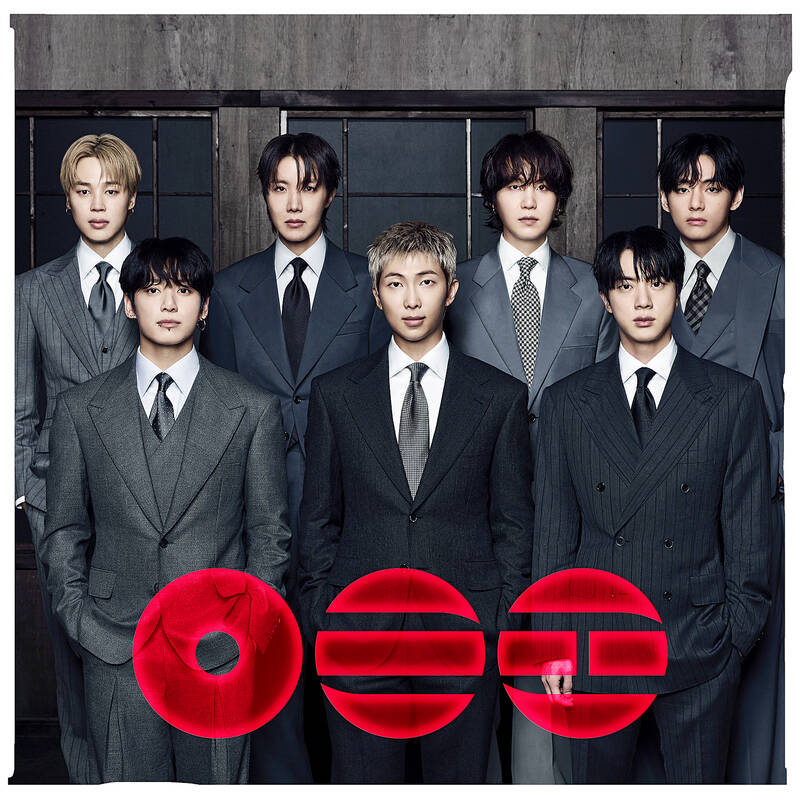
Photo: AP
The tagline for BTS’ comeback album is “born in Korea, playing for the world.” It couldn’t be more fitting: Here, the septet utilize their familiar strengths and further their inventive spirit, bringing their country to a global audience eager to hear from them again.
To call it highly anticipated would be a gross understatement. ARIRANG is the band’s first original full-length release since all seven members completed South Korea’s mandatory military service. Not that it has been all quiet at team BTS: The band tiered their enlistments, giving ample time for its members to focus on solo projects while the group was on a break.
The time apart must’ve bolstered their hunger for composition and experimentation: According to a press release, leader RM is credited on every track save for the interlude. The others contributed, too: Suga and j-hope on a number of songs, including Body to Body, Merry Go Round and Normal; Jimin with They Don’t Know ‘Bout Us and Into the Sun. V was also involved in the latter as well as 2.0. Jung Kook was involved in four tracks, including Hooligan.
There are a number of familiar names on the credits: Mike WiLL Made-It, Ryan Tedder, Tame Impala’s Kevin Parker and Diplo are among the listed producers, and their presence is known. The latter brings Jersey club to the energetic FYA; there’s a real joy in its boisterous lyrics: “Club go crazy like Britney, baby / Hit me with it one more time.” Parker’s dreamy, psych-pop production is heard on Merry Go Round; BTS’ performance amplifies the producer’s signatures. Normal has echoes of Taylor Swift with a low-key hook; it leads to the distorted trip-hop and Pixies’ wistfulness of Like Animals.
Then, a brief pivot back to the first half’s trap-pop. There’s the 808 bass of They Don’t Know ‘Bout Us, a partner to the earlier track 2.0, before pivoting again and again: to the synth-y One More Night, the R&B harmonies of Please and the acoustic, early morning closer, Into the Sun, that climbs to a resonant, rock ’n’ roll coda. Zig, they zag.
With ARIRANG, BTS had big shoes to fill: their own. The group’s last album, 2020’s Be, debuted at No. 1 on the Billboard 200 and featured some of their best-known hits, Dynamite and Life Goes On. Here, on ARIRANG, there is no Butter, no English-language bubblegum pop. Instead, there is a band atop the music world, returning to their throne on their own terms: with bilingual bangers and avant-garde ambitions.

And so, in the wake of US President Donald Trump’s trip to the People’s Republic of China (PRC), all the experts on the Strait of Hormuz suddenly became experts on US-China-Taiwan relations. The Internet has certainly expanded human knowledge. Lots of these sudden experts made noise this week about Trump’s words after the meeting with PRC dictator Xi Jin-ping (習近平). Trump is going to sell out Taiwan! Longtime Taiwan commentator J. Michael Cole summed the situation up neatly in the Guardian: “We need to keep in mind that he has a tendency to say many things — sometimes contradicting himself within

Last week US President Donald Trump was asked by a reporter whether he would speak on the phone to the President of Taiwan. “l’ll speak to him. I speak to everybody. We have that situation very well in hand,” Trump said. This marked the second time in a couple of weeks he had said he would talk to the President of Taiwan. In 2016 he famously took a call from then-president Tsai Ing-wen (蔡英文), when he was president-elect. Despite warnings that the apocalypse was nigh because of a phone call, the world quickly forgot about the conversation between two democratically-elected presidents.

There is considerable frustration and confusion among many, both in Taiwan and abroad — including in Washington — as to why the Chinese Nationalist Party (KMT) seems so dead set on using their legislative leverage to slash defense spending and disrupt the ability of the ruling Democratic Progressive Party (DPP) administration to function. Are they pawns of the Chinese Communist Party (CCP)? Are they traitors? In reality, there are multiple reasons. In the first column in this series on this subject, “Donovan’s Deep Dives: How and why the TPP and KMT help Beijing” (Sat May 16, page 12), we examined three

May 25 to May 31 Few believed that apples could be cultivated on a commercial scale in Taiwan’s high mountains. When horticulturalist Cheng Chao-hsiung (程兆熊) first proposed the idea in 1955, both American and Taiwanese colleagues dismissed it as implausible, arguing that temperate fruit could not be reliably grown on a subtropical island, especially on rugged terrain. However, it was this terrain in the Central Mountain Range where many Chinese Civil War veterans were resettled in the late 1950s. With limited job prospects and no family in Taiwan, they were placed on cooperative farms aimed toward self-sufficiency. Some say the conditions


 RSS
RSS