


For the past five years, Sammy Jou (周祥敏) has climbed Kinmen’s highest peak, Taiwu Mountain (太武山) at 6am before heading to work. In the winter, it’s dark when he sets out but even at this hour, other climbers are already coming down the mountain.
All of this is a big change from Jou’s childhood during the Martial Law period, when the military requisitioned the mountain for strategic purposes and most of it was off-limits. Back then, only two mountain trails were open, and they were open only during special occasions, such as for prayers to one’s ancestors during Lunar New Year.
“I’ve been looking up at Mount Taiwu since I was a child,” Jou said. “It’s like a shadow over the hearts of the Kinmenese — you can’t help but stare at it.
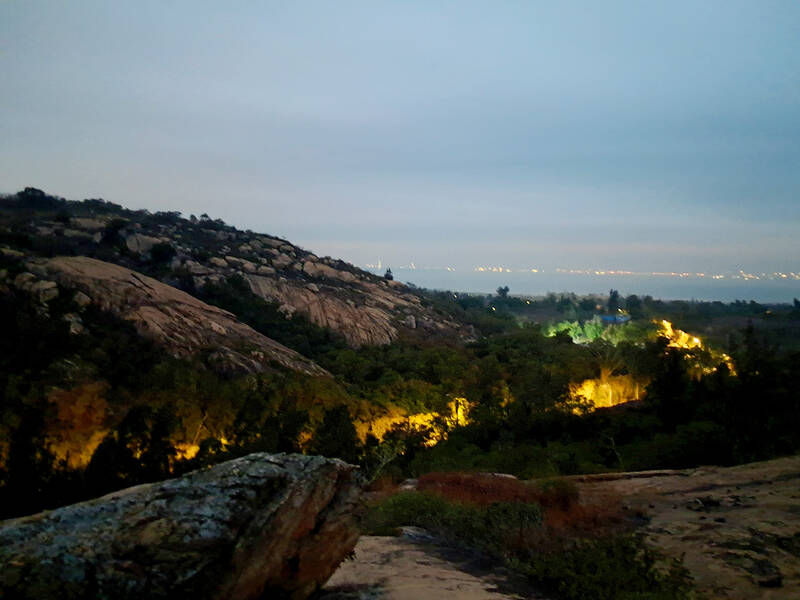
Photo: Jeffrey Mo
“And one day, I decided that I would do more than just stare at it.”
Jou developed a passion for hiking after moving to Taiwan proper for university. He is now one of the leaders of a group that brings interested locals and visitors up the mountain. Weekend afternoon expeditions often have 20 or 30 attendees of all ages.
Although it is only 253 meters high, it’s home to some 20 paths. Jou estimates that he’s climbed these paths around 1,500 times over the last five years.
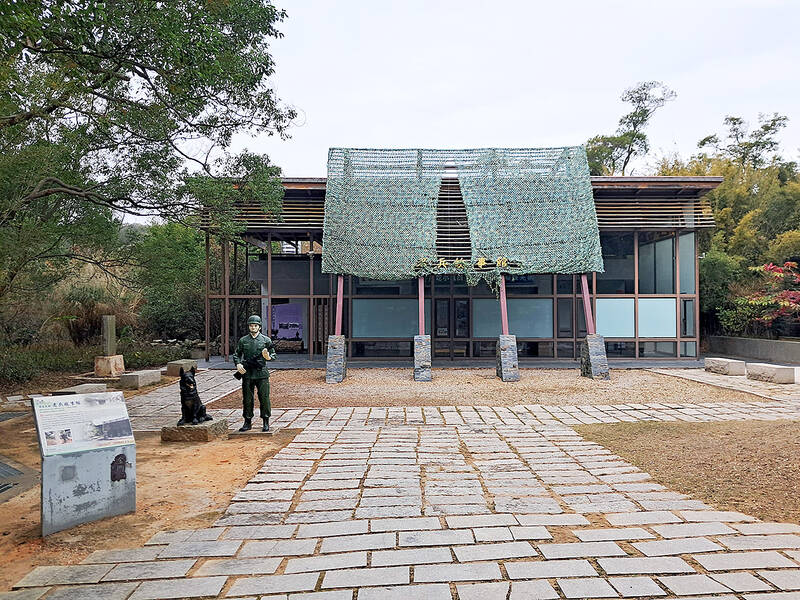
Photo: Jeffrey Mo
The hikers usually bring along machetes or shears to cut down thorny plants and vines, and sometimes even a small electric chainsaw to remove fallen trees. But they try to keep their interventions to a minimum and avoid overwidening the trails — they want them to be just right for walking.
ORAL HISTORY
The opening-up of the trails has also been a way to discover and preserve the island’s oral history. Jou and his team talked to a man who was nearly 100 years old and who regularly climbed the mountain in the 1930s, when Kinmen was still a part of China’s Fujian Province and not yet captured by Japan.
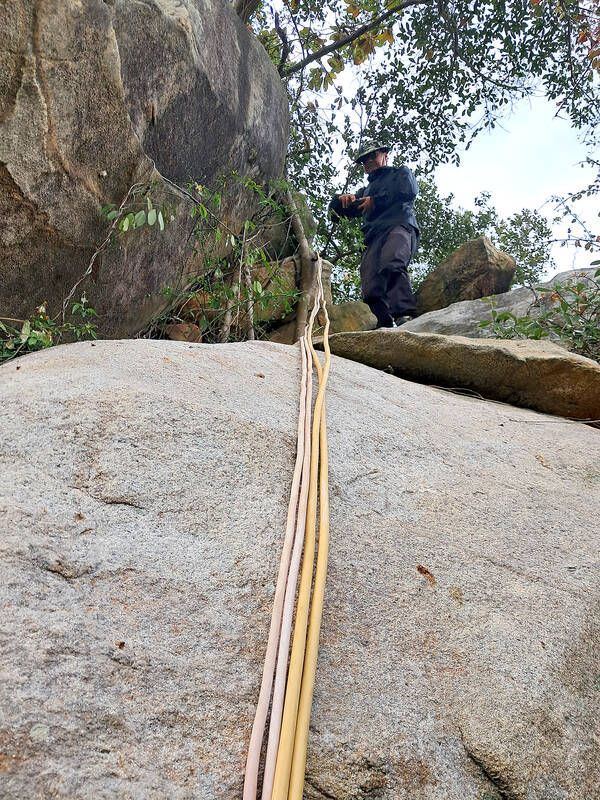
Photo: Jeffrey Mo
He told them about Sheep Horn Cave (羊角囊), which was formed from volcanic activity and the landslide of large boulders. It was a refuge for local residents during the Kengshen Disaster (庚申之難) of 1560, when Japanese pirates burned houses, temples and ancestral halls for almost two months, killing or injuring at least 100 people in the process.
The locals fled onto the mountain and hid inside, among other places, Sheep Horn Cave. Despite its narrow entrance, through which only one person at a time can pass, the cave can accommodate up to 20 people in its two-pronged, croissant-shaped interior.
The man was too old to make the climb up himself — indeed, there are no natural footholds along the rockfaces so ropes must be used — but he gave approximate directions to Jou’s team.
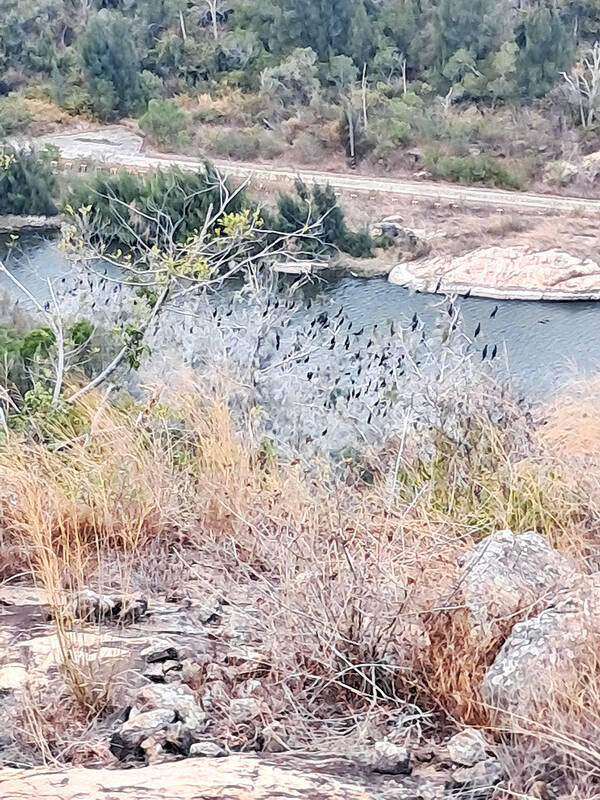
Photo: Jeffrey Mo
Although the ancient trails were overgrown with weeds, the team was still able to first find Sheep Horn Rock (羊角石), and 30 meters behind that, Sheep Horn Cave.
Another trail restored by Jou and his team, the Savage Tiger Trail (猛虎步道), goes all the way to the octagonal Hsinglung Pavilion (醒龍亭), a resting spot with a view high above the Chingshui Reservoir (擎天水庫).
Cormorants, which migrate from Siberia to Kinmen in the winter, are a common sight and it’s their droppings and not snow that makes the slender Australian pines (木麻黃) alongside the reservoir white.
The Old Soldiers Story Hall (老兵故事館) is located halfway down the road back from Hsinglung Pavilion. A nod to the mountain’s former military uses, visitors can take photos in soldiers’ fatigues, see pictures of female celebrities — Teresa Teng (鄧麗君) and Tien Hsin (天心) — that visited the soldiers, or learn how to make some classic soldiers’ grub, such as a stew of braised pork, Kinmen taro, bamboo and kaoliang (高粱) liquor.
Most hikes are only one or two hours long, but the trail to the Crescent Moon Cave (月牙洞) takes four hours and is arguably the most challenging. It involves climbing through dense bush and scaling rope ladders.
Despite Taiwu Mountain’s relatively low elevation, regular hikers don’t seem to tire of its various paths. Jou is particularly engaged in using hiking to promote Kinmen’s culture and history. He is the section chief of the Social Education Section of the Kinmen Department of Education, and has developed curricula to promote using the Kinmen dialect for place names on the mountain, or to collect oral histories from soldiers who were once stationed there.
MIXED MESSAGE
The Kinmen government has an ambiguous attitude towards hiking on Taiwu Mountain: they want to promote tourism along the trails, but they also want to maintain the usability and symbolic significance of the mountain for military defense in the case of Chinese aggression, Jou says.
Many islanders, though, think that with today’s technology, China would simply bypass Kinmen and attack the major prize — Taiwan — directly.
”Mount Taiwu just isn’t as important as it was before,” says Alice Ouyang (歐陽亞慧).
Ouyang, like Jou, also once lived and worked on Taiwan before moving back to Kinmen. She didn’t hike while living on the main island, but her newfound zeal for hiking Taiwu Mountain has inspired her to take on a new challenge: climbing the 100 peaks of Taiwan (台灣百岳).
But beyond the panoramic views and health benefits, the hikers also say that this activity has given them the chance to meet people from different walks of life.
Kinmen is a small island and doesn’t have a lot of places where one can go and have fun, Ouyang says.
“If you don’t climb, then there’s just the ocean here — and that also used to be off-limits.”
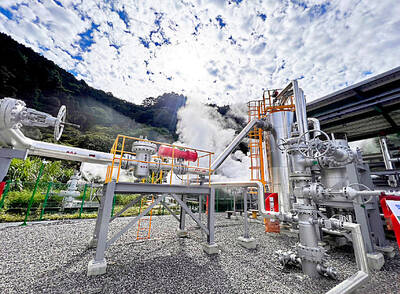
Taiwan’s semiconductor industry consumes electricity at rates that would strain most national grids. Taiwan Semiconductor Manufacturing Co (TSMC) alone accounted for more than 9 percent, or 2,590 megawatts (MW), of the nation’s power demand last year. The factories that produce chips for the world’s phones and servers run around the clock. They cannot tolerate blackouts. Yet Taiwan imports 97 percent of its energy, with liquefied natural gas reserves measured in days. Underground, Taiwan has options. Studies from National Taiwan University estimate recoverable geothermal resources at more than 33,000 MW. Current installed capacity stands below 10 MW. OBSTACLES Despite Taiwan’s significant geothermal potential, the

In our discussions of tourism in Taiwan we often criticize the government’s addiction to promoting food and shopping, while ignoring Taiwan’s underdeveloped trekking and adventure travel opportunities. This discussion, however, is decidedly land-focused. When was the last time a port entered into it? Last week I encountered journalist and travel writer Cameron Dueck, who had sailed to Taiwan in 2023-24, and was full of tales. Like everyone who visits, he and his partner Fiona Ching loved our island nation and had nothing but wonderful experiences on land. But he had little positive to say about the way Taiwan has organized its

The entire Li Zhenxiu (李貞秀) saga has been an ugly, complicated mess. Born in China’s Hunan Province, she moved to work in Shenzhen, where she met her future Taiwanese husband. Most accounts have her arriving in Taiwan and marrying somewhere between 1993 and 1999. She built a successful career in Taiwan in the tech industry before founding her own company. She also served in high-ranking positions on various environmentally-focused tech associations. She says she was inspired by the founding of the Taiwan People’s Party (TPP) in 2019 by Ko Wen-je (柯文哲), and began volunteering for the party soon after. Ko
Chinese Nationalist Party (KMT) Chair Cheng Li-wun (鄭麗文) returned from her trip to meet People’s Republic of China (PRC) dictator Xi Jinping (習近平) bearing “a gift” for the people of Taiwan: 10 measures the PRC proposed to “facilitate the peaceful development of cross-strait relations.” “China on Sunday unveiled 10 new incentive measures for Taiwan,” wrote Reuters, wrongly. The PRC’s longstanding habit with Taiwan relations is to repackage already extant or once-existing policies and declare that they are “new.” The list forwarded by Cheng reflects that practice. NEW MEASURES? Note the first item: establishing regular communication mechanisms between the Chinese Communist Party


 RSS
RSS