


A key feature of Taiwan’s environmental impact assessments (EIA) is that they seldom stop projects, especially once the project has passed its second stage EIA review (the original Suhua Highway proposal, killed after passing the second stage review, seems to be the lone exception).
Mingjian Township (名間鄉) in Nantou County has been the site of rising public anger over the proposed construction of a waste incinerator in an important agricultural area. The township is a key producer of tea (over 40 percent of the island’s production), ginger and turmeric. The incinerator project is currently in its second stage EIA.
The incinerator sits on a 7.5 hectare plot located in a special agricultural zone containing tea gardens, orchards and crop fields in Waipu (外埔) in Shinmin Village (新民) in Mingjian, in a basin with mountains on three sides. As a PTS Our Island report observes, the location is only 2-3 kilometers away from Songbailing (松柏嶺), the largest tea distribution center in Taiwan. Songbailing is a major tea industry cluster, containing tea farmers, tea factories and dedicated retailers. The incinerator is located near a major irrigation canal intake that supplies farmers in Changhua, who are also concerned about the project.
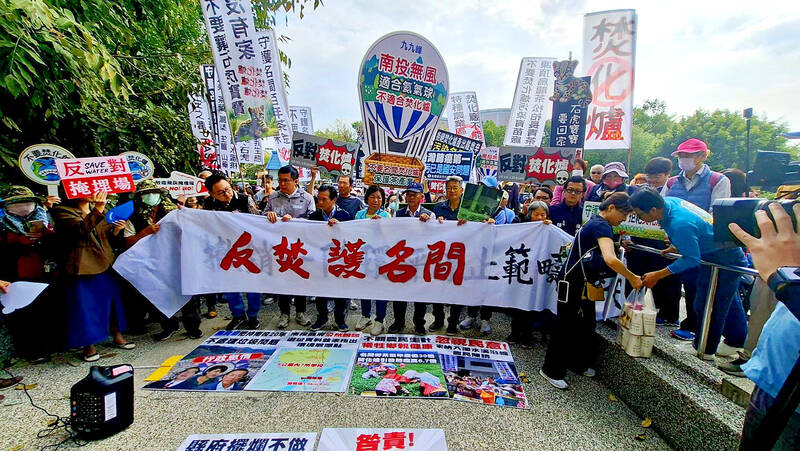
Photo: Chang Hsieh-sheng, Taipei Times
It also requires widening an access road, a separate process from the EIA for the incinerator itself. Private landowners have already given permission for that.
Nantou County Environmental Protection Bureau (EPB) Director-General Li Yi-shu (李易書) explained last month that two other potential locations in Caotun Township (草屯) and Gukeng Township (古坑) were rejected because of uneven terrain or proximity to schools.
However, it appears the Nantou EPB’s assessment items for the incinerator location were internally determined. These included whether the land is level, is at least 5 hectares and whether it is state-owned. Not surprisingly, they settled on state-owned land, since they will only have to clear that with the central government. Also unsurprisingly, the assessment criteria did not include any soil, water, or ecological factors, though the area hosts leopard cats and other threatened species, along with its agricultural productivity.
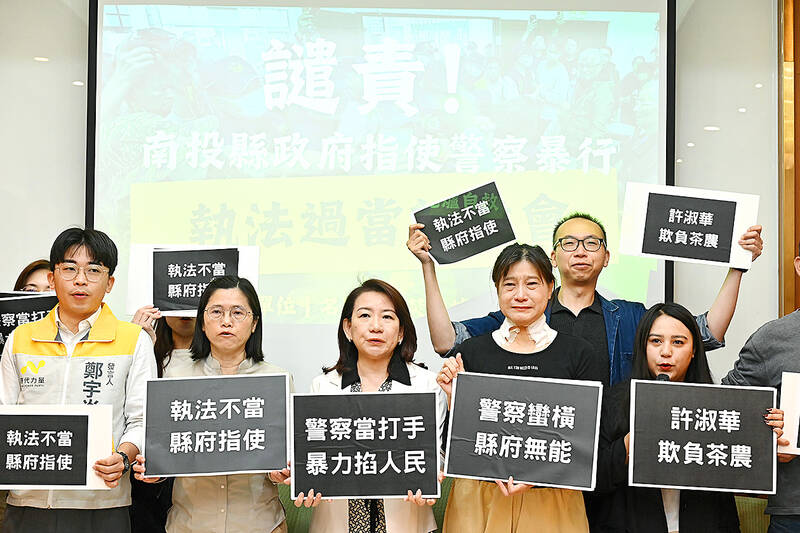
Photo: Tien Yu-hua, Taipei Times
Opponents note that the county has not made public information on at least three other possible sites. A local teacher observed in the Taipei Times last month that one site was rejected because it was upwind of the Nantou EPB director’s house. Opponents emphasized that the planned incinerator will have a 700 ton/day capacity, but handle only 200 tons/day, implying that the remaining capacity will be sold to process trash from elsewhere, providing income for the local government.
Nantou authorities argue that the county needs a way to dispose of the 300,000 tons of waste that have accumulated because the county has no incinerator and the nation’s other incinerators are operating at full capacity, says Nantou County Magistrate Hsu Shu-hua (許淑華) of the Chinese Nationalist Party (KMT). Hsu noted in a meeting last month that Nantou is the only county in Taiwan without a waste incinerator. No doubt she’ll want an MRT in Nantou one day too.
Note the underlying developmentalist mentality of that comment, the ideal of developmentalist completeness so common in government think. Hsu’s thinking echoes the Ministry of Transportation’s desire to destroy the lovely Alangyi Trail (阿朗壹古道) on the southeast coast so that the national road system encircles the island completely, or the demand that the high speed rail system be expanded east and south.
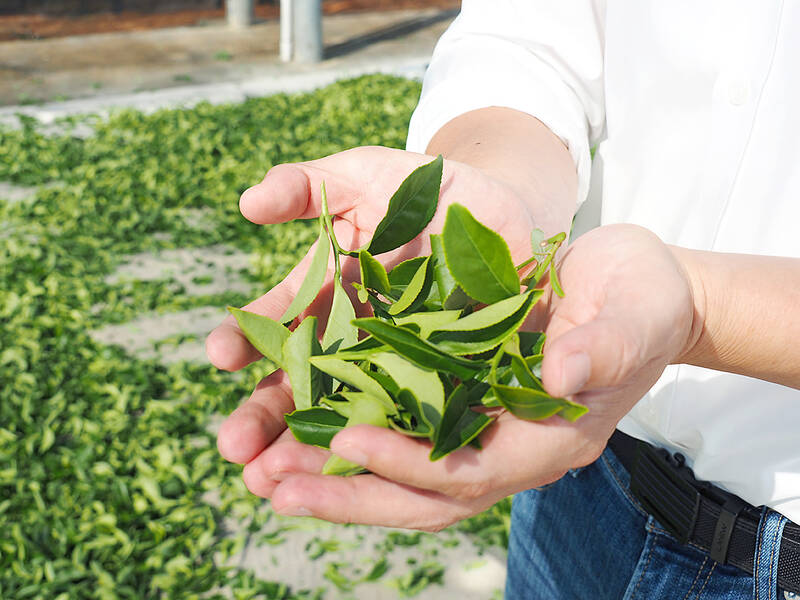
Photo: Chen Feng-li, Liberty Times
Incinerator opponents in Mingjian have formed the Mingjian Township Anti-Incinerator Association (名間鄉反焚化爐自救會) to fight the project. A group of seven top tea chains was formed last month to fight the incinerator as well, pointing out that 60 percent of their tea comes from Mingjian. Public protest has been strong.
The relationship between burgeoning waste dumps, insufficient incinerator capacity and multiple potential sites shows that this is not an environmental clash, but a clash over the government’s crazed land management policies, shaped by a political divide. The mayor of Mingjian is from the Democratic Progressive Party (DPP), the Nantou County Magistrate is KMT and the central government is DPP. The townships that were not selected all have KMT mayors, opponents noted.
The most important shaping factor, however, is the zombie mentality of the technocratic, developmentalist bureaucrats, that is entirely bipartisan. What kind of mentality puts an incinerator in the nation’s most important tea producing area? The same one that put the incinerator in Taipei’s Muzha District (木柵), also near a tea producing area. The same one that planned an industrial park for the Cigu (七股) wetlands in Tainan, a project finally canceled in the early 2000s after a decade of protest, or a petrochemical and steel complex in lovely Yilan. The list of defeated developmentalist state projects is long, yet still the government has not learned from four decades of resistance to projects like this.
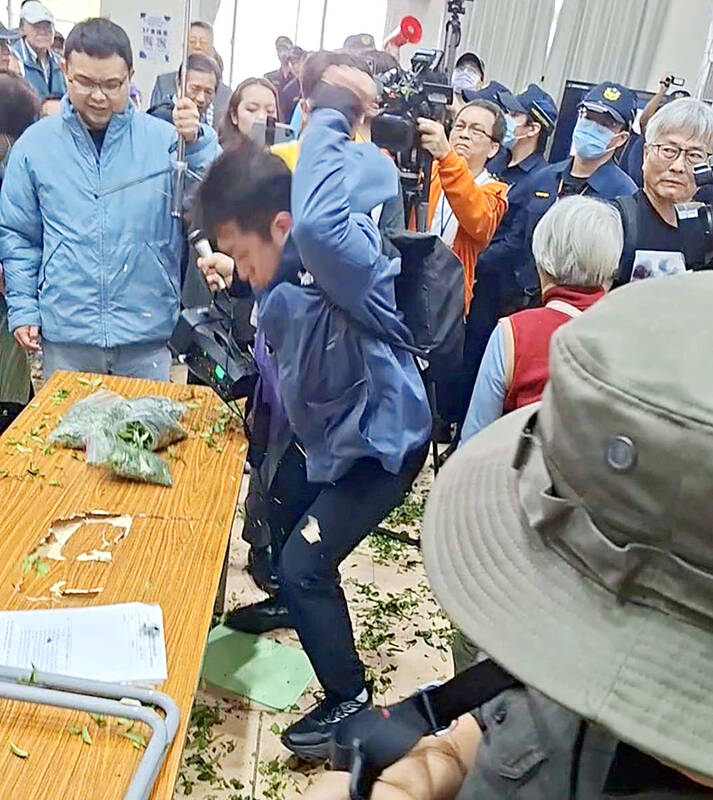
Photo: Chang Hsieh-sheng, Taipei Times
BUREAUCRATIC APPROACH
The Nantou County Magistrate’s deployment of the terms “rational” and “scientific” is a classic bureaucratic approach. Officials always present themselves as objective technocratic rationalists, casting their opponents as irrational, emotional and uneducated. “Negotiations” typically consist of officials telling locals what will happen, not giving them a say in it.
The Environmental Assessment Committee Chair, National Chi Nan University professor Tsai Yung-pin (蔡勇斌), told the tea farmers, mostly elderly people, that they “set a terrible example.”
In 2018, speaking on local protests against the construction and upgrade of a monumentally stupid coal-fired thermal power plant in Rueifang District (瑞芳) in New Taipei City, then-DPP minister of economic affairs Shen Jong-chin (沈榮津) said: “Our responsibility is to negotiate, negotiate and negotiate with them, with compassion, before going ahead with the plan.”
When the agriculture minister said that he would not allow prime farmland to be easily developed, Nantou County Magistrate Hsu replied that all would be handled according to the law.
“According to the law” is one of my favorite Mandarin phrases. In English it means “I win.”
The Nantou EPB’s requirement that the incinerator be on state-owned land is a symptom of one of the nation’s biggest land use problems: the state owns too much land. State-owned corporations, especially Taiwan Sugar Corp (Taisugar, 台灣糖業), act as a land bank for “development” projects. Because the land is state-owned, locals have less leverage they can exert against developmentalist state projects, and conversion is easy. The Nantou EPB’s most important criterion for selecting a site was that it be state-owned for just that reason.
More than that: the farmers in the area are all leaseholders on state land. The 7.5 hectare site is a leasehold of about 20 families, who will be unceremoniously booted off the land for the incinerator. They will then lose their right to acquire it under an old law that permits agricultural or aquacultural workers to own farmland they have been cultivating since at least Sept. 24, 1976.
The conversion of the land to incinerator use was approved by the National Property Administration (NPA) even before the completion of the EIA, of course. All according to the law, it claimed.
The cultivators have no say in the process.
Notes from Central Taiwan is a column written by long-term resident Michael Turton, who provides incisive commentary informed by three decades of living in and writing about his adoptive country. The views expressed here are his own.
Ajay Verma, a consultant gastroenterologist at Kettering general hospital in Northamptonshire, says our gut is a “complex machine.” “It is constantly providing us with the nutrition we need, initially to grow and develop, and then for us to survive, thrive and repair from injury and illness.” How can we keep it functioning well? Put simply: “Make sure what you put into it is balanced, and that you clear out its waste products adequately,” Verma says. “In a general gastroenterology clinic, the most common conditions we see are irritable bowel syndrome (IBS), gastroesophageal reflux disease, inflammatory bowel disease and constipation,” says Nisha
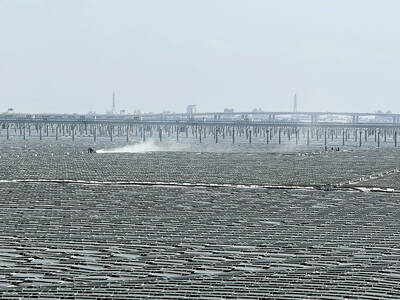
The arithmetic is straightforward and uncomfortable. By the end of 2025, Taiwan had committed itself to a 50-30-20 electricity mix — half natural gas, 30 per cent coal, 20 per cent renewables. The Ministry of Economic Affairs’s (MOEA) own monthly energy reports tell a different story. Natural gas reached 47.8 per cent of generation last year. Coal stood at 35.4 per cent, comfortably above its target ceiling. Renewables came in at 13.1 per cent, well short of the 20 per cent Taipei had pledged a decade earlier. Installed renewable capacity reached roughly half of the 12 gigawatts (GW) the government

Last week US President Donald Trump was asked by a reporter whether he would speak on the phone to the President of Taiwan. “l’ll speak to him. I speak to everybody. We have that situation very well in hand,” Trump said. This marked the second time in a couple of weeks he had said he would talk to the President of Taiwan. In 2016 he famously took a call from then-president Tsai Ing-wen (蔡英文), when he was president-elect. Despite warnings that the apocalypse was nigh because of a phone call, the world quickly forgot about the conversation between two democratically-elected presidents.
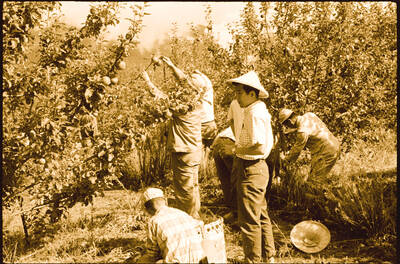
May 25 to May 31 Few believed that apples could be cultivated on a commercial scale in Taiwan’s high mountains. When horticulturalist Cheng Chao-hsiung (程兆熊) first proposed the idea in 1955, both American and Taiwanese colleagues dismissed it as implausible, arguing that temperate fruit could not be reliably grown on a subtropical island, especially on rugged terrain. However, it was this terrain in the Central Mountain Range where many Chinese Civil War veterans were resettled in the late 1950s. With limited job prospects and no family in Taiwan, they were placed on cooperative farms aimed toward self-sufficiency. Some say the conditions


 RSS
RSS