


Last week the government announced that by year’s end Taiwan will have the highest density of anti-ship missiles in the world. Its inventory could exceed 1,400, or enough for the opening two hours of an invasion from the People’s Republic of China (PRC). Snark aside, it sounds impressive. But an important piece is missing.
Lost in all the “dialogues” and “debates” and “discussions” whose sole purpose is simply to dawdle and delay is what the Chinese Nationalist Party (KMT) alternative special defense budget proposal means for the defense of Taiwan. It is a betrayal of both Taiwan and the US.
IT’S THE MINES, STUPID

Graphic: TT
Wen Lang-tung (溫朗東), a political commentator who writes at Fount Media, published a long piece last week explaining why the KMT’s proposed budget is so wrong.
In its opening attacks on Iran, the US destroyed Iran’s navy and air force. However, Iran still has powerful asymmetric capabilities, among them small fast boats that drop 2-3 mines each in the Strait of Hormuz. These mines have shut the Strait down, and the US lacks a counter to them. Kill a few, and many remain, with many possible launching points, Wen writes.
Ukraine has similarly pioneered the use of small unmanned craft to destroy ships. With that technology in mind, unmanned mine-laying drones have been developed. They can be pre-positioned, Wen writes, operate despite GPS and communications jamming, and navigate autonomously.
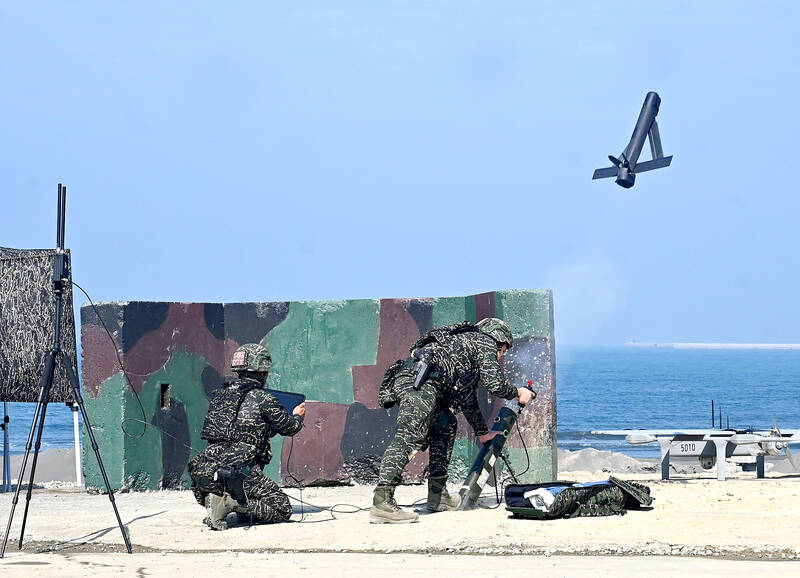
Photo: Wang Yi-sung, Taipei Times
American defense authorities last year spoke of turning the Taiwan Strait into a “Hellscape” in the event of a PRC invasion. Wen writes that last month the Center for a New American Security (CNAS) released a set of recommendations for creating that Hellscape in the Strait. The report recommended that Taiwan deploy drones to mine the sea. Once mines are in the water, ships can be channeled into areas where missiles can sink them.
We have the missiles, as noted at the outset of this column. And we could have the drones. Wen says Taiwan’s Jong Shyn Shipbuilding Group (中信造船) has already constructed a prototype drone that can engage in mine-sweeping, mine-laying and suicide attacks. National Chung-Shan Institute of Science and Technology (NCSIST) has plans for mass production starting this year, with a budget of NT$18 billion for 1,320 vessels.
WHERE IS THE BUDGET, KMT?
“The technology is ready. The concept is ready. America’s top defense think tank published the playbook. All Taiwan needs is the budget,” Wen says.
The budget? The KMT has blocked the Democratic Progressive Party’s (DPP) special budget proposal that would have funded this. The KMT’s own budget proposal, 70 percent smaller, mandates purchase of existing US weapons systems, and defunds the undersea drone program.
Track that. When the invasion begins, because Taiwan’s unmanned vessels are in place, ready to go, sophisticated US technology can handle their control, meaning that (according to CNAS) Taiwan can be defended without committing US military units. Instead, it relies on Taiwan creating a robust inventory of asymmetric firepower systems. To that end, NCSIST has also allocated NT$28 billion for undersea suicide drones. In June last year it held a competition for such drones, attended by officials from the American Institute in Taiwan (AIT), the officially-unofficial representative office of the US.
Moreover, as a Storm media piece on the drones pointed out, small unmanned vessels offer greater returns for local shipyards than conventional warships or submarines. This implies they would be more willing to construct them. I might add that they have a variety of peacetime applications, from oceanic survey work to supplying Taiwan’s islands. Further, Taiwan’s shipyards would find a ready market abroad for such vessels.
The DPP budget provides the funding to sustain production of the weapons and technologies to support the Hellscape concept and its associated weapons systems. The KMT has gutted that in its smaller package.
FALLING SHORT ON HELLSCAPE
The only real beneficiary of the KMT’s smaller budget is PRC war planners. If the KMT budget passes, they will not have to face the asymmetric weapons of the type the US is facing against Iran. It be should noted that the Iran war is not only providing an avalanche of intel on US military practices, it is also showing the PRC how a great power should go about subduing a middle power which has top-notch engineers and significant asymmetric capabilities.
The KMT proposal is for a package totaling US$11.1 billion, including High Mobility Artillery Rocket Systems (HIMARS), Javelin missiles, Altius-700M and Altius-600 drones, TOW missiles, M109A7 self-propelled howitzers, C5ISR systems, Harpoon missile follow-on support and helicopter parts. These are necessary, but not the core of the Hellscape system as envisioned by CNAS.
What is the KMT’s offer to buy weapons systems from the US? A cynical reading of US venality. It is a bribe disguised as an arms package, saying in effect: we’ll buy your weapons if you pretend you can’t see what we offer is a hollow fraud.
Later, when the PRC invades, more Americans will be killed as a result of this budget, if it is adopted. More Taiwanese too. No doubt that is a sacrifice the KMT is willing to make.
The KMT’s slashing of defense budgets is complemented by its delaying tactics in the legislature. As the DPP put it in its international newsletter: “In effect, the KMT is filibustering Taiwan’s defense.”
The defense committee’s agenda, the DPP says, is filled with political spectacle.
For example, the recent KMT noises about Premier Cho Jung-tai’s (卓榮泰) trip to Japan are part of that circus of distraction. Another set of distractions are the constantly mutating proposals of various individual legislators, as well as added conditions, such as demanding new Letters of Offer and Acceptance (LOA) from the US for the weapons systems before the KMT will fund new weapons. If that condition is accepted, a new one will appear.
Taichung Mayor Lu Shiow-yen (盧秀燕) left on a tour of US east coast cities last week. She has positioned herself as a moderate on defense, recently saying she was concerned that the KMT’s obstruction of the defense budget could affect US-Taiwan relations.
There may be quiet meetings with US officials, who may ask her pointed questions about the KMT’s defense budget stance. She will probably express regret and dismay at the behavior of her colleagues. Her job is to sow division and delay, to be the moderate face of what appears to be a PRC-aligned insurgency.
Some voices have been calling for more US dialogue with the KMT. The truth is the US has been shouting at the KMT for months now. The party is well aware of the US position and obviously, well aware of what it is doing. There is no point in further dialogue, since it merely hands the KMT another opportunity to delay and divide.
It is long past time for the US to take serious, meaningful action against the KMT.
Notes from Central Taiwan is a column written by long-term resident Michael Turton, who provides incisive commentary informed by three decades of living in and writing about his adoptive country. The views expressed here are his own.

It starts out as a heartwarming clip. A young girl, clearly delighted to be in Tokyo, beams as she makes a peace sign to the camera. Seconds later, she is shoved to the ground from behind by a woman wearing a surgical mask. The assailant doesn’t skip a beat, striding out of shot of the clip filmed by the girl’s mother. This was no accidental clash of shoulders in a crowded place, but one of the most visible examples of a spate of butsukari otoko — “bumping man” — shoving incidents in Japan that experts attribute to a combination of gender

The race for New Taipei City mayor is being keenly watched, and now with the nomination of former deputy mayor of Taipei Hammer Lee (李四川) as the Chinese Nationalist Party’s (KMT) candidate, the battle lines are drawn. All polling data on the tight race mentioned in this column is from the March 12 Formosa poll. On Christmas Day 2010, Taipei County merged into one mega-metropolis of four million people, making it the nation’s largest city. The same day, the winner of the mayoral race, Eric Chu (朱立倫) of the Chinese Nationalist Party (KMT), took office and insisted on the current

When my friend invited me to take a tour of a wooden house hand-built by a Pingtung County resident, my curiosity was instantly piqued and I readily agreed to join him. If it was built by a single person, it would surely be quite small. If it was made of wood, it would surely be cramped, dingy and mildewy. If it was designed by an amateur, it would surely be irregular in shape, perhaps cobbled together from whatever material was easily available. I was wrong on all counts. As we drove up to the house in Fangliao Township (枋寮鄉), I was surprised
Last month, media outlets including the BBC World Service and Bloomberg reported that China’s greenhouse gas emissions are currently flat or falling, and that the economic giant appears to be on course to comfortably meet Beijing’s stated goal that total emissions will peak no later than 2030. China is by far and away the world’s biggest emitter of greenhouse gases, generating more carbon dioxide than the US and the EU combined. As the BBC pointed out in their Feb. 12 report, “what happens in China literally could change the world’s weather.” Any drop in total emissions is good news, of course. By


 RSS
RSS