


It is as captivating as it is divisive: the tale of two Chinese American athletes who have so much in common but make such different choices.
Eileen Gu, a 22-year-old freestyle skier, and Alysa Liu, a 20-year-old figure skater, were both born to Chinese immigrants in California, and both were brought up in single-parent households. Both are elite athletes who turned in gold-medal performances at the 2026 Milan Cortina Winter Olympics last month.
But public opinion diverges over their choices about the countries for which they compete.
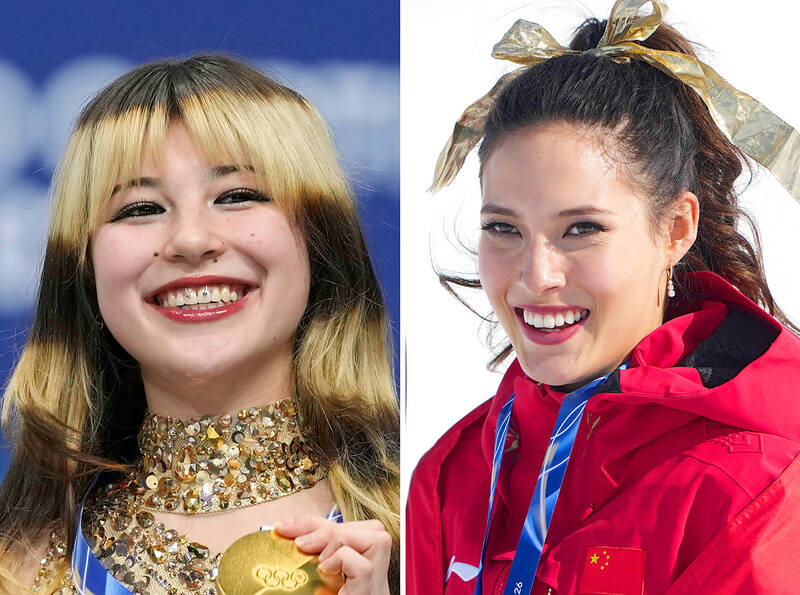
Photo: AP
Gu chooses to represent China, while Liu waves the US flag. Those decisions are generating heated debates over loyalty — an issue interwoven with money, values and politics on both sides of the Pacific Ocean.
In China, many laud Gu for identifying herself as Chinese and competing for the honor of the motherland. But plenty praise Liu, too, for her free spirit and genuineness — sometimes with a subtle nod to her father’s role in the 1989 Tiananmen Square democracy protests that landed him in the US.
In the US, Gu’s choice has raised eyebrows among politicians, including Vice President JD Vance, and even prompted a congressional proposal threatening to tax 100 percent on athletes such as Gu who compete for countries like China and Russia in the Olympics.

Photo: EPA
“Any American who works with a foreign adversary has not only betrayed our country but must be stripped of all benefits from doing so,” said Representative Andy Ogles, a Republican from Tennessee.
CHINESE DREAM COME TRUE
To a large extent, Gu’s is a story of China’s economic success, when its spectacular growth has made it alluring for those with Chinese roots to return for greater financial gains.

Photo: Reuters
Gu was born in San Francisco to a Chinese mother working in finance. No information about her father is available. Gu competed for China in the Winter Games in both 2022 and 2026, and she has landed endorsements worth millions of dollars from major Chinese brands as well as multinationals eyeing the Chinese market.
In 2022, when she won two golds and one silver in Beijing, Gu was a national idol and fondly known by her Chinese nickname, Frog Princess. Video clips of her eating Chinese snacks went viral on social media. Her performances in Italy were closely followed and celebrated in China.
She has long said her decision to compete for China has more to do with getting girls involved in her sport — with a greater opportunity for growth there than in the US — than about pure dollars and cents.
But controversy over Gu’s citizenship has cast a shadow over her popularity, with members of the public questioning her loyalty, wondering aloud if she has given up her US passport to comply with the Chinese law against dual citizenship. Gu has dodged the question, making it anyone’s guess.
Hu Xijin, a former party newspaper editor in China, argued that what’s important for China is attracting talents like Gu and chalking it up as a win over the US.
“Today’s China is stronger, and it can provide Gu with interests that cannot be realized if she represented Team USA,” Hu wrote in a social media post. “She has the sharp judgment to pick Team China, and this is the magnetic effect resulted from China’s growth.”
LIU’S CHOICE
For Liu, skating for China is out of the question.
Liu was born to Arthur Liu through surrogacy. Unlike Gu’s mother, Liu’s father fled China when he was wanted by the authorities for his involvement in the 1989 student movement that ended with a bloody crackdown in the heart of Beijing and forced many student activists into exile. Hundreds, perhaps thousands, were killed when the military quelled the protests on June 3 to June 4, 1989.
“Chinese people still have no freedom of speech, no freedom of religion, and there are still political prisoners in China,” Arthur Liu recently told Nikkei Asia. “Clearly, I wouldn’t allow my daughter to compete for such a government.”
While the Chinese government embraced Gu with flattering publicity and millions in state funding for her training, Liu said he only let his daughter compete in Beijing in 2022 with assurances from the State Department and the US Olympic Committee about her safety. The FBI had warned him that he and his daughter were targeted in a Chinese government spying operation. That year, Alysa Liu placed sixth in women’s single skating.
This time, she became the first American woman to win Olympic figure skating gold in 24 years. Her story spread wildly in China’s social media, garnering praises such as “free spirit” and “more genuine.” Some, however, pledged loyalty to Gu and suggested that Liu’s success was nothing for the Chinese people to get excited about.
With Liu’s rise, her father’s story bubbled up in China’s social media, though any mention was usually brief and cryptic because the 1989 Tiananmen Movement — generally known as 6-4 for the date of the military crackdown, remains a deeply sensitive political taboo in China 37 years later. While some called the elder Liu a freedom fighter, others denounced him.
The comparison between his daughter and Gu was so prevalent that Arthur Liu was asked about it.
“Everyone is entitled to her own ambition,” the father said in a YouTube chat with Zhang Boli, another former student activist. “The two have chosen different paths, and people immediately see the contrast. The contrast is so sharp that people cannot help but comment.”
Asked about the comparison recently, Alysa Liu told Newsweek: “Oh, my God, I think this discourse is really silly because we’re both half Chinese.”
BACKLASH IN THE US
The backlash against Gu in the US this time appeared to start with Vance, who told Fox News during the Games that “I certainly think that somebody who grew up in the United States of America, who benefited from our education system, from the freedoms and liberties that make this country a great place, I would hope that they want to compete with the United States of America.”
In response, Gu said, “I’m flattered. Thanks, JD! That’s sweet,” USA Today reported.
Ogles’ bill aside, Representative Lisa McClain, a Michigan Republican, slammed Gu for not even having “the respect for the country which has given them so much to represent that country.”
Citizenship change is nothing new in competitive sports, and other Chinese Americans or Chinese Canadians have played for Team China. But they have not riled up public opinion as Gu has, noted Susan Brownell, a professor at the University of Missouri-St. Louis who studies Chinese sports and the Olympic Games.
“It does really appear,” she said, “that part of the issue here is if you’re good enough to beat the US.”
Badiucao, a Chinese-Australian artist, illustrated the comparison in two drawings: one of Alysa Liu skating triumphantly along with the Statue of Liberty, the other of Gu draped in an oversized, blood-dripping piece of Chinese currency, its image of Mao Zedong (毛澤東) looking over her shoulder.
“In a world of Eileen Gu,” the artist wrote, “be Alysa Liu.”


Taiwan’s English education system is being pulled apart by three opposing forces. Bilingual Nation 2030 pulls students toward English and global communication. Artificial Intelligence (AI) readiness pulls them toward digital judgment, verification and AI-mediated work. But Taiwan’s old exam culture pulls them back toward memorization, grammar drills, timed reading and correct answers. If the education system keeps using old exams to define success, it risks producing graduates who are neither genuinely bilingual nor genuinely AI-ready, but trained for tasks machines can already perform. The first force is Bilingual Nation 2030. Launched in 2018, the policy aimed to “help Taiwan’s workforce connect

“Taiwan’s Opposition Leader Comes to US With a Message Straight Out of Beijing” read a May 31 headline in the Wall Street Journal. Top US administration officials and members of Congress almost certainly read the WSJ, and if there was a bullet point takeaway that people in Washington should absorb ahead of Chinese Nationalist Party (KMT) Chair Cheng Li-wun’s (鄭麗文) arrival in DC on June 9, that headline is it. The last few columns have discussed this very topic, and the timing is not coincidental. While those top officials likely do not read the Taipei Times, judging by the number

With weighty, anxiety-inducing geopolitical topics dominating the headlines, checking in on the wild and weird state of local politics can take some of the edge off. This November’s elections will determine who will be in charge of fixing potholes in your neighborhood, not the potholes in Taiwan’s complicated geopolitical space. Recently, after an online interview with a Taipei-based journalist, I commented that Taipei journalists never go further than the MRT can take them. He laughed and agreed. Naturally, the Taipei mayoral race is eating up much of the press attention. TAIPEI CITY Democratic Progressive Party (DPP) candidate Puma Shen (沈伯洋) has
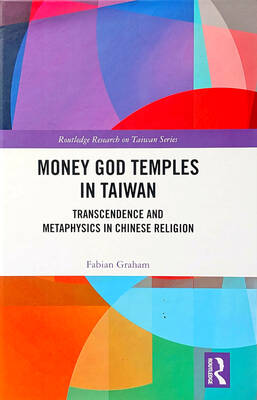
As someone who normally steers clear of books with “transcendence” or “metaphysics” in their subtitles, this reviewer — a casual observer of local belief systems since the 1990s — found Fabian Graham’s Money God Temples in Taiwan a challenging read. Those who’ve only dipped their toes into temple culture will likely need to parse several sections with special care if they’re to keep up with the author, a British ethnographic researcher whose previous books have investigated religious practices among ethnic Chinese in Southeast Asia. This scholarly volume examines a facet of Taiwan’s religious landscape that didn’t exist a century ago, and


 RSS
RSS