


The Siberian crane (Leucogeranus leucogeranus) is an exceptionally attractive bird. Mature specimens have snowy white plumage and wingspans well over 200cm. This critically endangered species wasn’t recorded in Taiwan until December 2014, when a juvenile landed in New Taipei City’s Jinshan District (金山), having apparently gotten separated from its flock during a southward migration from the Russian Arctic to Poyang Lake (鄱陽湖) in China.
During the crane’s 17-month sojourn, the area’s rice farmers curtailed their use of agrochemicals. A security detail paid for by the local government prevented dogs and photographers from getting too close to the bird.
In November 2021, a second Siberian crane was sighted, this time close to Kaising Temple (開興廟) in Yilan City. The local government responded immediately to ensure pesticides weren’t sprayed in the neighborhood and birdwatchers didn’t disturb the crane.
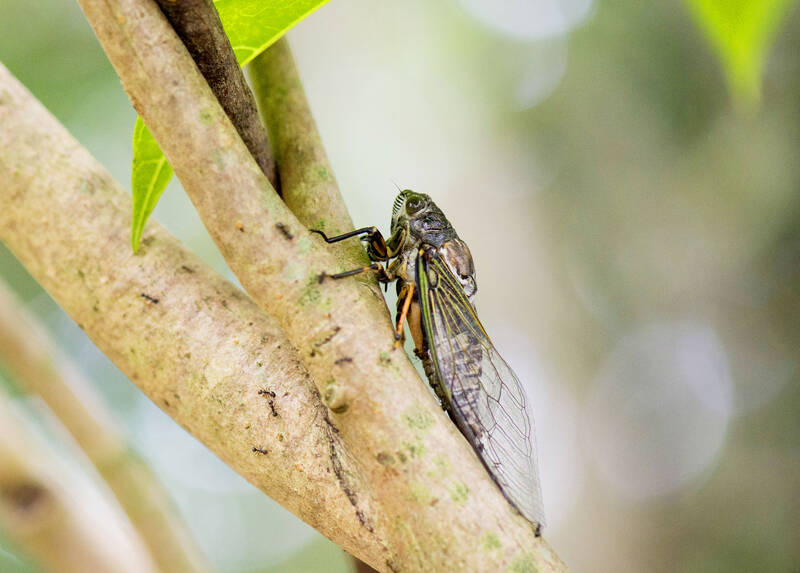
Photo courtesy of Wikimedia Commons
Showing an awareness that’s unusual, the authorities announced that, in the runup to the Gregorian and Lunar New Years, there’d be no firecrackers, fireworks or bell ringing at the temple. They also requested that those living nearby shouldn’t make excessive noise until the crane left, which it eventually did in March 2022.
There’s no doubt that anthropogenic noise has negative impacts on wildlife. What with the hum of factories, the din of road traffic, and fixing offshore wind turbines in place, humanity makes quite a racket — and it’s more than just an annoyance for birds, mammals, and sea creatures.
ACOUSTIC ECOLOGY
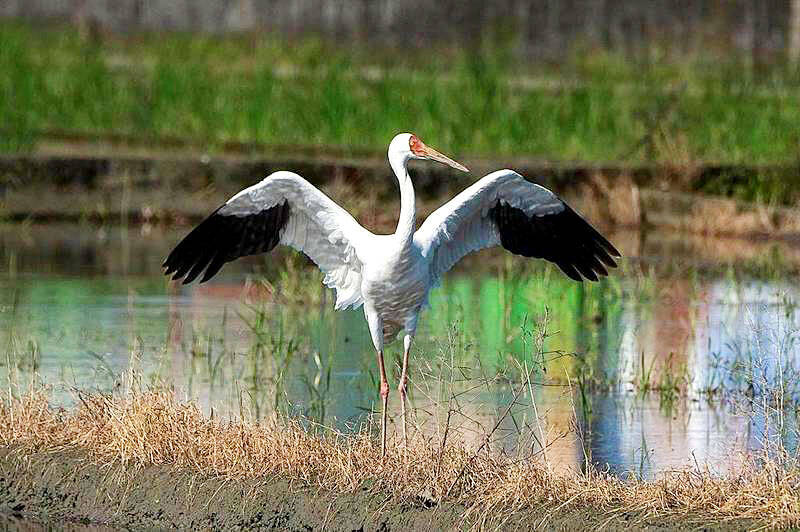
Photo courtesy of the Yilan City Government
What conservationists call “acoustic ecology” — the study of relationships between living beings and their environment through sound — is a relatively new research field. Two of the earliest studies by Taiwanese scholars looked at how man-made noise affects cicadas, of which the country has at least 60 species.
For their 2012 paper, a team which included Shieh Bao-sen (謝寶森) and Liang Shih-hsiung (梁世雄) recorded the calling songs of the male Cryptotympana takasagona, a cicada that’s common between sea level and elevations below 1,200m, in built-up parts of Kaohsiung. Like a great many species, acoustic signaling is central to its mating strategy. Rather than engage in what’s called “temporal shifting” (waiting for a gap or a lull in the cacophony), the researchers discovered that Cryptotympana takasagona sang at higher frequencies when immersed in anthropogenic noise.
The long-term consequences for urban populations aren’t yet clear. The researchers mention that larger males may be able to adjust their song frequency by changing their abdominal cavities. But it’s also possible that, because smaller males naturally produce higher-pitched sounds, they’ll have a distinct advantage. If their mating calls are the only ones to cut through the rumble of traffic, females will find and mate with them. Evolutionary pressure would thus favor smaller body sizes, a form of “human-induced selection” like that which famously changed the appearance of the peppered moth in 19th-century Manchester. (As soot from coal-burning factories polluted the environment, light-colored moths were at greater risk of bird predation; within a few decades, the percentage of dark-colored moths went from less than 1 percent to 98 percent.)
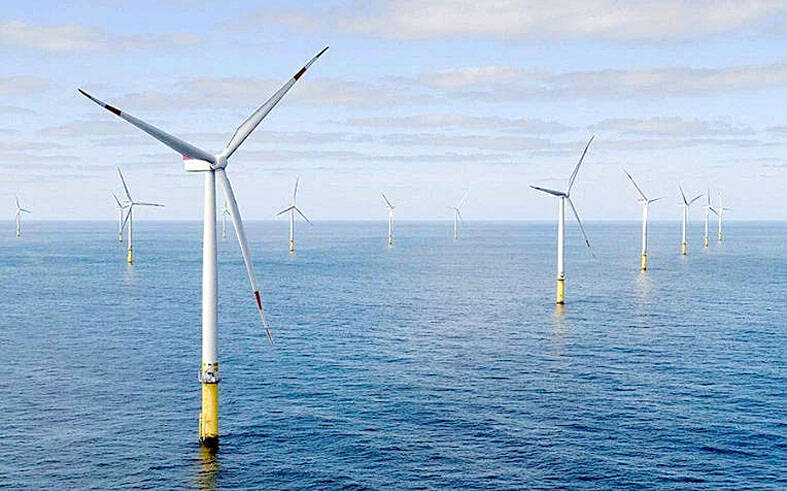
Photo: TT file photo
Mankind can’t be blamed for everything, however. Some species struggle to make themselves heard because their vocalizations are drowned out by other forest dwellers. For his 2017 master’s thesis at National Taiwan University’s School of Resource and Forestry Conservation, Chen Yi-chuan (陳奕全) examined acoustic competition between cicadas and birds in Yangmingshan National Park, and confirmed that the former “interfere with avian vocal behavior,” frequency overlap and sound intensity being key factors.
Shieh and Liang, this time working with Chiu Yuh-wen (邱郁文), went on to compare cicadas in urban Kaohsiung with those in Shanping Forest Ecological Garden (扇平森林生態科學園), a pristine conservation site far from human population centers. Their 2015 paper notes that, at the city sites where they made digital recordings, they found fewer cicada species and higher anthropogenic noise than at Shanping. Urban cicada assemblages “suffered more from selective pressures of anthropogenic noise,” but less from interspecies masking, than their relatives at Shanping.
The following year, the trio published research on how traffic noise impacts the cooing of pigeons. They found that “dominant urban species such as the spotted dove… temporally and spatially adjust cooing to reduce the masking effects of traffic noise,” while less common species (such as the emerald dove) avoid places where there’s a lot of traffic.

Photo: Tsai Wen-chu, Taipei Times
Efforts to protect birds from man-made noise aren’t always well received by humans. On Feb. 20, 2013, the Liberty Times (the Chinese-language sister newspaper of Taipei Times) reported that residents of Hanbao (漢寶), a village in Changhua County’s Fangyuan Township (芳苑), were unhappy that the authorities had funded the addition of barriers to a nearby stretch of Expressway 61, so as to protect around 60 pairs of black-winged kites (Elanus caeruleus) from both noise and light disturbance, but weren’t willing to do the same where people were actually living. “Do humans matter less than birds?” the newspaper quoted them as saying.
SILENT SEAS OR GREEN POWER?
Offshore wind is central to Taiwan’s efforts to reduce its carbon emissions, but the country also has more than 350 onshore wind turbines. For several years, people living near these bladed towers have complained that the low-frequency noise they generate disturbs their sleep. As long ago as 2009, goat farmers were claiming that the background whoosh-whoosh caused scores of their animals to die of exhaustion.
Yet placing turbines out of earshot doesn’t mean there won’t be acoustic disturbance. Cetaceans and fish rely on sounds for various life functions, among them feeding, reproduction, and navigation. In noisy environments, sea creatures show limited sound and prey/predator detection, and shorter communication range. They may change their vocalization, swimming speed, and/or social cohesion. Some suffer hearing damage or the physiological consequences of stress.
Not surprisingly, the construction phase is far noisier than the operational phase. Driving piles into the seabed can be, for whatever lives in the surrounding waters, literally deafening.
To mitigate this problem, Taiwan’s Ministry of the Environment requires companies building wind farms to ensure that: no more than one in 20 pile-driving thrusts exceeds 160 decibels, measured at a distance of 750m; that each session begins with gentler strikes, to scare away any dolphins or whales in the vicinity; and observers on site are ready to call a halt to work if a cetacean is spotted within a certain distance (usually 500m or 1,000m).
It’s possible to install offshore wind turbines without pile driving. One alternative is to fit them with bases which are heavy enough to stay in position without pushing down into the sediment. Another is to use turbines that float. But if units of either kind are to survive in the seas around Taiwan, they’ll need to be typhoon-proof.
Researchers in several countries, including Taiwan, are developing floating turbines. If they’re successful, marine life won’t be the only beneficiary. Where the water is too deep for turbines fixed to the ocean floor, winds tend to be stronger and more consistent. It’s hard to see how Taiwan will meet its ambitious wind-power targets (18.4 GW target by 2035) without floating turbines. Like many environmental issues, the push for renewables brings to mind Thomas Sowell’s famous words: “There are no solutions, only trade-offs.”
Steven Crook, the author or co-author of four books about Taiwan, has been following environmental issues since he arrived in the country in 1991. He drives a hybrid and carries his own chopsticks. The views expressed here are his own.

May 18 to May 24 Gathered on Yangtou Mountain (羊頭山) on Dec. 5, 1972, Taiwan’s hiking enthusiasts formally declared the formation of the “100 Peaks Club” (百岳俱樂部) and unveiled the final list of mountains. Famed mountaineer Lin Wen-an (林文安) led this effort for the Chinese Alpine Association (中華山岳協會). Working with other experienced climbers, he chose 100 peaks above 10,000 feet (3,048m) that featured triangulation points and varied in difficulty and character. The list sparked an alpine hiking craze, inspiring many to take up mountaineering and competing to “conquer” the summits. A common misconception is that the 100 Peaks represent Taiwan’s 100 tallest

Yesterday, the Democratic Progressive Party (DPP) nominated legislator Puma Shen (沈伯洋) as their Taipei mayoral candidate, the Chinese Nationalist Party (KMT) put their stamp of approval on Wei Ping-cheng (魏平政) as their candidate for Changhua County commissioner and former legislator Tsai Pi-ru (蔡壁如) of the Taiwan People’s Party (TPP) has begun the process to also run in Changhua, though she has not yet been formally nominated. All three news items are bizarre. The DPP has struggled with settling on a Taipei nominee. The only candidate who declared interest was Enoch Wu (吳怡農), but the party seemed determined to nominate anyone

In a sudden move last week, opposition lawmakers of the Chinese Nationalist Party (KMT) and Taiwan People’s Party (TPP) passed a NT$780 billion special defense budget as a preemptive measure to stop either Chinese leader Xi Jinping (習近平) or US President Donald Trump from blocking US arms sales to Taiwan at their summit in Beijing, said KMT heavyweight Jaw Shaw-kong (趙少康), speaking to the Taipei Foreign Correspondents Club on Wednesday night in Taipei. The 76-year-old Jaw, a political talk show host who ran as the KMT’s vice presidential candidate in 2024, says that he personally brokered the deal to resolve

The Chinese Nationalist Party (KMT), alongside their smaller allies the Taiwan People’s Party (TPP), are often accused of acting on behalf of the Chinese Communist Party (CCP). Some go so far as to call them “traitors.” It is not hard to see why. They regularly pass legislation to stymie the normal functioning of the ruling Democratic Progressive Party’s (DPP) administration, and they have yet to pass this year’s annual budget. They slashed key elements of the government’s proposed NT$1.25 trillion (US$40 billion) special military budget, and in the smaller NT$780 billion package they did pass, it is riddled with provisions that


 RSS
RSS