


Specialty sandwiches loaded with the contents of an entire charcuterie board, overflowing with sauces, creams and all manner of creative add-ons, is perhaps one of the biggest global food trends of this year. From London to New York, lines form down the block for mortadella, burrata, pistachio and more stuffed between slices of fresh sourdough, rye or focaccia.
To try the trend in Taipei, Munchies Mafia is for sure the spot — could this be the best sandwich in town?
Carlos from Spain and Sergio from Mexico opened this spot just seven months ago. The two met working in the food industry and wanted to create a “chill” neighborhood spot, Carlos says, but they’ve been booked and busy ever since they opened — and for good reason.
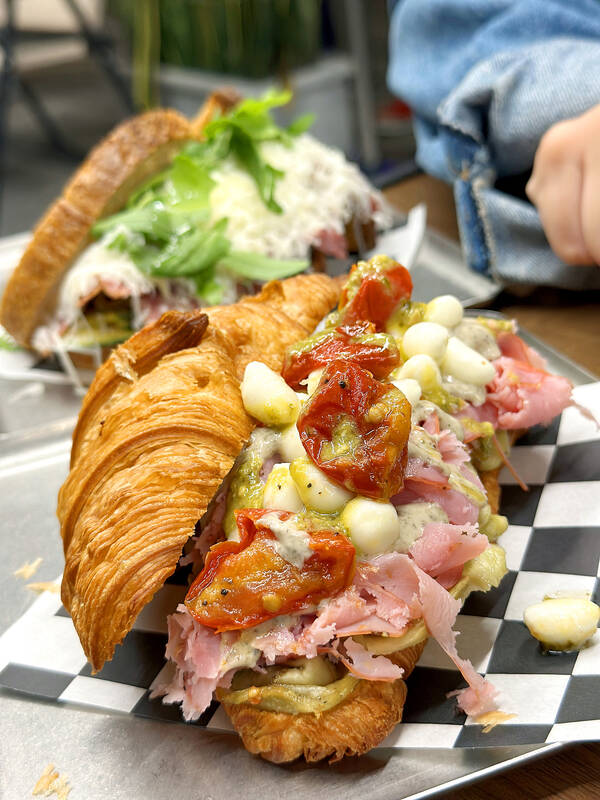
Photo: Hollie Younger, Taipei Times
The price point may seem a little high at first glance — over NT$300 for a sandwich — but once you see the sheer amount of cold cuts they manage to stack Jenga-style onto one piece of focaccia, it’s actually a fantastic price compared to charcuterie boards across the city.
As closing time nears on a cold Tuesday, every table outside was taken. I’ve actually never walked past this place during the day and not seen the outdoor patio bustling.
As they mostly cater to takeout and outdoor dining, we grab a tiny canvas chair outside. With a can of Taihu lager (NT$140) in one hand and a sandwich in the other, it felt rather like a fancy picnic in the middle of the city.
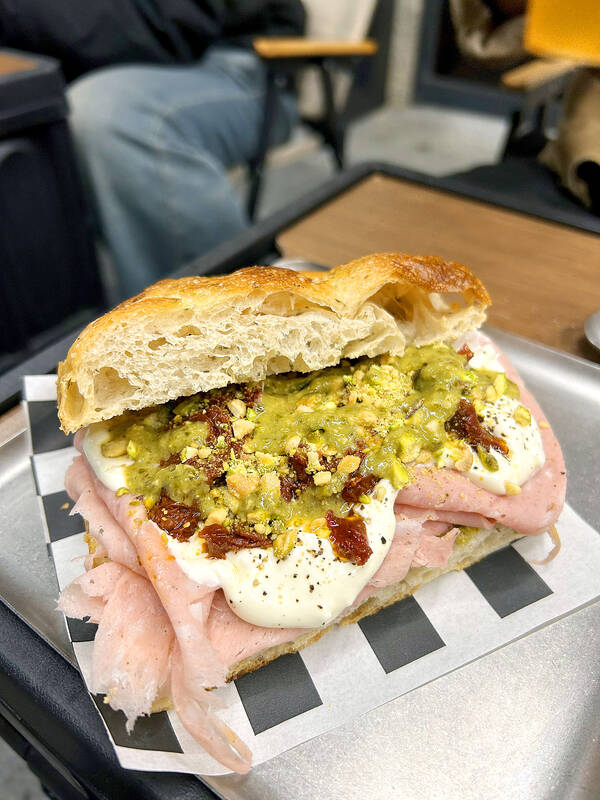
Photo: Hollie Younger, Taipei Times
The menu is split into cold-cut sandwiches, slow-cooked meats and a vegetarian option.
All sandwiches are available on rosemary focaccia, sourdough or croissant, with the bread sourced fresh from Feed the Wife Bakery & Desserts (胖死我太太) in Zhongzheng District (中正).
All are good options, but it would be criminal not to try the focaccia. The golden shell is so crispy there is audible crackling. The inside is perfectly chewy and, surprisingly, holds in the obscene amount of fillings. It glistens with olive oil but is never greasy, among the best breads I’ve tried in the city.
Photo: Hollie Younger, Taipei Times
The sourdough is nothing to write home about, but don’t overlook the croissant option. The buttery, flaky pastry is actually the perfect complement to tangy tomato and briny olives.
The slow cooked pastrami and roast beef are made in house, while the cold cuts and cheeses are imported.
Onto the sandwiches. Everyone must try the Winner Jackpot (NT$330), served on rosemary focaccia. Creamy, burrata-like stracciatella is dolloped onto hearty layers of pistachio mortadella, with pops of sundried tomato, basil pesto and chunky bits of pistachio.
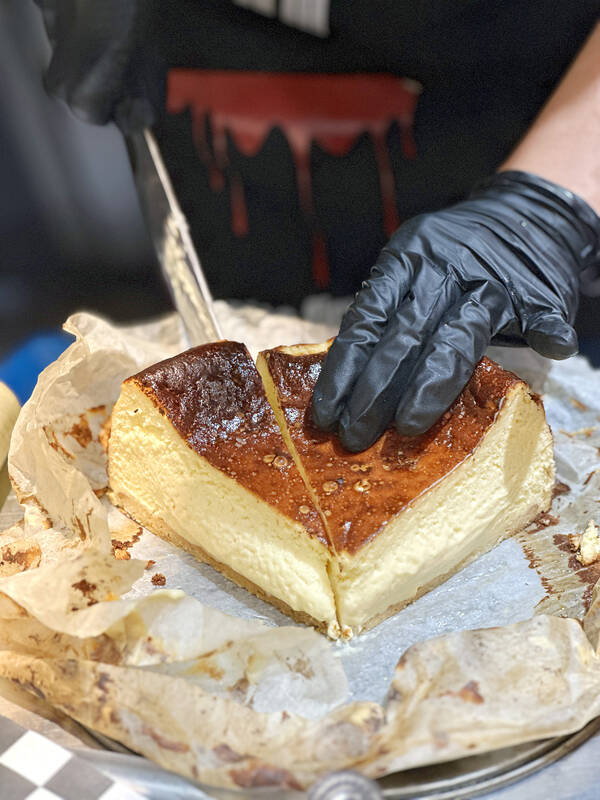
Photo: Hollie Younger, Taipei Times
The key to piling so many ingredients into one humble bread roll is balance, and this one was perfectly executed, no flavor or texture too overpowering, each ingredient getting its time in the spotlight.
This sandwich most closely resembles the Italian sarnies that Londoners and New Yorkers have been lining up for this year, with decadent and bang-on-trend pistachio packed into the toppings and the mortadella.
A close second was the Omerta (NT$310), served on a croissant. Black pepper ham, mozzarella, truffle cream, confit cherry tomato, baked eggplant and basil pesto. The strongest flavor was the fresh, bursting tomatoes, which perhaps could’ve taken a backseat and let the truffle cream do more of the talking.
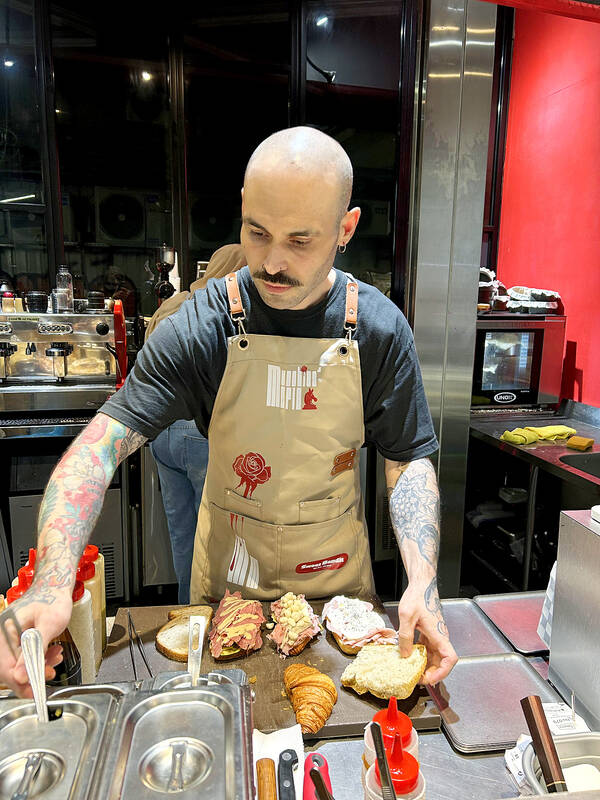
Photo: Hollie Younger, Taipei Times
Finally, we opt for one of the only non-pork products from the “slow cooked meat sandwiches” section.
God save the Beef (NT$320) has lashings of roast beef, flushed pink, with a vitello tonnato sauce, blended in-house with tuna and anchovies, paired with parmigiano, zucchini, olives and arugula. Unfortunately, the thick layers of cold zucchini stole the show and we couldn’t particularly taste the arugula or olives, two of my favorite sandwich toppings.
Even the roast beef was fighting to be seen under all the cold veg. God should save the beef from all that zucchini, we thought.
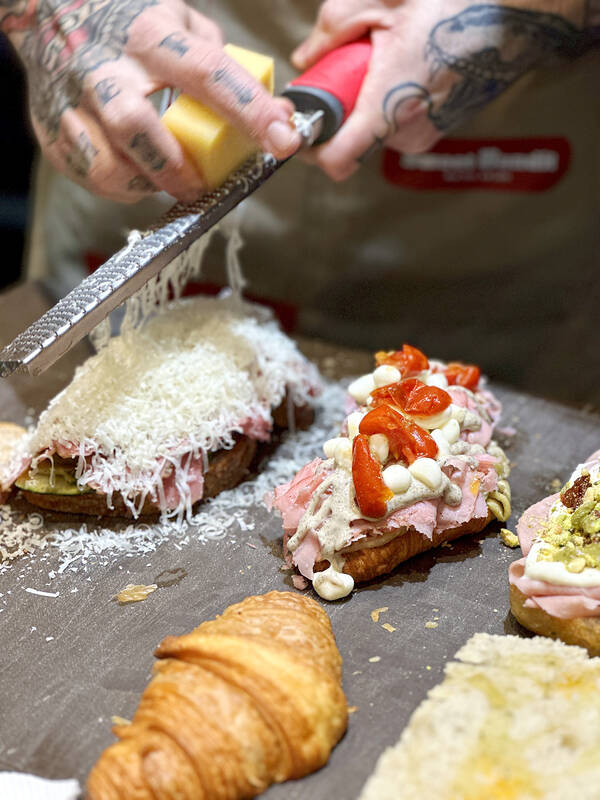
Photo: Hollie Younger, Taipei Times
Their slow-cooked pastrami sandwich with mustard and pickles is also popular.
They are also known for their oozy, gooey baked Basque cheesecake (NT$180), “straight outta Donosti” that every diner outside has somehow made room for.
Munchies Mafia is primarily a lunchtime spot, offering a full coffee menu and milkshakes, though in the evenings they do sell Taihu lager, IPA and a Sakura peach ale.
This place has been blowing up on social media and has become a solid go-to spot for the best Western sandwiches in Taipei.
Ajay Verma, a consultant gastroenterologist at Kettering general hospital in Northamptonshire, says our gut is a “complex machine.” “It is constantly providing us with the nutrition we need, initially to grow and develop, and then for us to survive, thrive and repair from injury and illness.” How can we keep it functioning well? Put simply: “Make sure what you put into it is balanced, and that you clear out its waste products adequately,” Verma says. “In a general gastroenterology clinic, the most common conditions we see are irritable bowel syndrome (IBS), gastroesophageal reflux disease, inflammatory bowel disease and constipation,” says Nisha
The arithmetic is straightforward and uncomfortable. By the end of 2025, Taiwan had committed itself to a 50-30-20 electricity mix — half natural gas, 30 per cent coal, 20 per cent renewables. The Ministry of Economic Affairs’s (MOEA) own monthly energy reports tell a different story. Natural gas reached 47.8 per cent of generation last year. Coal stood at 35.4 per cent, comfortably above its target ceiling. Renewables came in at 13.1 per cent, well short of the 20 per cent Taipei had pledged a decade earlier. Installed renewable capacity reached roughly half of the 12 gigawatts (GW) the government

Last week US President Donald Trump was asked by a reporter whether he would speak on the phone to the President of Taiwan. “l’ll speak to him. I speak to everybody. We have that situation very well in hand,” Trump said. This marked the second time in a couple of weeks he had said he would talk to the President of Taiwan. In 2016 he famously took a call from then-president Tsai Ing-wen (蔡英文), when he was president-elect. Despite warnings that the apocalypse was nigh because of a phone call, the world quickly forgot about the conversation between two democratically-elected presidents.
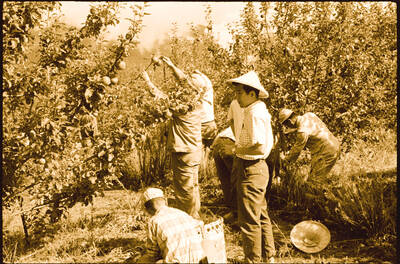
May 25 to May 31 Few believed that apples could be cultivated on a commercial scale in Taiwan’s high mountains. When horticulturalist Cheng Chao-hsiung (程兆熊) first proposed the idea in 1955, both American and Taiwanese colleagues dismissed it as implausible, arguing that temperate fruit could not be reliably grown on a subtropical island, especially on rugged terrain. However, it was this terrain in the Central Mountain Range where many Chinese Civil War veterans were resettled in the late 1950s. With limited job prospects and no family in Taiwan, they were placed on cooperative farms aimed toward self-sufficiency. Some say the conditions


 RSS
RSS