


The disruption of 941 flights in and out of Taiwan due to China’s large-scale military exercises was no accident, but rather the result of a “quasi-blockade” used to simulate creating the air and sea routes needed for an amphibious landing, a military expert said.
The disruptions occurred on Tuesday and lasted about 10 hours as China conducted live-fire drills in the Taiwan Strait.
The Civil Aviation Administration (CAA) said the exercises affected 857 international flights and 84 domestic flights, affecting more than 100,000 travelers.
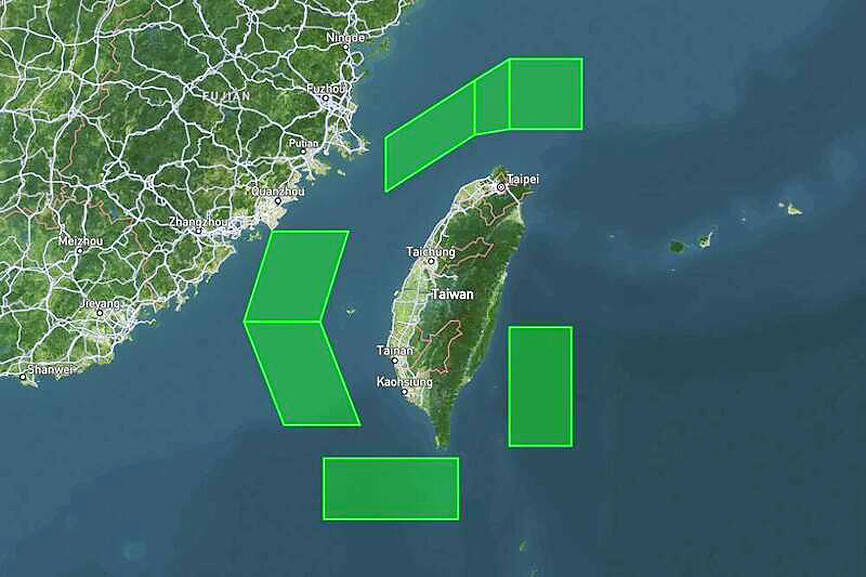
Illustration: Taipei Times
Su Tzu-yun (蘇紫雲), a research fellow at the government-sponsored Institute for National Defense and Security Research, said the air traffic disruption triggered by the military drills served multiple purposes.
First, it simulated a “quasi-blockade” by shutting down some of Taiwan’s international air routes, Su wrote in an article published on the institute’s Web site on Wednesday.
“The apparent objective was to demonstrate China’s ability to impose a blockade and exert control over Taiwan, while converting travelers’ inconvenience into public dissatisfaction with the government,” he wrote.
Su said the exercises also tested the feasibility of establishing “joint domain control,” a newly proposed Chinese People’s Liberation Army (PLA) training concept that integrates sea control, air superiority and electromagnetic dominance.
Such integration is intended to secure the sea lines of communication and air routes necessary for logistics and military sustainment during an eventual amphibious landing, he said.
While blocking most of Taiwan’s air routes, China deliberately left open three — M750, G587 and R583, Su said.
“This is believed to have been an exercise in establishing ‘humanitarian corridors’ to facilitate foreign evacuations during a blockade of Taiwan, signaling an attempt to project an image of control and negotiability,” Su wrote.
While military exercises are not prohibited under international law, they are subject to multiple legal constraints and China’s “quasi-blockade” failed to comply with several established international practices, he said.
Although China issued aviation notices and maritime warnings, and claimed to avoid unnecessary interference, Su said the large-scale drills that amounted to a de facto “blockade” seriously overstepped the boundaries of freedom of navigation and overflight.
In particular, he said the exercises contravened the “advance notice principle” set out in Section 6.2.3 of Annex 15 to the Convention on International Civil Aviation on aeronautical information services.
That principle requires notices to be issued 28 days in advance to prevent sudden announcements that disrupt flight scheduling.
“The PLA exercises have clearly compromised the safety and freedom of navigation of Taiwan and neighboring countries, significantly affecting the economic interests and navigational rights of coastal states,” Su wrote.
They also contravened the legal principles and procedures of the UN Charter, international maritime law and international civil aviation law, he said.
Meanwhile, Lin Po-chou (林柏州), another researcher at the institute, said the latest exercises caused the most severe disruption to maritime and air traffic on record.
China’s actions underscored a “hegemonic mindset” that disregards the international community’s commitment to peace and stability in the Taiwan Strait, Lin wrote in a separate article published on Wednesday.
“By responding to calls for peace with displays of force, China has further reinforced accusations that it is a ‘disrupter of the international order,’” Lin wrote.

FUKUOKA SITUATION: Japanese media reported that the pathogen is expected to be identified by the summer, while the CDC downplayed the idea that it was hMPV A “mysterious cold-like illness” reported in Japan’s Fukuoka Prefecture does not seem to be a new disease, but Japanese authorities have been asked about the situation, the Centers for Disease Control (CDC) said yesterday. The Fukuoka Prefectural Medical Association on Wednesday told a news conference that a “mystery cold” that has become a hot topic on social media is “highly likely to be caused by some kind of viral infection,” Japan’s KBC News reported. “Many people are experiencing symptoms starting with a sore throat, followed by a runny nose, phlegm and a severe cough,” KBC News reported, citing association officials. Health authorities are

Nvidia Corp CEO Jensen Huang (黃仁勳) arrived in Taiwan yesterday ahead of upcoming AI and technology events, saying he plans to meet with clients and Taiwan Semiconductor Manufacturing Co Chairman C.C. Wei (魏哲家) during his visit. After landing at Taipei Songshan Airport, Huang posed for photos with fans and handed out Yakult drinks to reporters and supporters waiting at the scene, saying he has “a lot to do” during the trip. Asked about reports that Nvidia’s planned headquarters site in Taipei’s Beitou Shilin Technology Park could break ground on May 27, Huang said that if the company holds an event, he would

The Ministry of Finance this afternoon announced the winning numbers for the March-April uniform invoice lottery. The winning number for the NT$10 million (US$318,060) special prize is 19531471, and the winning number for the NT$2 million grand prize is 85941329. Three numbers were drawn for the NT$200,000 first prize: 07225810, 20231230 and 83518781. Those with receipts matching the last seven digits of any of the first-prize numbers will win the NT$40,000 second prize, while those matching the last six digits will win the NT$10,000 third prize. Those whose receipts match the last five digits of the first-prize numbers can claim the NT$4,000 fourth prize,
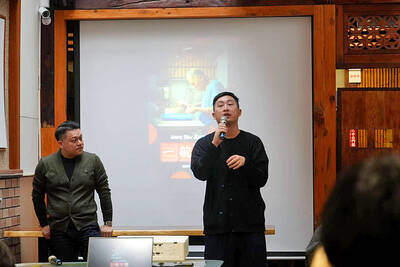
Taiwan Travelogue (臺灣漫遊錄), which earlier this week became the first Taiwanese novel to win the International Booker Prize, is to be adapted into a television series through a Taiwan-Japan coproduction, producer Chang Chen-yu (張辰漁) said yesterday. Chang, a producer at World Softest Production Film Co, wrote on Facebook that the company had been searching for projects with international appeal that retain a strong Taiwanese identity after colleagues and Japanese partners strongly recommended the novel. After reading the book, Chang said he immediately decided to pursue the screen rights. “A great story has the power to transcend time and borders, and connect countless people,”


 RSS
RSS