


It is a soulful folk song, filled with feeling and history: A love-stricken young man tells God about his hopes and dreams of happiness. Generations of Uighurs, the Turkic ethnic minority in China’s Xinjiang region, have played it at parties and weddings.
But today, if they download it, play it or share it online, they risk ending up in prison.
Besh pede, a popular Uighur folk ballad, is among dozens of Uighur-language songs that have been deemed “problematic” by Xinjiang authorities, according to a recording of a meeting held by police and other local officials in the historic city of Kashgar in October. The recording was shared by the Norway-based nonprofit Uighur Hjelp.
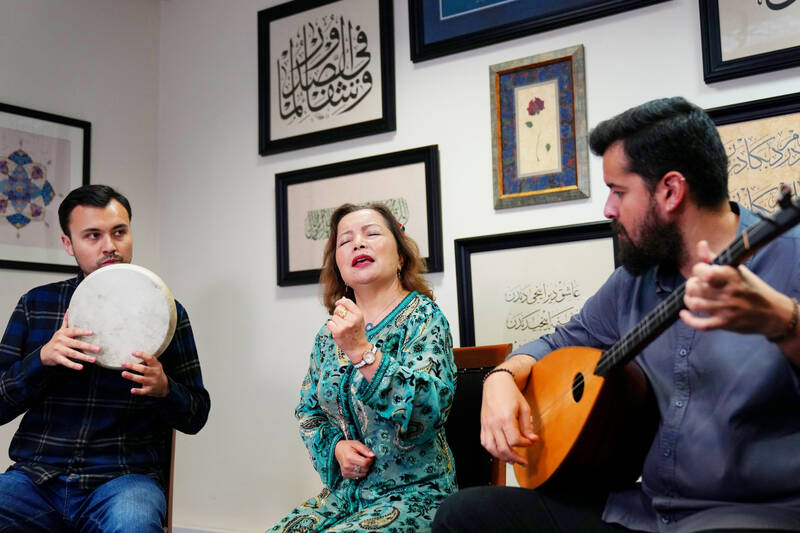
Photo: AP
During the meeting, authorities warned residents that those who listened to banned songs, stored them on devices or shared them on social media could face prison. Attendees were also instructed to avoid phrases like “As-salamu alaykum,” the greeting common among Muslims, and to replace the popular farewell phrase “Allahqa amanet,” which means “May God keep you safe,” with “May the Communist Party protect you.”
The policy has been corroborated by interviews with former Xinjiang residents, whose family members, friends and acquaintances have been detained for playing and sharing Uighur music. AP has also obtained rare access to the court verdict of a Uighur music producer sentenced last year to three years in prison for uploading to his cloud account songs deemed sensitive.
BROAD CRACKDOWN

Photo: AP
The renewed crackdown on cultural expression in Xinjiang, classified as an “autonomous region” but tightly controlled by the central government, suggests a continuation of the past decade’s repressive policies. They have culminated in the extrajudicial detention, between 2017 and 2019, of at least 1 million Uighurs and other ethnic minorities in China such as Kazakhs, Kyrgyz and Huis, rights activists and foreign governments say.
In 2022, the UN accused China of rights violations it said might amount to crimes against humanity in Xinjiang, where Beijing also faces allegations of forced labor, forced sterilizations and family separations as part of a broader assimilation campaign.
The Chinese government maintains its policies in Xinjiang rooted out terrorism and religious extremism after sporadic bouts of violence rocked the region in previous decades. Beijing doubled down on that narrative in particular after the Sept. 11, 2001, attacks brought antiterror policies into the accepted global mainstream.
“The Chinese government has cracked down on violent terrorist crimes and eradicated the breeding ground for religious extremism in accordance with the law, resolutely safeguarding Xinjiang’s development and stability,” the Foreign Ministry said in a statement.
It added that “anti-China forces” have “maliciously hyped up issues related to Xinjiang,” including by “linking audio and video recordings of Xinjiang departments cracking down on the propaganda of violent terrorism and religious extremism in accordance with the law to specific regions, ethnicities, and religions.”
Reached by phone, a Xinjiang government official wouldn’t confirm whether a faxed request for comment had arrived and did not pick up subsequent calls.
CONTINUED REPRESSION
After facing international backlash and sanctions over the alleged arbitrary internment of ethnic minorities, Beijing in late 2019 claimed the detention camps were closed and life had returned to normal in the region. China now aims to refashion Xinjiang into a destination for tourism.
Although many of the more glaring signs of repression such as internment camps and frequent traffic checkpoints appear to have been decommissioned, the list of banned songs indicates repression in Xinjiang continues, albeit more subtly, said Rian Thum, a senior lecturer in East Asian history at the University of Manchester.
Other, less conspicuous forms of control include the expansion of boarding schools, where middle-schoolers are educated while separated from their families and learn almost exclusively in Mandarin Chinese, and random checks of phones for sensitive material are common.
Chinese authorities, Thum said, seem to be normalizing a policy for long-term control in Xinjiang.
“I’m not at all surprised to hear these accounts of people either being threatened with detention or being detained or imprisoned for listening to the wrong music,” he said. “It’s the kind of thing that hasn’t stopped.”
‘PROBLEMATIC’ SONGS
During the Kashgar meeting, authorities played a prerecorded message warning residents against listening to, downloading and sharing seven categories of so-called problematic songs.
They range from traditional folk ballads such as Besh pede to newer tunes that emerged from the Uighur diaspora. Besh pede was flagged for its religious content, though the song hardly incites religious extremism, said Rachel Harris, a professor of ethnomusicology at SOAS University of London.
Religion is referenced in the context of romantic tropes, with exhortations such as “Oh, God, I love you!” said Harris, who focuses on Uighur culture.
“That’s very clearly the problem with it,” she said.
Targeting religious expression has been a cornerstone of China’s crackdown. The Communist Party is suspicious of any community organizing, especially as it pertains to religions. Over the past decade, residents have been detained for praying, fasting and storing religious books; mosques have been repurposed or stripped of their authentic role.
Music “became part of my upbringing, and removing that is like removing the soul,” said Rahima Mahmut, a Uighur singer and activist in London who performs songs with religious connotations abroad.
Even songs once featured on state TV have been banned. “As-salamu alaykum,” a pop tune that starts with the Islamic greeting recited in the style of a call to prayer, was performed on the talent show The Voice of the Silk Road, a spinoff of The Voice, on state-run Xinjiang Television.
The performance aired in 2016, the year China started amping up its campaign of repression against Uighurs. Now, the tune is prohibited for “forcing people to believe in religion.”
Another category of problematic songs: those “inciting terrorism, extremism and smearing the Chinese Communist Party’s rule of Xinjiang.”
Among the tunes listed is Yanarim Yoq, a song based on the poem No Road Back Home by the imprisoned Uighur poet Abduqadir Jalalidin. The sorrowful song, evoking entrapment and hopelessness, has spread across the diaspora in recent years; one of its most popular renditions is performed by the Turkish artists Kilich and Yenilmes.
Atilar, or “Forefathers,” by the famed Uighur musician Abdurehim Heyit, is also accused of inciting terrorism and extremism. The nationalistic song was likely flagged for describing the Uighur forefathers as martyrs ready for battle, Harris said.
Heyit, like many other Uighur cultural elites, was detained at the height of China’s campaign in Xinjiang. Many remain in detention.
In fact, a common denominator across the banned songs is that many were written or performed by imprisoned Uighur musicians, said Elise Anderson, a nonresident senior fellow at the New Lines Institute who specializes in Uighur issues.
Anderson isn’t certain that every artist associated with a banned song has been detained, but “at least a number of them have,” she said. “I think just by association with those individuals, those songs are going to be seen as — you know — dangerous, sensitive.”
THREE-YEAR SENTENCE
Authorities at the Kashgar meeting said those found with the songs would be “heavily prosecuted” but did not specify punishment — something that gives authorities flexibility in enforcement. The prerecorded message gave the example of several people who had served 10 days in detention for being found with the banned songs.
For Uighur music producer Yashar Xiaohelaiti, punishment has been much more severe.
The 27-year-old was detained in 2023 in Bole, a city in Xinjiang, on charges of promoting extremism. According to his verdict, Xiaohelaiti wrote and produced 42 “problematic” songs, which he uploaded to his account on NetEase Cloud Music, a Chinese streaming service. He was also convicted of downloading eight “problematic” e-books, according to the document. He received three years in prison and a 3,000 yuan (US$420) fine.
Two Uighur said they brushed up against the songs ban themselves. A man who asked that his name not be revealed, fearing repercussions, said he was called into the police station and his phone searched after he commented on the social media post of another Uighur living abroad. While at the police station, he said he spoke to others who had been summoned specifically for storing or sharing certain Uighur songs.
Separately, a former official from Xinjiang said a family friend was sentenced to more than 10 years in prison for playing traditional Uighur instruments and singing Uighur songs. Several family members and friends who watched the performance were also sentenced, she said. The interviewees claims could not be independently verified.
In a separate incident, the official said two teenagers were detained after sharing Uighur songs online.
“Because they sent each other a Uighur song on WeChat, they were arrested,” the former cadre said, referring to the teens. “I remember it very clearly. At the time we were saying, ‘What song were they listening to?’ How could they be arrested for listening to a song?’”

By global standards, the traffic congestion that afflicts Taiwan’s urban areas isn’t horrific. But nor is it something the country can be proud of. According to TomTom, a Dutch developer of location and navigation technologies, last year Taiwan was the sixth most congested country in Asia. Of the 492 towns and cities included in its rankings last year, Taipei was the 74th most congested. Taoyuan ranked 105th, while Hsinchu County (121st), Taichung (142nd), Tainan (173rd), New Taipei City (227th), Kaohsiung (241st) and Keelung (302nd) also featured on the list. Four Japanese cities have slower traffic than Taipei. (Seoul, which has some

Michael slides a sequin glove over the pop star’s tarnished legacy, shrouding Michael Jackson’s complications with a conventional biopic that, if you cover your ears, sounds great. Antoine Fuqua’s movie is sanctioned by Jackson’s estate and its producers include the estate’s executors. So it is, by its nature, a narrow, authorized perspective on Jackson. The film ends before the flood of allegations of sexual abuse of children, or Jackson’s own acknowledgment of sleeping alongside kids. Jackson and his estate have long maintained his innocence. In his only criminal trial, in 2005, Jackson was acquitted. Michael doesn’t even subtly nod to these facts.

Writing of the finds at the ancient iron-working site of Shihsanhang (十 三行) in New Taipei City’s Bali District (八里), archaeologist Tsang Cheng-hwa (臧振華) of the Academia Sinica’s Institute of History and Philology observes: “One bronze bowl gilded with gold, together with copper coins and fragments of Tang and Song ceramics, were also found. These provide evidence for early contact between Taiwan aborigines and Chinese.” The Shihsanhang Web site from the Ministry of Culture says of the finds: “They were evidence that the residents of the area had a close trading relation with Chinese civilians, as the coins can be

During her 2015 trip to Taiwan, Sophia J. Chang (張詠慧) got fewer answers than she’d hoped for, but more revelations than she could have imagined. “That was the year I last saw my grandmother. She was in hospice care in Tainan, and it was painful to see her in bed, barely able to open her eyes,” says Los Angeles-born Chang. “The grandma I’d known, a fantastic cook and incredibly kind, was already gone.” After their visit, Chang and her grandfather went back to his apartment. There she asked him how he’d met her grandmother. “He hesitated, then started talking a bit.


 RSS
RSS