


The People’s Republic of China (PRC) was out in force in the Taiwan Strait this week, threatening Taiwan with live-fire exercises, aircraft incursions and tedious claims to ownership. The reaction to the PRC’s blockade and decapitation strike exercises offer numerous lessons, if only we are willing to be taught.
Reading the commentary on PRC behavior is like reading Bible interpretation across a range of Christian denominations: the text is recast to mean what the interpreter wants it to mean. Many PRC believers contended that the drills, obviously scheduled in advance, were aimed at the recent arms offer to Taiwan by the administration of US President Donald Trump, citing PRC noises to that effect. Another denomination of believers contended that they were aimed at the recent remarks on a Taiwan contingency by Japanese Prime Minister Sanae Takaichi, again citing PRC noises. Observers noted the irony of the PRC performing military drills in the Strait while accusing Japan of reviving militarism.
PRC atheists like President William Lai (賴清德), however, avoided the search for meaning and simply criticized the PRC for being “irrational.” The correct move with the PRC is to ignore the noises it makes and avoid repeating them — they are propaganda designed to influence commentary and signal its shills and speakers on what they should be saying.
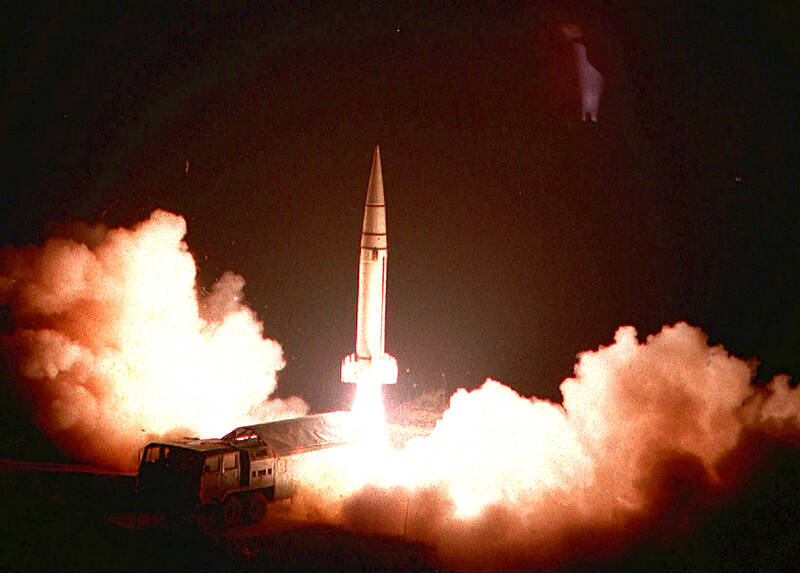
Photo: Xinhua via AP
PRC THEATER
The PRC holds periodic large drills because it wants to intimidate the Taiwanese and shore up support at home. Whenever it does, it uses recent events to construct a narrative explaining its behavior that blames Taiwan and its supporting democracies for its own belligerent choices. Remember that a key goal of PRC propaganda is to transfer the tension it manufactures in its relationship with Taiwan to the Taipei-Washington relationship.
The PRC’s seemingly inept poster art publicizing the drill were passed around to laughter on many social media platforms. The last four words of the previous sentence are the key: the PRC was leveraging the Streisand effect to get others to stream its propaganda. Beijing wants people to meme the crap out of its hilariously incompetent poster art because then it gets exposure in all sorts of Taiwan-related discourse spaces it otherwise might not, and for a much longer period of time.
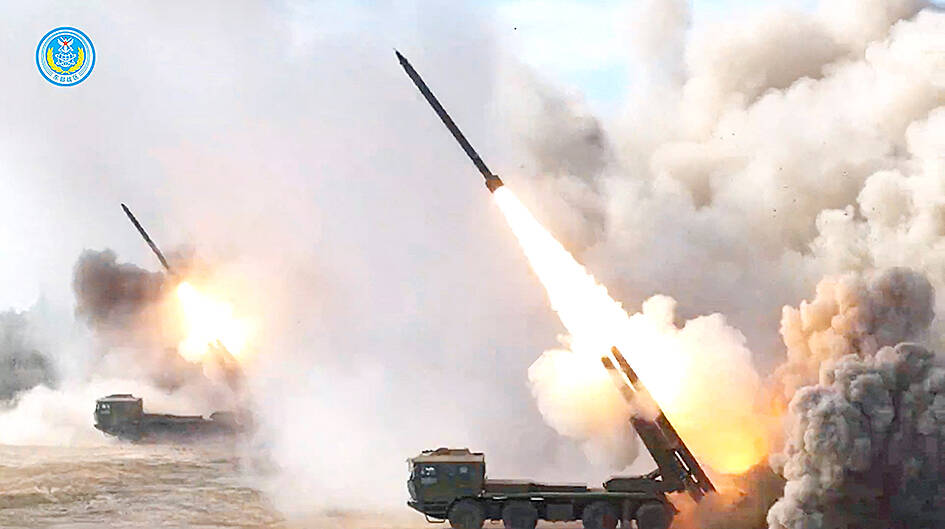
Photo: Eastern Theatetr Command via Reuters
Further, hardly anyone remarked on how the PRC was engaging in theater for its own domestic audience. Chinese people are like any other humans and do not want war. The PRC not only has to legitimate a war to its people, it also has to show that it has the willingness, competence and capacity to carry out that war, in order to gain public support for it. It has cultivated nationalist expansionism in its own people for decades, and now it must keep responding to that public sentiment, lest it lose its own people.
Of course, the usual pro-PRC commentators were out in force blaming the US and Japan for PRC belligerence or deprecating the catastrophic implications of a PRC occupation of Taiwan. Both Jennifer Kavanagh and Stephen Wertheim, who appeared to have been part of a coordinated pro-PRC influence effort ahead of the last meeting between Trump and PRC dictator Xi Jin-ping (習近平) — see “The emerging argument to sell out Taiwan,” Nov. 3, 2025 — made such comments. Kavanagh, for example, observed on X: “A successful Chinese seizure of Taiwan would have little effect on the region’s balance of power.”
Apparently the last five centuries of leaders grabbing Taiwan and then looking south for further expansion never happened.
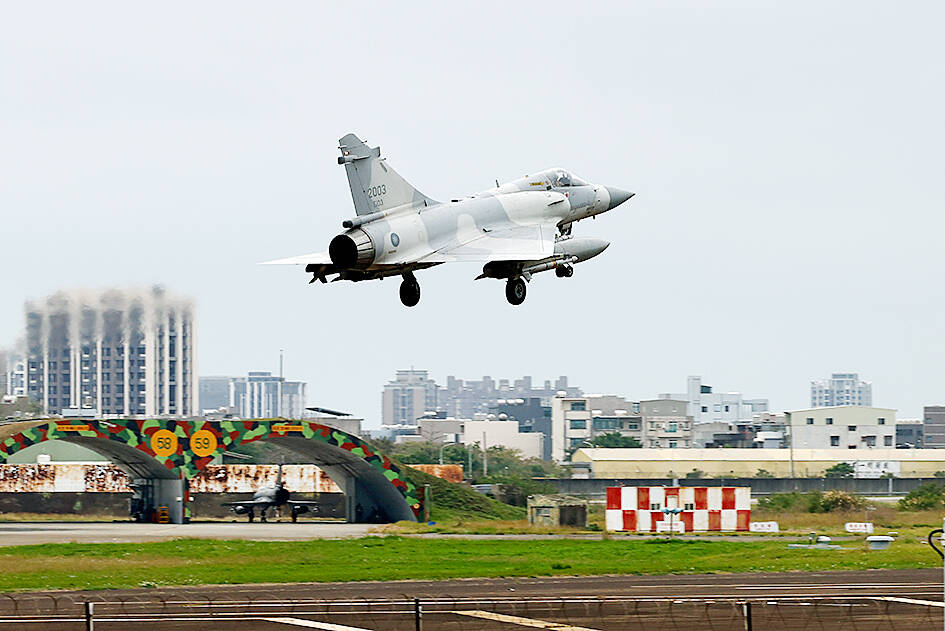
Photo: EPA
According to this crowd, the US was to blame.
“Beijing’s explanation for the exercises explicitly cites foreign support for Taiwan separatism,” said Paul Heer, a former US government official.
Poor put-upon Beijing, the Jessica Rabbit of nations — it’s not evil, it’s just drawn that way.
INCREASED ACTIVITY
The drills highlighted the increasing PRC activity around Taiwan. The number of ships and airplanes deployed around Taiwan was double that of the previous two years as of October, Vice Minister of National Defense Hsu Szu-chien (徐斯儉) said on Christmas Day. It is clear that the drills are simply somewhat more visible spikes in an ongoing and steadily rising campaign of incursions and “gray zone” activities, several of which have been in this size class. For example, in October last year incursions by 153 aircraft were tracked in a similar one-day drill scenario, which pro-PRC speakers blamed on a speech by President Lai (there is always something going on that the PRC could be angry about). Similarly, 103 aircraft surrounded Taiwan in September of 2023.
The size of PRC incursion events ebbs and flows, but is clearly increasing over time as part of a long-standing policy. The fact that observers automatically search for a “reason” for a specific data point in a policy stream that dates back years is of enormous help to the PRC in its quest to camouflage and conceal its behavior. Well-meaning observers should avoid the search for the meaning behind the PRC’s anger. Instead, PRC verbiage should be regarded as an opportunity for its hacks and shills to out themselves by forwarding rationalizations for the PRC’s aggression that blame its victims.
The drills also had another disinformation function. Jeff Pao observed in a sharp piece at Asia Times that the drills also served the PRC’s information war goal of undermining Taiwan’s faith in its ability to defend itself. He instanced the case of a Chinese military commentator in Italy on YouTube who published a recording of a phone call in which he had been offered a large sum of money to cast doubt on Taiwan’s ability to fight China. One way to do that, the caller suggested, was to criticize Ukraine’s war conduct to show how Taiwan would be punished in a war with the PRC.
Vice Minister of National Defense Hsu’s remarks came a day after the legislature, controlled by the pro-China parties — the Chinese Nationalist Party (KMT) and Taiwan People’s Party (TPP) — voted against reviewing this year’s government budget, including the NT$1.25 trillion (US$39.71 billion) special defense budget bill. This week, as PRC missiles were landing in Taiwan waters, the KMT and TPP again blocked the special defense budget in committee. Note that several of the systems in the offer from the US that has so “angered” the PRC are paid for out of that budget.
It is not too late, but the clock is ticking.
Notes from Central Taiwan is a column written by long-term resident Michael Turton, who provides incisive commentary informed by three decades of living in and writing about his adoptive country. The views expressed here are his own.

Yesterday, the Democratic Progressive Party (DPP) nominated legislator Puma Shen (沈伯洋) as their Taipei mayoral candidate, the Chinese Nationalist Party (KMT) put their stamp of approval on Wei Ping-cheng (魏平政) as their candidate for Changhua County commissioner and former legislator Tsai Pi-ru (蔡壁如) of the Taiwan People’s Party (TPP) has begun the process to also run in Changhua, though she has not yet been formally nominated. All three news items are bizarre. The DPP has struggled with settling on a Taipei nominee. The only candidate who declared interest was Enoch Wu (吳怡農), but the party seemed determined to nominate anyone
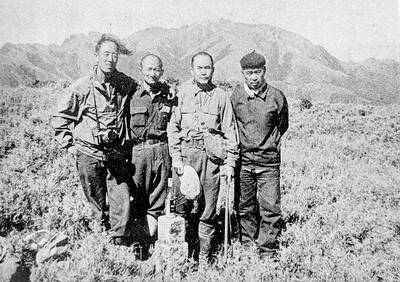
May 18 to May 24 Gathered on Yangtou Mountain (羊頭山) on Dec. 5, 1972, Taiwan’s hiking enthusiasts formally declared the formation of the “100 Peaks Club” (百岳俱樂部) and unveiled the final list of mountains. Famed mountaineer Lin Wen-an (林文安) led this effort for the Chinese Alpine Association (中華山岳協會). Working with other experienced climbers, he chose 100 peaks above 10,000 feet (3,048m) that featured triangulation points and varied in difficulty and character. The list sparked an alpine hiking craze, inspiring many to take up mountaineering and competing to “conquer” the summits. A common misconception is that the 100 Peaks represent Taiwan’s 100 tallest
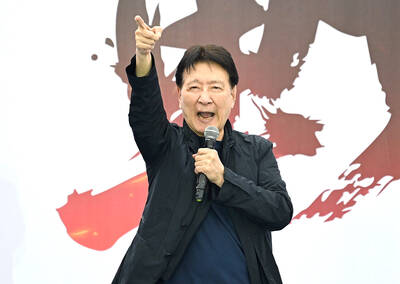
In a sudden move last week, opposition lawmakers of the Chinese Nationalist Party (KMT) and Taiwan People’s Party (TPP) passed a NT$780 billion special defense budget as a preemptive measure to stop either Chinese leader Xi Jinping (習近平) or US President Donald Trump from blocking US arms sales to Taiwan at their summit in Beijing, said KMT heavyweight Jaw Shaw-kong (趙少康), speaking to the Taipei Foreign Correspondents Club on Wednesday night in Taipei. The 76-year-old Jaw, a political talk show host who ran as the KMT’s vice presidential candidate in 2024, says that he personally brokered the deal to resolve
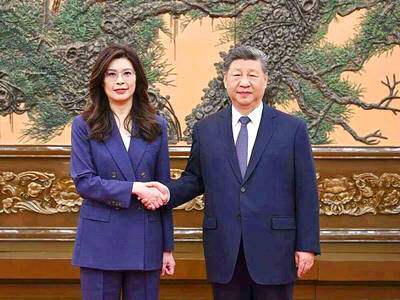
The Chinese Nationalist Party (KMT), alongside their smaller allies the Taiwan People’s Party (TPP), are often accused of acting on behalf of the Chinese Communist Party (CCP). Some go so far as to call them “traitors.” It is not hard to see why. They regularly pass legislation to stymie the normal functioning of the ruling Democratic Progressive Party’s (DPP) administration, and they have yet to pass this year’s annual budget. They slashed key elements of the government’s proposed NT$1.25 trillion (US$40 billion) special military budget, and in the smaller NT$780 billion package they did pass, it is riddled with provisions that


 RSS
RSS