


This is the year that the demographic crisis will begin to impact people’s lives. This will create pressures on treatment and hiring of foreigners. Regardless of whatever technological breakthroughs happen, the real value will come from digesting and productively applying existing technologies in new and creative ways.
INTRODUCING BASIC SERVICES BREAKDOWNS
At some point soon, we will begin to witness a breakdown in basic services. Initially, it will be limited and sporadic, but the frequency and newsworthiness of the incidents will only continue to accelerate dramatically in the coming years.

Photo: Bloomberg
Here in central Taiwan, many basic services are severely understaffed, and many of the employees critical to their functioning are entering retirement age. In Changhua, police are forced to delay retirement
In Taichung, despite rapid pay rises in recent years, the number of bus drivers continues to decline. Recently, I reported on ICRT News a situation where a bus driver called in sick, and another was on vacation, disrupting routes that brought people to work and school. This was a one-off case — but this basic daily necessity for many has reached the point where there is a shrinking margin of error. If a driver does not show up for work, it is increasingly likely that a bus will not run, stranding many and overcrowding later buses.
In Taichung last year, one of the top recurring news items was of buses involved in fatal accidents. That is directly related to the system reaching breaking point; the drivers have been pushed to their limits, and are overworked and exhausted. People died.
That industries are facing serious staff shortages has been in the news for years, but through a combination of figuring out how to make do and filling stopgaps with imported foreign workers, daily life for most people has not been impacted. Hotels are more expensive, service at restaurants sometimes worse, but overall life has simply gone on.
It is hard to replace local city bus drivers with foreigners or technology; the routes are complex, the road signs in Chinese and the ability to communicate with passengers essential. Self-driving vehicles on complex routes are still years away.
Bus drivers are one example of an essential service that faces periodic breakdowns. There are countless others like it.
This is likely the year the public begins to wake up to this crisis.
FROM THEM TO US
Officially, Taiwan’s population is declining, but that is a lie. Those are citizens; the actual population is increasing fast.
According to Ministry of Interior statistics, at the end of November, there were 865,811 “foreign workers” in Taiwan. At some point late this year or next year, Taiwan is going to face the psychologically important one million mark. The government will likely try to delay that, but eventually, they will have no choice.
In reality, those statistics are for blue-collar workers, so including white-collar workers, the number is higher. FW News, citing “official statistics and rough estimates” on Dec. 30, estimates the total is 1.19 million.
At the end of November, according to official statistics by the Directorate-General of Budget, Accounting and Statistics, there were over 11.6 million people in the workforce. An oft-cited statistic is that foreigners make up seven percent of the workforce, but in reality, the foreign-born workforce is already over 10 percent and could be over 15 percent.
The government has been systematically trying to cover up this reliance by hiding these people as much as possible from the public. Most are treated like indentured servants, forced to live in company dorms or trapped in homes as caregivers and work long overtime hours, intentionally limiting their freedom to keep their public visibility to a minimum.
That cannot continue. As basic services start to suffer, necessity will force changes that moral arguments alone have failed to accomplish. The mindset will shift from viewing foreign workers as disposable labor and a problem to be contained to one of recognizing them as valued people contributing to society.
The bureaucrats in the Executive Yuan are aware of this, but they are allergic to making big changes. As any long-time foreigner in Taiwan is well aware, improvements come incrementally over painfully long periods of time.
The Ministry of Labor just announced plans to open an office in Manila to facilitate direct hiring to bypass predatory labor brokers. Starting this year, foreign skilled workers will be allowed to arrange their own accommodation and will no longer be required to live in employer-provided housing. Those are important, but tentative steps. Why are only “skilled workers” allowed the freedom to choose where they live?
The pressure to move faster will increase significantly in the near future, likely starting this year. Unfortunately, that pressure will likely only increase the number of tentative steps forward, rather than a wholesale rethink of the underlying problems and the necessity to integrate them into society long-term.
PRAGMATIC TECH, NOT BREAKTHROUGH TECH
This year will see a spike in seeking technological solutions to bolster labor productivity. Many of these will not see widespread adoption this year, but more resources will be directed to solving problems and demonstrating concepts and prototypes.
As the limits of artificial intelligence (AI) large-language models (LLMs) became clear last year, studies have shown corporate adoption slowing, or even declining.
That will change. This is in part because AI is continuously improving, but the big changes this year will not come from mega breakthroughs, but instead from people figuring out new and creative ways to apply AI effectively while minimizing the weaknesses of LLM models.
A quarter century ago, the Internet was flush with fancy new hardware and software standards that allowed Web sites to be far more than static pages, but it took time for people to figure out the best ways to take advantage of those new capabilities. I did that professionally at the time, and remember that transition clearly.
Stories about the merging of AI and humanoid robotics are exciting, but they will not be a significant factor this year. The real gains will be in more mundane use cases involving specialized AI and industrial robots solving real-world problems like factory floor productivity and logistics that enhance a shrinking workforce.
In 2025, the feared AI job apocalypse failed to materialize outside of specific cases. One study showed that coders were slowed down by AI assistance on software projects, when even the coders themselves expected productivity gains. The vibe coding revolution did not materialize — that is still at least a couple of years away.
Technology is improving at a speed unimaginable only a few years ago, but optimists forget it takes time to ensure safety, work out bugs and get production lines fully functioning. Then, it takes time for people to figure out how to effectively use the new technology.
A video just surfaced from China of a man training a robot to mimic human movements. The robot was impressive, mimicking the man’s movements nearly perfectly. The man demonstrated a kick and turned towards the robot. The robot delivered the kick perfectly, but as the man was turning toward the robot, that kick landed right between the man’s legs. The poor man doubled over in pain, and the robot mimicked him doubling over — oblivious to the harm it had just inflicted. It neatly demonstrated how even the most technically advanced robots have a lot to learn before they are ready for widespread public adoption.
Look for more mundane technology this year like simpler, slower-moving wheeled robots handling safer tasks, like delivering items around a hospital to assist nurses or ferrying food service orders in hotels. Not fancy, but it could make employees’ time better spent, and spare them sore feet.
Technology will eventually solve many problems, but for now, practical fixes are all we can expect.
Donovan’s Deep Dives is a regular column by Courtney Donovan Smith (石東文) who writes in-depth analysis on everything about Taiwan’s political scene and geopolitics. Donovan is also the central Taiwan correspondent at ICRT FM100 Radio News, co-publisher of Compass Magazine, co-founder Taiwan Report (report.tw) and former chair of the Taichung American Chamber of Commerce. Follow him on X: @donovan_smith.

Yesterday, the Democratic Progressive Party (DPP) nominated legislator Puma Shen (沈伯洋) as their Taipei mayoral candidate, the Chinese Nationalist Party (KMT) put their stamp of approval on Wei Ping-cheng (魏平政) as their candidate for Changhua County commissioner and former legislator Tsai Pi-ru (蔡壁如) of the Taiwan People’s Party (TPP) has begun the process to also run in Changhua, though she has not yet been formally nominated. All three news items are bizarre. The DPP has struggled with settling on a Taipei nominee. The only candidate who declared interest was Enoch Wu (吳怡農), but the party seemed determined to nominate anyone
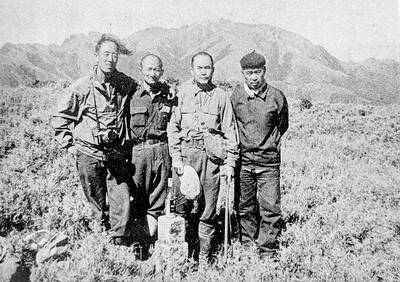
May 18 to May 24 Gathered on Yangtou Mountain (羊頭山) on Dec. 5, 1972, Taiwan’s hiking enthusiasts formally declared the formation of the “100 Peaks Club” (百岳俱樂部) and unveiled the final list of mountains. Famed mountaineer Lin Wen-an (林文安) led this effort for the Chinese Alpine Association (中華山岳協會). Working with other experienced climbers, he chose 100 peaks above 10,000 feet (3,048m) that featured triangulation points and varied in difficulty and character. The list sparked an alpine hiking craze, inspiring many to take up mountaineering and competing to “conquer” the summits. A common misconception is that the 100 Peaks represent Taiwan’s 100 tallest

In a sudden move last week, opposition lawmakers of the Chinese Nationalist Party (KMT) and Taiwan People’s Party (TPP) passed a NT$780 billion special defense budget as a preemptive measure to stop either Chinese leader Xi Jinping (習近平) or US President Donald Trump from blocking US arms sales to Taiwan at their summit in Beijing, said KMT heavyweight Jaw Shaw-kong (趙少康), speaking to the Taipei Foreign Correspondents Club on Wednesday night in Taipei. The 76-year-old Jaw, a political talk show host who ran as the KMT’s vice presidential candidate in 2024, says that he personally brokered the deal to resolve

The Chinese Nationalist Party (KMT), alongside their smaller allies the Taiwan People’s Party (TPP), are often accused of acting on behalf of the Chinese Communist Party (CCP). Some go so far as to call them “traitors.” It is not hard to see why. They regularly pass legislation to stymie the normal functioning of the ruling Democratic Progressive Party’s (DPP) administration, and they have yet to pass this year’s annual budget. They slashed key elements of the government’s proposed NT$1.25 trillion (US$40 billion) special military budget, and in the smaller NT$780 billion package they did pass, it is riddled with provisions that


 RSS
RSS