


Taipei Mayor Chiang Wan-an (蔣萬安) announced last week a city policy to get businesses to reduce working hours to seven hours per day for employees with children 12 and under at home. The city promised to subsidize 80 percent of the employees’ wage loss. Taipei can do this, since the Celestial Dragon Kingdom (天龍國), as it is sardonically known to the denizens of Taiwan’s less fortunate regions, has an outsize grip on the government budget.
Like most subsidies, this will likely have little effect on Taiwan’s catastrophic birth rates, though it may be a relief to the shrinking number of people with kids. Announced in the lead up to November’s nine-in-one elections, it instead appears to be the usual case of buying private votes with public dollars.
Taipei houses 24 percent of the nation’s seniors, who constitute 20 percent of the population at present. With the rising number of seniors, how long can Taiwan and its local governments keep finding the money to invest in luxuries like programs aimed at families with children?
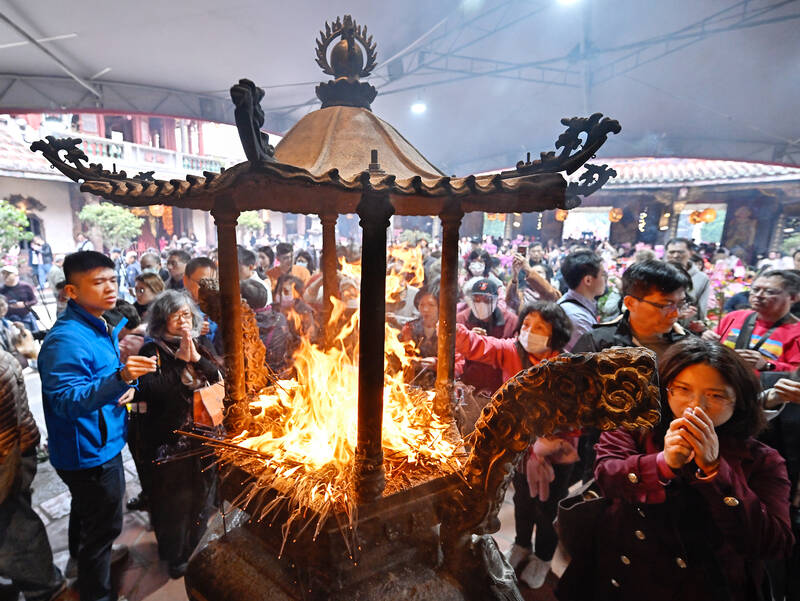
Photo: Chen Chih-chu, Taipei Times
According to Directorate-General of Budget, Accounting and Statistics (DGBAS) estimates, Taiwan’s social protection expenditure (SPE) in 2024 was NT$2.63 trillion (US$80.89 billion). Essentially all of it, 98.6 percent, goes to social benefits. Of that sum, old-age benefits constituted 46.9 percent (NT$1.22 trillion), a sum roughly twice the size of the defense budget (Roughly NT$600 billion when supplemental funding is included). DGBAS said this was driven by a greater number of people retiring and collecting benefits, and predicts this expenditure will only grow.
This threat is not stopping the expansion of programs for the elderly at the local level. The Miaoli County Government in February last year announced a program that uses NT$385 million (US$12 million) in stamp tax revenue (derived from fees for official stamps on documents) to pay for National Health Insurance (NHI) premiums for the county’s 25,000 residents aged 80 and above. The program was developed to ease the burden on younger members of the families of this group, who often pay the health fees. Similarly, Taipei announced last year it would double the size of the New Year handout for elders over 85.
Taiwan’s working age population peaked in 2015. Deaths are now exceeding births. By 2037, half the workforce will be over 45 and headed to retirement. Around 100,000 babies were born last year, and this year the total will likely slip below 100,000.
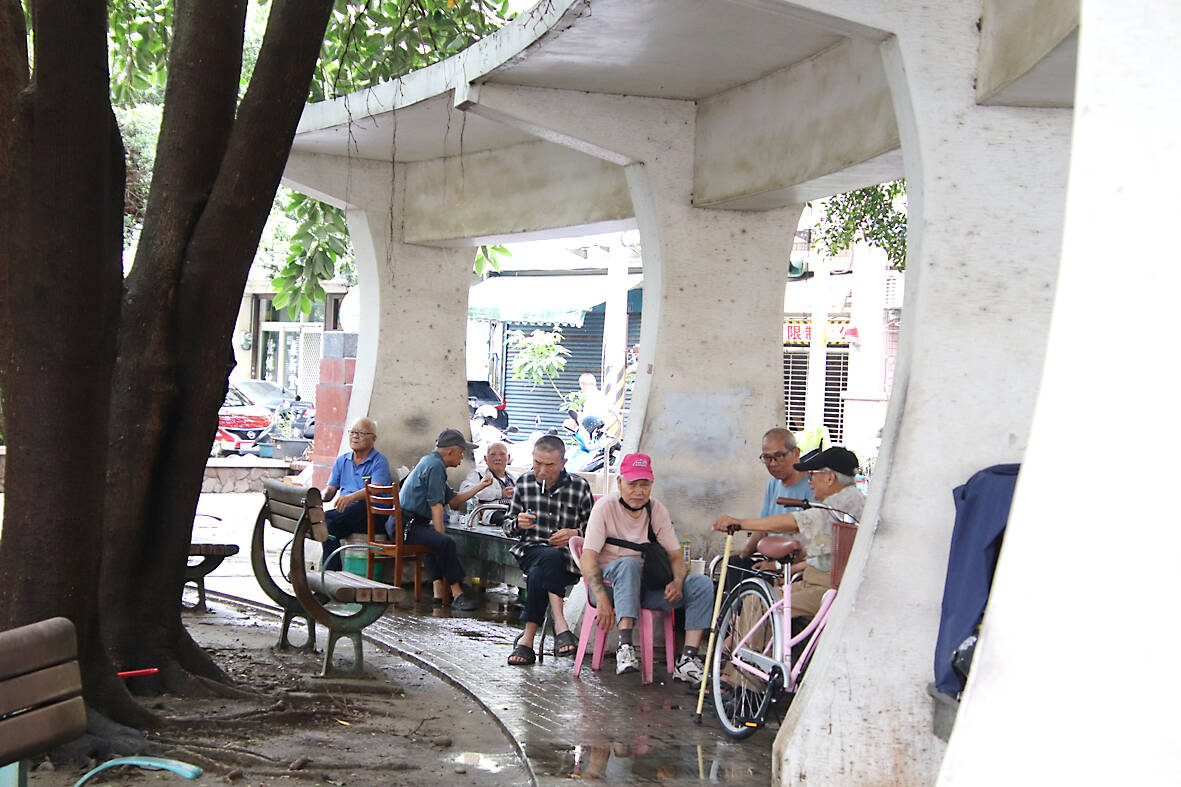
Photo: Huang Mei-chu, Taipei Times
The ratio of the number of people 65 and over to the overall 15-64 population, known as the dependency ratio, is skyrocketing. National Development Council (NDC) estimates show that figure will be 36 percent in 2030, rising to 56 percent by 2044 when the 100K babies born this year hit adulthood. That means in 2044 there will be 56 elderly for every 100 workers.
As a 2023 review paper from the Chung-hua Institution for Economic Research put it, “the current pension system in Taiwan is financed mostly by a pay-as-you-go system through intergenerational transfers.” Hence, the burden of payment falls on the working population. Pension reform is thus absolutely critical in enabling the government to maintain solvency in the coming years.
The spending issue is old, and driven in part by democratization. From 1955 to 1980, the Chung-Hua paper recounts, defense spending was the largest budget outlay. After 1990, social spending began to outstrip it, driven by the competitive party dynamics under which the Chinese Nationalist Party (KMT) and the Democratic Progressive Party (DPP) sought to outbid each other for votes with increases in social spending.
This understanding illuminates the behavior of the KMT in the legislature and its demand that pensions for police, firefighters and other traditional recipients of KMT pork-barrel largesse be restored. The previous administration of Tsai Ing-wen (蔡英文) carried out pension reforms, in order to maintain the government’s fiscal solvency. The KMT’s demand that its traditional constituencies be handed higher pensions, effectively rolling back Tsai’s pension reforms, should not be seen as mere vote buying with public dollars, but part of its larger program to wreck governance in Taiwan by ruining government solvency and limiting its ability to spend money elsewhere.
Note that the increase in the elderly is a double-whammy to the budget. Not only does the government spend more on the aged, but tax revenues fall as the population ages. Another issue that will affect government revenues is the “asset meltdown hypothesis,” currently hotly contested among economists. Decades ago it was proposed that as the Boomer generation aged and sold off its assets such as real estate and stocks, their prices would collapse. Unfortunately most of the work on this has been done in the US, where markets are smart and probably price this effect in. But Taiwan’s domestic economy is heavily dependent on high home prices and on real estate.
Spending on the elderly has another effect.
“As populations age, the political power of elderly citizens strengthens, leading to higher taxes and a reallocation of budgets from public investment toward current welfare,” observes a paper in the journal Economic Modeling.
The Financial Times pointed out recently that across major economies, rising government spending on the elderly is pushing down public investment. Public investment drives growth and provides a foundation for innovation. Old people want spending on current health and welfare, not on the future. Indeed, President William Lai (賴清德) announced in November last year that the national health insurance program budget would reach NT$1 trillion (US$31 billion) this year. That’s an annual sum three-fourths the size of the special defense budget.
It is intuitively, if absurdly, obvious that if the NHI and social services budgets (currently exceeding NT$2 trillion) continue to increase, at some point the entire government budget will consist of medical and services expenditures for old people. This is especially true if spending continues to rise without concomitant tax increases.
This should be highlighted in the coming debates: as always, hidden behind this or any of the looming fiscal disasters the government faces is the unspoken agreement of the major parties that there will be no new taxes, especially on the rich. Instead, the government is encouraging employers to continue to permit people to work past the age of 65, though businesses can still refuse under the current law and force workers to retire. Track that: the government would rather have old people breaking their bodies working than properly tax the economy.
The irony of this is that so much of the nation’s wealth in the last two decades has gone disproportionately to its seniors, whose real estate holdings, as this column has ceaselessly documented, remain only lightly taxed. Not only would proper taxation force people to put properties on the market and gently lower housing prices, but it would provide a fiscal boost desperately needed by local governments.
Remember the tax issue whenever politicians speak of “reform” of the working age and similar.
Notes from Central Taiwan is a column written by long-term resident Michael Turton, who provides incisive commentary informed by three decades of living in and writing about his adoptive country. The views expressed here are his own.

Yesterday, the Democratic Progressive Party (DPP) nominated legislator Puma Shen (沈伯洋) as their Taipei mayoral candidate, the Chinese Nationalist Party (KMT) put their stamp of approval on Wei Ping-cheng (魏平政) as their candidate for Changhua County commissioner and former legislator Tsai Pi-ru (蔡壁如) of the Taiwan People’s Party (TPP) has begun the process to also run in Changhua, though she has not yet been formally nominated. All three news items are bizarre. The DPP has struggled with settling on a Taipei nominee. The only candidate who declared interest was Enoch Wu (吳怡農), but the party seemed determined to nominate anyone
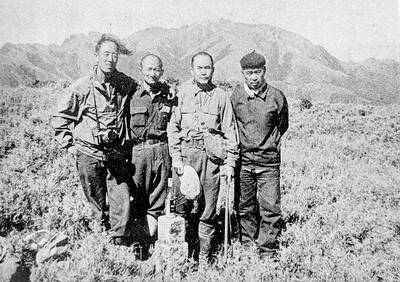
May 18 to May 24 Gathered on Yangtou Mountain (羊頭山) on Dec. 5, 1972, Taiwan’s hiking enthusiasts formally declared the formation of the “100 Peaks Club” (百岳俱樂部) and unveiled the final list of mountains. Famed mountaineer Lin Wen-an (林文安) led this effort for the Chinese Alpine Association (中華山岳協會). Working with other experienced climbers, he chose 100 peaks above 10,000 feet (3,048m) that featured triangulation points and varied in difficulty and character. The list sparked an alpine hiking craze, inspiring many to take up mountaineering and competing to “conquer” the summits. A common misconception is that the 100 Peaks represent Taiwan’s 100 tallest

In a sudden move last week, opposition lawmakers of the Chinese Nationalist Party (KMT) and Taiwan People’s Party (TPP) passed a NT$780 billion special defense budget as a preemptive measure to stop either Chinese leader Xi Jinping (習近平) or US President Donald Trump from blocking US arms sales to Taiwan at their summit in Beijing, said KMT heavyweight Jaw Shaw-kong (趙少康), speaking to the Taipei Foreign Correspondents Club on Wednesday night in Taipei. The 76-year-old Jaw, a political talk show host who ran as the KMT’s vice presidential candidate in 2024, says that he personally brokered the deal to resolve
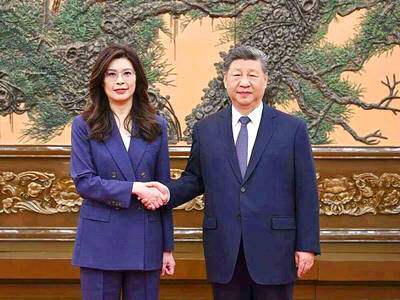
The Chinese Nationalist Party (KMT), alongside their smaller allies the Taiwan People’s Party (TPP), are often accused of acting on behalf of the Chinese Communist Party (CCP). Some go so far as to call them “traitors.” It is not hard to see why. They regularly pass legislation to stymie the normal functioning of the ruling Democratic Progressive Party’s (DPP) administration, and they have yet to pass this year’s annual budget. They slashed key elements of the government’s proposed NT$1.25 trillion (US$40 billion) special military budget, and in the smaller NT$780 billion package they did pass, it is riddled with provisions that


 RSS
RSS