


The media world we live in is of recent evolution, a construction of the desire of the Chinese Nationalist Party (KMT) to control the media in Taiwan. For example, the National Communications Commission (NCC) was established by the KMT-controlled legislature in 2006, under Democratic Progressive Party (DPP) president Chen Shui-bian (陳水扁). Its purpose was to circumvent the central government’s oversight of the media via its control of the Government Information Office (GIO), which had long been the KMT’s media overseer during the one-party state era.
Under KMT president Ma Ying-jeou (馬英九), the GIO was shut down and its personnel scattered across the government. Ma established the Central News Agency (CNA) as the government media platform. The NCC remained to steer private media. It blocked the acquisition of local media by mogul Jimmy Lai (黎智英), a strong voice against the authoritarian People’s Republic of China (PRC). When Lai’s Next Media attempted to open a news channel, it was blocked by the NCC. When it tried to get around that by opening an Internet-only channel, the KMT-controlled legislature immediately began to consider legislation to control the Internet.
When the NCC was established in 2006 its commissioners were originally apportioned according to the ratio of party control of the legislature. However, the Constitutional Court in 2008 ruled that agencies should function with greater coordination from the executive. The Executive Yuan has since then sent a list of nominees, who are supposed to be neutral experts, for approval by the legislature. In practice this has eroded the independence of the NCC.
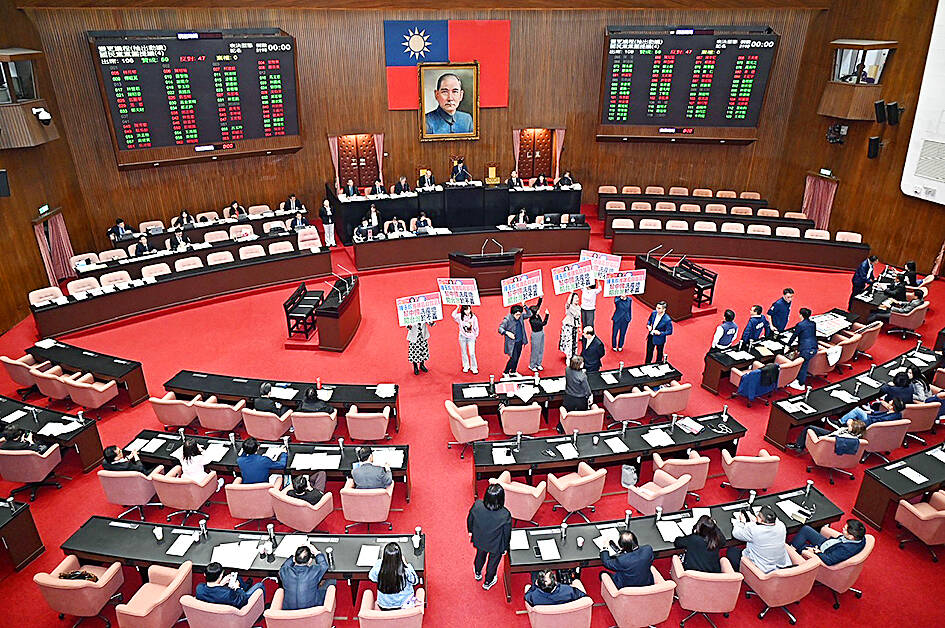
Photo: TT file photo
That is why one of the current KMT-controlled legislature’s first moves was against the NCC. The legislature last year passed an amendment that banned commissioners from serving more than two terms or serving an extended term. It came into effect on Nov. 1 last year. The amendment forced the acting chair to resign, leaving the NCC with only three active members, insufficient to form a quorum. The KMT-controlled legislature last month blocked the government’s nominees to fill the remaining seats.
At present the NCC, its authority eviscerated, has only an advisory role. It has been unable to rule on a case since December of last year. According to an editorial in this paper, it has 431 major cases before it.
Two recent cases indicate how the NCC’s governance ability has disappeared. Apparently Mirror TV has been attempting to establish a political talk show featuring former president Chen. The show is a rumor but the NCC has warned Mirror TV that it cannot establish the show without NCC approval, and will face fines if it does. Mirror TV had applied last year to establish such a program, but the NCC has no quorum and could not make a judgment on the request.
Not content with gutting the NCC’s ability to function, when CTi News (中天新聞台) wanted its news channel reinstated (it had been shut down in 2020 by the NCC) this month, KMT legislators proposed amendments to the laws that required the NCC to renew licenses of news channels by default, thus rendering the NCC a rubber stamp. The effect would be to reduce governance.
The general KMT push to degrade governance was also highlighted this month in the introduction of bills into the legislature by KMT Legislator Chen Yu-jen (陳玉珍) proposing amendments to the Organic Act of the Legislative Yuan (立法院組織法) and Regulations on Allowances for Elected Representatives and Subsidies for Chiefs of Village (地方民意代表費用支給及村里長事務補助費補助條例) that would enable legislators and local councilors to use their allowances without providing invoices for reimbursement.
This is not new. In the old KMT authoritarian days more that 6,500 public officials had access to “special funds,” half of which they could use but need not submit receipts for. Many officials kept them as informal salary. That legislation was thus a throwback to the bad old days of systemic corruption. When former president Ma was put on trial for diverting NT$11 million from his Taipei City special funds to his private accounts when he was mayor, his defense was not that he didn’t do it. Rather, he argued, essentially, that everyone did it, and that official theft of the funds was in fact the government’s intended income subsidy for officials (a Tainan court had upheld that position in a previous case).
This systemic corruption had two political functions. First, it co-opted local officials into the KMT’s system, and second, it provided a ready excuse in case the KMT government needed to prosecute a local official.
Chen Yu-jen’s bill is actually worse than the original “special funds” program: it exempts all the funds from receipts, not just half. The local press has speculated that the intent of the bill is to save KMT officials who are currently under criminal investigation for misusing allowances. That is no doubt one motivation, but the bill would engender widespread petty corruption at the local level, degrading governance across the nation. It is thus clearly an attack on governance in general, fitting into the general pattern of KMT attacks on the administration of President William Lai (賴清德).
The media reported on Monday that the KMT had shelved the bill due to public outcry and opposition from legislators and staff. The Taipei Times reported that KMT legislators had discussed the matter, and “that no decision was made on “suspending the proposal” or “deciding not to suspend the proposal.” There was thus widespread speculation in the pan-Green media that it would simply revive the bill at a later point, such as the end of the current legislative session “when there is always a rush of bills passed,” as a long-time observer of Taiwan politics pointed out to me. Hence, the Liberty Times, Taipei Times’ sister paper, has kept the proposed legislation front-and-center in its reporting this week.
The KMT’s legislative assault on governance has several prongs. Where oversight bodies such as the NCC or the Constitutional Court exist, it guts their functioning by impairing their ability to form a quorum, or defunding them (Control Yuan). Where agencies exist to raise Taiwan’s profile, such as TaiwanPlus News (in English, aimed at a global audience), or the Ministry of Foreign Affairs (MOFA), it defunds them (the MOFA budget was initially slashed). When agencies have wide public reach, such as public TV and the Ministry of Agriculture, they also face defunding. When private actors threaten to circumvent oversight (or KMT supporting entities need to), the KMT proposes specific legislation aimed at them. Though it is sometimes hard to grasp, the overall pattern is clear, and deeply threatening.
Notes from Central Taiwan is a column written by long-term resident Michael Turton, who provides incisive commentary informed by three decades of living in and writing about his adoptive country. The views expressed here are his own.

Taiwan’s English education system is being pulled apart by three opposing forces. Bilingual Nation 2030 pulls students toward English and global communication. Artificial Intelligence (AI) readiness pulls them toward digital judgment, verification and AI-mediated work. But Taiwan’s old exam culture pulls them back toward memorization, grammar drills, timed reading and correct answers. If the education system keeps using old exams to define success, it risks producing graduates who are neither genuinely bilingual nor genuinely AI-ready, but trained for tasks machines can already perform. The first force is Bilingual Nation 2030. Launched in 2018, the policy aimed to “help Taiwan’s workforce connect

It seems every few days one bumps into one of those “real man” comments in which Taiwan is urged to “face reality” or similar, and “make a deal,” with the speaker implying that soon it will be too late. “Deal” advocates always present themselves as having a superior grip on reality, and the manly ability to make the “hard choice.” Their testosterone-laden language often echoes that of Taiwan sellout advocates. Note that such commentary always specifies a process (“make a deal, work with, make progress”), never the end state of what occupation by a violent authoritarian colonialist state will entail. In
June 1 to June 7 "If all Taiwanese were as afraid of dying as you, then what would happen?” Physician Shih Chiang-nan (施江南) reportedly said this to his wife Chen Chiao-tung (陳焦桐) after she urged him to stop intervening on behalf of Taiwanese soldiers stranded overseas after serving in the Japanese Army during World War II. Shih had clashed with high-ranking officials over the issue, engaged in several heated arguments with Taiwan governor-general Chen Yi (陳儀) and allegedly shouted at general Ko Yuan-fen (柯遠芬), chief of staff of the Taiwan Garrison Command, over

“Taiwan’s Opposition Leader Comes to US With a Message Straight Out of Beijing” read a May 31 headline in the Wall Street Journal. Top US administration officials and members of Congress almost certainly read the WSJ, and if there was a bullet point takeaway that people in Washington should absorb ahead of Chinese Nationalist Party (KMT) Chair Cheng Li-wun’s (鄭麗文) arrival in DC on June 9, that headline is it. The last few columns have discussed this very topic, and the timing is not coincidental. While those top officials likely do not read the Taipei Times, judging by the number


 RSS
RSS