


Last week writer Wei Lingling (魏玲靈) unloaded a remarkably conventional pro-China column in the Wall Street Journal (“From Bush’s Rebuke to Trump’s Whisper: Navigating a Geopolitical Flashpoint,” Dec 2, 2025). Wei alleged that in a phone call, US President Donald Trump advised Japanese Prime Minister Sanae Takaichi not to provoke the People’s Republic of China (PRC) over Taiwan. Wei’s claim was categorically denied by Japanese government sources.
Trump’s call to Takaichi, Wei said, was just like the moment in 2003 when former US president George Bush stood next to former Chinese premier Wen Jia-bao (溫家寶) and criticized former president Chen Shui-bian (陳水扁) for holding a referendum.
Trump’s alleged advice to Takaichi was indeed just like that moment when Bush and Wen stood together, which was a bad decision by the US to help Beijing suppress Taiwan and public encouragement to Beijing, with the US playing along with its talking points, as well as a public rebuke of a badly needed ally.
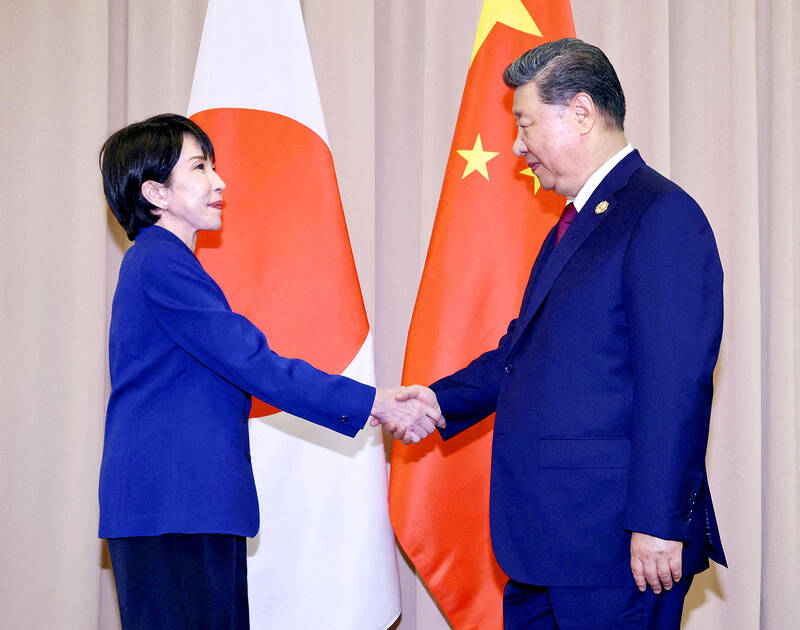
Photo: Reuters
Describing Chen’s promotion of the “defensive” referendum on the PRC missile threat in the 2004 election, Wei wrote that both Washington and Beijing saw it as a move that could alter the status quo, “crossing a Chinese red line and risking war.”
Skipping over the ridiculous claim that in 2003 there was a real possibility of war — let alone over a referendum — Wei presents the concept of red lines as something the reader should be concerned about. In discussions of a fraught geopolitical relationship studded with ill-defined, nebulous catchphrases such as “status quo,” strategic ambiguity” and “declare independence,” “red lines” stands out for both its inherent pro-Beijing slant and utter lack of definition.
Indeed, much of the effectiveness of the concept of red lines lies in the way its meaning is concealed by the writers and speakers who deploy it. What is the purpose of identifying red lines?
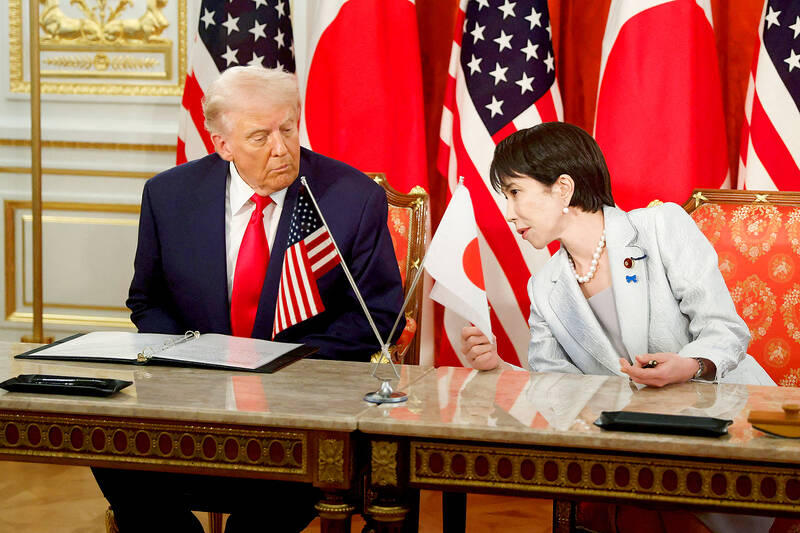
Photo: Reuters
IMAGINARY LINES
First, it should be noted that the referendum that marked a red line according to Wei was actually held (it failed to meet the threshold). What was the response of the PRC? Beijing did nothing. Wei withholds that fact from readers because it destroys her point about Bush (and Trump) saving the situation. If Beijing doesn’t react, then the red line is imaginary. It never existed.
“Nothing” is in fact the PRC’s normal response to its alleged red lines. For years we were told US troops in Taiwan were a red line. They are here in Taiwan, training Taiwanese to fight. Beijing has done nothing. President-elect Trump and then-president Tsai Ing-wen (蔡英文) had a phone call in 2016. The world commentariat blew up. “This is how wars start,” screamed one well known US TV commentator.
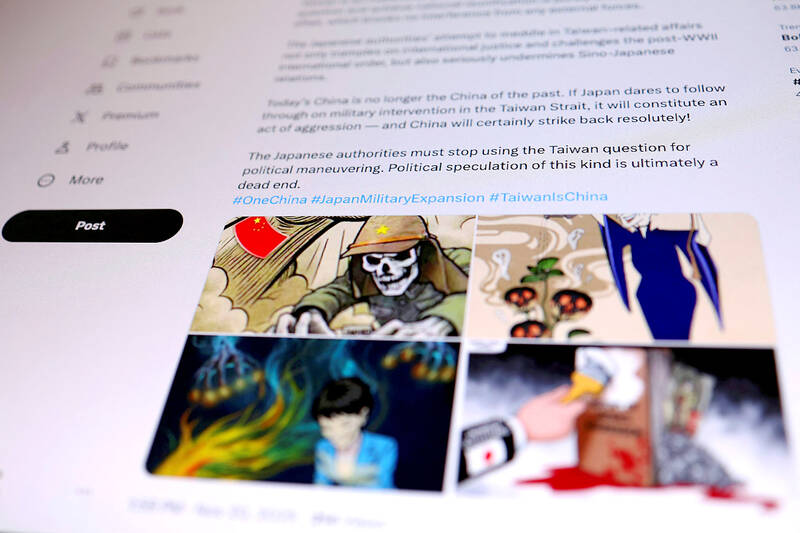
Photo: Reuters
Reality: the Trump-Tsai call was just another evanescent red line crossed. Nothing happened. Beijing threw a tantrum, as usual, encouraged by the overwrought US media response. Indeed, it would be tedious to list all the red lines that have been crossed over the years without subsequent comment or action by the PRC.
PRC red lines evaporate when crossed. They shift constantly, like reflections in ocean waves, appearing and disappearing, without effect or consequence. They are more rhetoric than reality.
PLAYING THE VICTIM
The Wei piece beautifully illustrates a key function of the undefined concept of red lines: they remove agency from Beijing, and place it only on Beijing’s victims. Identifying something as a “red line” is inherently pro-PRC because it implies that the targets of PRC aggression must make meaningful (and accommodating) changes in their behavior, since Beijing will not. After all, poor put-upon Beijing just can’t help itself. Red lines, you know.
Red lines thus function as constraints on other actors, especially Taiwan, but never on Beijing. Each red line marks a boundary that cannot be crossed, limiting the actions of nations resisting PRC territorial expansion and aggression.
When a red line disappears, analysts and media workers invariably act as if it never existed, never referring to it again. When has the reader ever seen a piece reporting on a time Taiwan crossed a red line and nothing happened?
Yet, despite the implications of red lines regularly forwarded by commentators, the PRC has full agency. Beijing could have laughed at Takaichi and said it regretted her words, and then sent another 100,000 tourists to Japan and increased purchases of Japan’s exports. We are just lucky the PRC prefers tantrums to soft power.
Red lines are linked to Beijing’s deployment of “anger” to manage the foreign policy of other nations, and the people who write about it. Many times this writer has commented that fomenting tensions and displaying anger are strategic policy for Beijing. Such behavior enables the PRC to transfer tensions from the US-PRC relationship to the US-Taiwan relationship, a key goal of PRC policy. In this case, they are deployed against Takaichi to transfer tensions between the PRC and Japan to the US-Japan relationship.
That is one reason Beijing has adopted the tantrum-as-strategy approach against Takaichi. Tantrums are a policy that helps convince observers that red lines exist. They also alert Beijing’s supporters in the media that they should be talking about the offenses that poor, put-upon Beijing is suffering. They then shape the way media workers write and think about Beijing’s behavior.
BACKING DOWN
After a given event, when a tantrum fails and a putative red line is ignored, Beijing normally does nothing. As I write, Beijing appears to be searching for a way to back down from its confrontation with Takaichi. Despite this cycling of tensions, perfectly normal for Beijing, international media commentators will continue to go dowsing for Beijing’s red lines, the ley lines of East Asian geopolitics.
Another feature of red lines is that only the PRC is permitted to have them. For PRC supporters, a mere democratic referendum can alter the never-defined, but always-invoked status quo and “cross a red line.” By contrast, the PRC’s military build-up and aggression can never cross a red line for the nations around the PRC. Takaichi in fact clearly indicated a red line for Japan: a PRC invasion of Taiwan would be an existential threat to Tokyo. Yet, despite the extensive commentary on Takaichi’s statement, few writers described Japan’s response as a red line for Tokyo. That vocabulary is reserved for Beijing.
Moreover, the idea of red lines focuses media attention on Beijing’s demands rather than on the victims of its aggression. Identifying an action as a red line provides instant tension-driven clickbait for international media hyping of tensions in East Asia. This stereotyped, automated forwarding of PRC stances and narratives in the Western media harms democratic states and cedes the information ecosphere to the PRC.
Because red lines make Beijing’s agency and actions disappear, they help the PRC create a media fantasy world where Taiwan’s leaders are presented as a clutch of madmen rattling their pro-independence chains, who could “declare independence” at any time and start a war. Red lines shift the onus onto Taiwan (and Japan). In the real world, only the PRC is pursuing a war, and only its actions and aggression are the causes of tension.
The concept of PRC “red lines” short-circuits analytical thought and is inherently pro-PRC. It should never be used to describe or explain PRC behavior.
Time for it to disappear.
Notes from Central Taiwan is a column written by long-term resident Michael Turton, who provides incisive commentary informed by three decades of living in and writing about his adoptive country. The views expressed here are his own.
The arithmetic is straightforward and uncomfortable. By the end of 2025, Taiwan had committed itself to a 50-30-20 electricity mix — half natural gas, 30 per cent coal, 20 per cent renewables. The Ministry of Economic Affairs’s (MOEA) own monthly energy reports tell a different story. Natural gas reached 47.8 per cent of generation last year. Coal stood at 35.4 per cent, comfortably above its target ceiling. Renewables came in at 13.1 per cent, well short of the 20 per cent Taipei had pledged a decade earlier. Installed renewable capacity reached roughly half of the 12 gigawatts (GW) the government
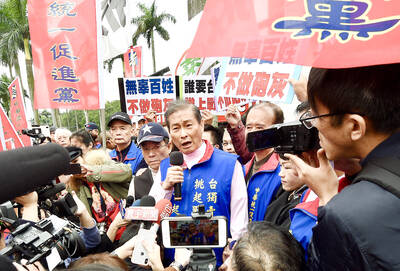
There are shadowy cabals plotting to sell out Taiwan to be annexed by China, by invasion if necessary. Fortunately, they are buffoons. In 2019, former Bamboo Union gangster and founder of the China Unification Promotion Party (CUPP), Chang An-le (張安樂, colorfully known as “White Wolf”), led a protest at the Legislative Yuan against comments made by then-premier Su Tseng-chang (蘇貞昌) that in the event of an attack by China, he would never surrender, but would protect the nation by fighting to the end, even if he only had a broom. Chang had party members bring a wooden casket that they

Taiwan’s drone exports are taking off, fuelled by the war in Ukraine, as Taiwanese companies seek a stake in the fast-growing global market for unmanned aerial vehicles (UAV). Low-cost drones used for reconnaissance and strikes are in high demand as governments around the world boost defense spending in the face of intensifying conflicts. A relative new player in the increasingly competitive industry, Taiwan’s pitch is to be an “Asian hub” for the production of UAVs and components free of Chinese materials, or “non-red.” That means its UAVs can be up to three times more expensive than their Chinese competitors, like the world’s biggest

It seems every few days one bumps into one of those “real man” comments in which Taiwan is urged to “face reality” or similar, and “make a deal,” with the speaker implying that soon it will be too late. “Deal” advocates always present themselves as having a superior grip on reality, and the manly ability to make the “hard choice.” Their testosterone-laden language often echoes that of Taiwan sellout advocates. Note that such commentary always specifies a process (“make a deal, work with, make progress”), never the end state of what occupation by a violent authoritarian colonialist state will entail. In


 RSS
RSS