


We lay transfixed under our blankets as the silhouettes of manta rays temporarily eclipsed the moon above us, and flickers of shadow at our feet revealed smaller fish darting in and out of the shelter of the sunken ship. Unwilling to close our eyes against this magnificent spectacle, we continued to watch, oohing and aahing, until the darkness and the exhaustion of the day’s events finally caught up with us and we fell into a deep slumber.
Falling asleep under 1.5 million gallons of seawater in relative comfort was undoubtedly the highlight of the weekend, but the rest of the tour organized by the staff at the National Museum of Marine Biology & Aquarium in Pingtung County was entertaining, informative and efficient, which made the relatively high price tag seem quite reasonable.
All overnight guests get a guided tour of their building, a behind-the-scenes view of where staff access and maintain one of the large tanks, a chance to feed fish and manta rays by hand, a tour of the aquarium’s tanks in the dark of night, a private viewing of a scuba diver feeding sharks, rays and fish by hand, a guided visit to the intertidal zone, DIY craft time and an interactive educational seminar. It’s little wonder we were already so tired the first evening.
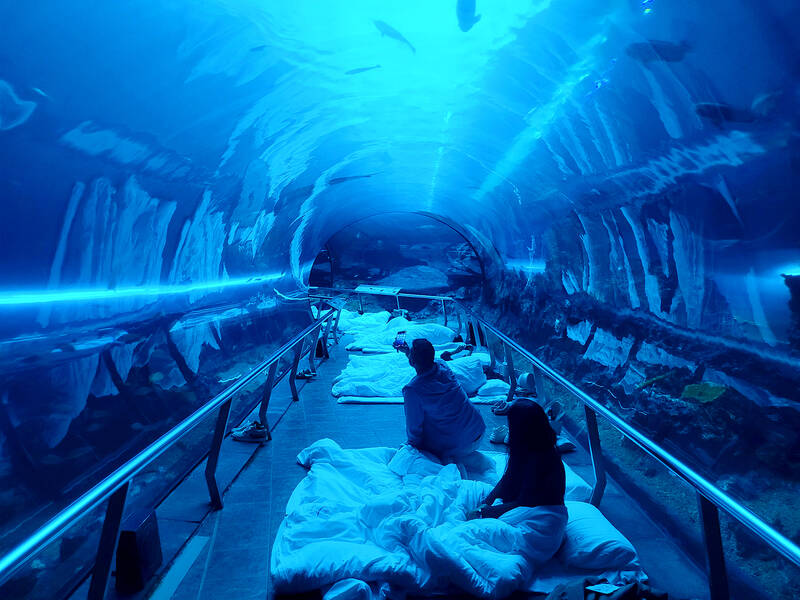
Photo: Tyler Cottenie
AN ACTION-PACKED AFTERNOON
Our first day was even longer, as our package started with an additional tour outside the aquarium. In the afternoon, we visited the nearby Longshuei Village (龍水里), an area known for its clean, natural spring water and organic rice farming.
We were taught about the different types of rice and their uses, and guided in making our own red turtle cakes (紅龜粿). Then, as the cakes were being steamed, we went for a walk outside, where our guide identified nearly every plant we passed and something interesting or useful about it. We tasted several edible seeds growing on what appeared to the untrained eye as simply roadside weeds, and had fun blowing on an empty seed pod to produce an ear-splitting whistle.
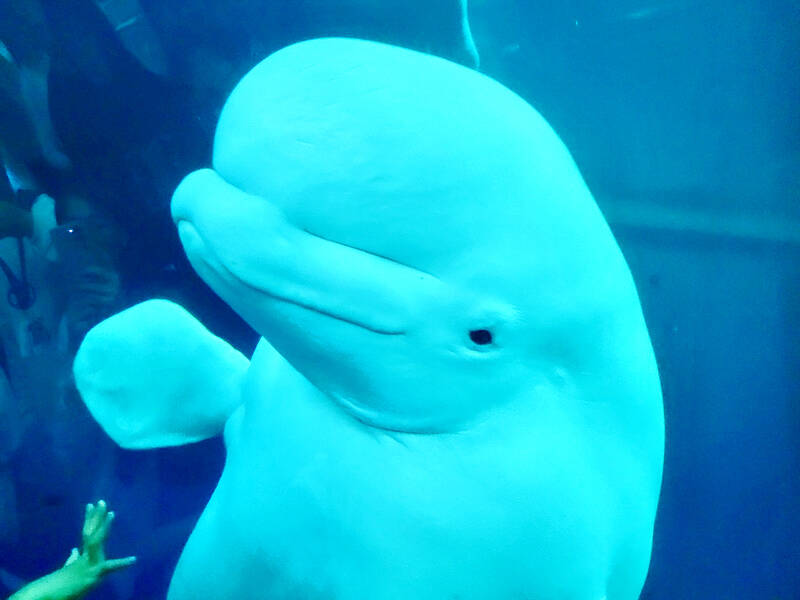
Photo: Tyler Cottenie
We then stepped into a narrow ditch where crystal-clear water from the Longshuei spring first starts flowing downhill. Digging in the sand at the bottom, our guide pulled up a variety of river snails that prefer this pristine environment. The rest of us managed to find a few on our own, but could not match the skill of our guide. This clean water source free of pesticide contamination is also the reason farmers are able to grow organic rice here.
Back at the aquarium, now that all of the other overnight guests had arrived, we were given a quick orientation and then split into groups. Our guide — different than the one who had gone with us in the afternoon, but equally enthusiastic and professional — took us on a guided tour of the Coral Kingdom Pavilion, and introduced us to the layout for our sleeping area, the Underwater Tunnel. Along the way we passed by the Beluga Tank and had a few minutes with these creatures all by ourselves, as the aquarium was already closed for the day.
OVERNIGHT EXCLUSIVES
Photo: Tyler Cottenie Photo: Tyler Cottenie
Buffet dinner with 250 other guests was efficiently delivered and with plenty of variety in food. Afterward, we stepped out into the lobby, now dark except for the glow of a few floodlights and echoing with the footsteps and subdued voices of the VIP overnight crowd. We split up into our smaller groups again to continue with a series of activities only available to those who stay overnight.
On the second floor of the Coral Kingdom Pavilion, we got a behind-the-scenes, surface-level view of the massive central tank, complete with sunken ship and tunnel down below where we would be sleeping that night. Our guide talked at length about how the aquarium is maintained and special protections for new marine life.
Before leaving, each guest was also given a handful of frozen baby shrimp and allowed to feed the fish and manta ray in a small subsidiary tank. This, and the following 45-minute break where guests were given modeling clay to create their own aquarium-inspired souvenirs, were especially popular with the younger visitors.
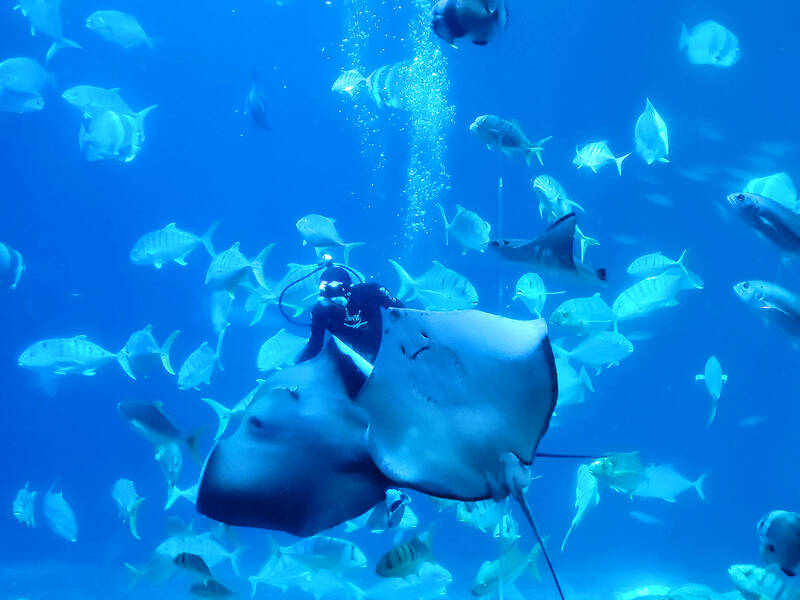
Photo: Tyler Cottenie
The final activity of the evening was another walk through the Coral Kingdom Pavilion, this time in the dark of night, an opportunity never afforded to daytime aquarium visitors. The tour ended at the Underwater Tunnel, where we selected our sleeping spots and laid out our blankets. We were then free to get washed up and head to bed whenever we were ready. Surprisingly, the shower stalls (clean and with hot water) were numerous enough that there was no queue at all.
After an excellent night’s sleep and an adequate breakfast, we got to watch a scuba diver enter the Waters of Taiwan tank and hand-feed fish, rays and sharks just before the aquarium opened to the public. A guided visit to the intertidal zone outside and a final educational seminar and interactive quiz for prizes rounded out the two-day tour. At this point, guests were free to leave, or spend another half-day exploring the rest of the aquarium on their own.
SIGNING UP
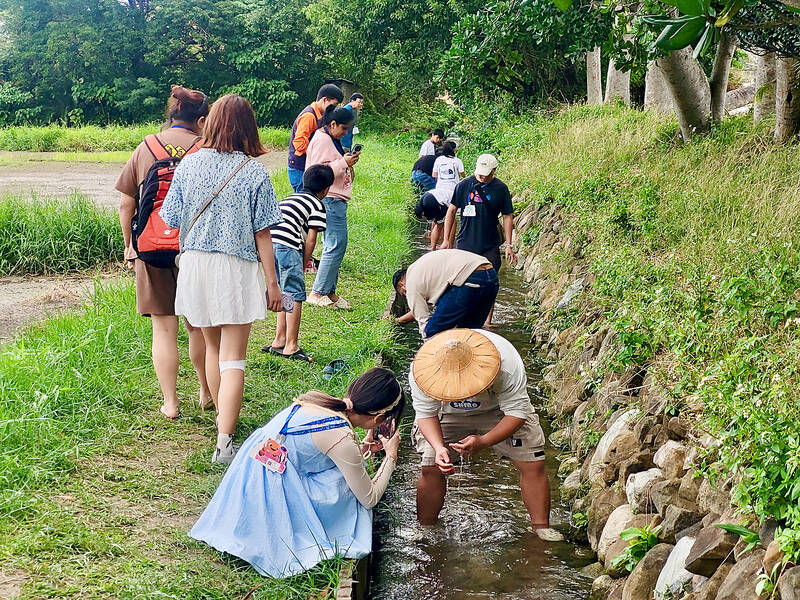
Photo: Tyler Cottenie
To sign up for the overnight experience, visit www.aquarium.com.tw/booking_b.asp, choose your sleeping location, and then select from the dates available. The booking website is, unfortunately, in Chinese only. However, museum staff do look carefully at who has signed up and confirm with guests by phone a week in advance. If there are guests who don’t speak Chinese but can understand English, they will do their best to assign an English-speaking guide to the group.
There is a minimum number of guests for each location, but this is not usually an issue on weekends. The more popular locations generally fill up completely on weekends two or three weeks in advance in the winter, and even earlier during school vacations. The earlier you book, the higher priority you have for choosing the exact place you want to sleep within your exhibit.
The packages for the three sleeping locations in the Coral Kingdom Pavilion (Underwater Tunnel, Beluga Tank and Sunken Ship Deck) always include an additional tour outside the museum. From March to June, visitors take a boat ride on the ocean with windows below deck allowing you to view the coral reef. From July to October, head to the coast at night to witness land crabs releasing their eggs into the ocean. From November to February, visit nearby Longshuei Village for the activities described above.
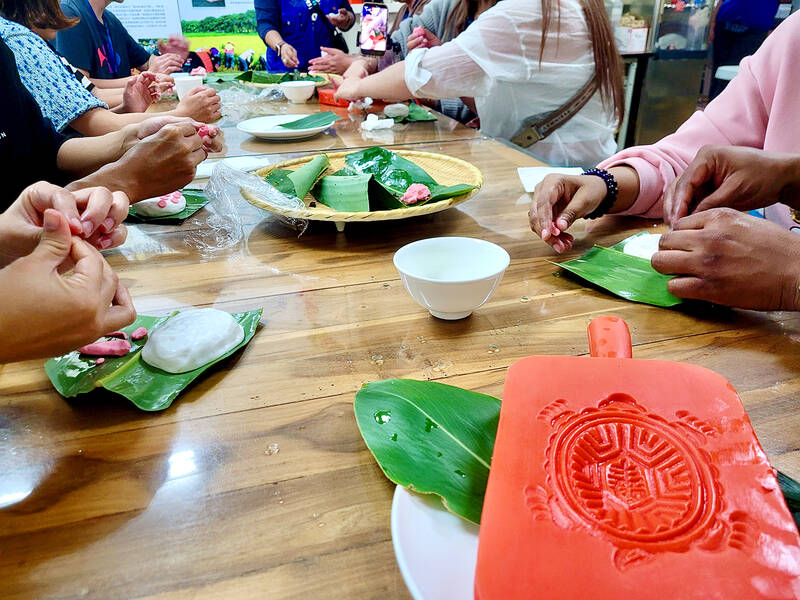
Photo: Tyler Cottenie
The package for the Penguin Exhibit includes the crab tour in June, and the boat tour in July and August. The packages for the Shark Tank and Kelp Forest include an inspection of the sea turtle rescue center, coral farm and blue whale specimen room from April through August. All other months and sleeping locations do not include any of these additional tours.
The basic cost for the overnight and aquarium tour package is NT$2,680 per adult, NT$1,340 for children under 6 and free for children under 3. For packages that include an additional tour as mentioned above, all guests aged 3 and up are charged an additional NT$700. All packages include dinner, breakfast, accommodation, showers, in-house tours mentioned in this article and two days’ admission to the aquarium. Parking is not included (NT$50 for cars) and guests should bring their own jackets (it’s quite cold indoors), towels, toiletries, snacks and water bottles.
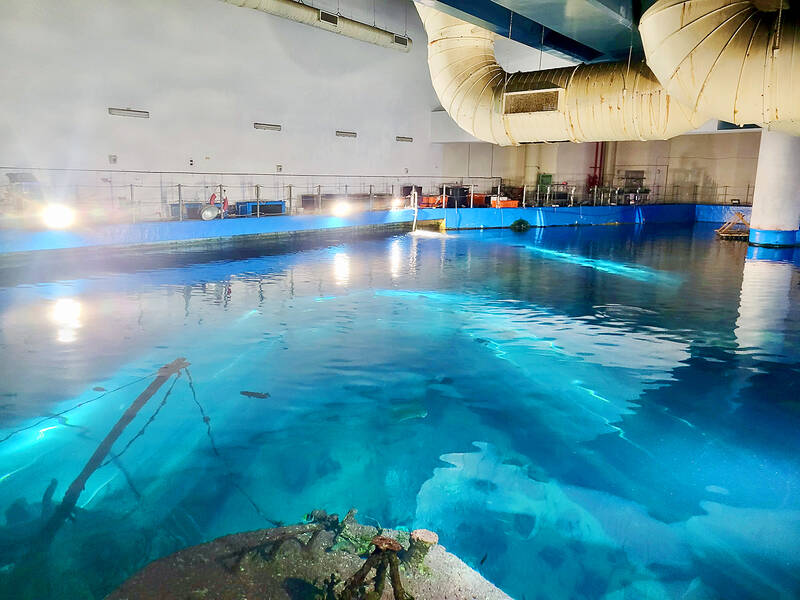
Photo: Tyler Cottenie

Taiwan’s overtaking of South Korea in GDP per capita is not a temporary anomaly, but the result of deeper structural problems in the South Korean economy says Chang Young-chul, the former CEO of Korea Asset Management Corp. Chang says that while it reflects Taiwan’s own gains, it also highlights weakening growth momentum in South Korea. As design and foundry capabilities become more important in the AI era, Seoul risks losing competitiveness if it relies too heavily on memory chips. IMF forecasts showing Taiwan widening its lead over South Korea have fueled debate in Seoul over memory chip dependence, industrial policy and

“China wants to unify with Taiwan at the lowest possible cost, and it currently believes that unification will become easier and less costly as time passes,” wrote Amanda Hsiao (蕭嫣然) and Bonnie Glaser in Foreign Affairs (“Why China Waits”) this month, describing how the People’s Republic of China (PRC) is playing the long game in its quest to seize Taiwan. This has been a favorite claim of many writers over the years, easy to argue because it is so trite. Very obviously, if the PRC isn’t attacking Taiwan, it is waiting. But for what? Hsiao and Glaser’s main point is trivial,
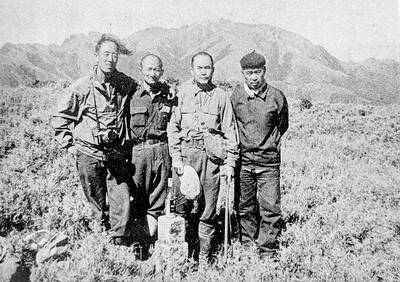
May 18 to May 24 Gathered on Yangtou Mountain (羊頭山) on Dec. 5, 1972, Taiwan’s hiking enthusiasts formally declared the formation of the “100 Peaks Club” (百岳俱樂部) and unveiled the final list of mountains. Famed mountaineer Lin Wen-an (林文安) led this effort for the Chinese Alpine Association (中華山岳協會). Working with other experienced climbers, he chose 100 peaks above 10,000 feet (3,048m) that featured triangulation points and varied in difficulty and character. The list sparked an alpine hiking craze, inspiring many to take up mountaineering and competing to “conquer” the summits. A common misconception is that the 100 Peaks represent Taiwan’s 100 tallest

Yesterday, the Democratic Progressive Party (DPP) nominated legislator Puma Shen (沈伯洋) as their Taipei mayoral candidate, the Chinese Nationalist Party (KMT) put their stamp of approval on Wei Ping-cheng (魏平政) as their candidate for Changhua County commissioner and former legislator Tsai Pi-ru (蔡壁如) of the Taiwan People’s Party (TPP) has begun the process to also run in Changhua, though she has not yet been formally nominated. All three news items are bizarre. The DPP has struggled with settling on a Taipei nominee. The only candidate who declared interest was Enoch Wu (吳怡農), but the party seemed determined to nominate anyone


 RSS
RSS