


As devices from toys to cars get smarter, gadget makers are grappling with a shortage of memory needed for them to work.
Dwindling supplies and soaring costs of Dynamic Random Access Memory (DRAM) that provides space for computers, smartphones and game consoles to run applications or multitask was a hot topic behind the scenes at the annual gadget extravaganza in Las Vegas.
Once cheap and plentiful, DRAM — along with memory chips to simply store data — are in short supply because of the demand spikes from AI in everything from data centers to wearable devices.
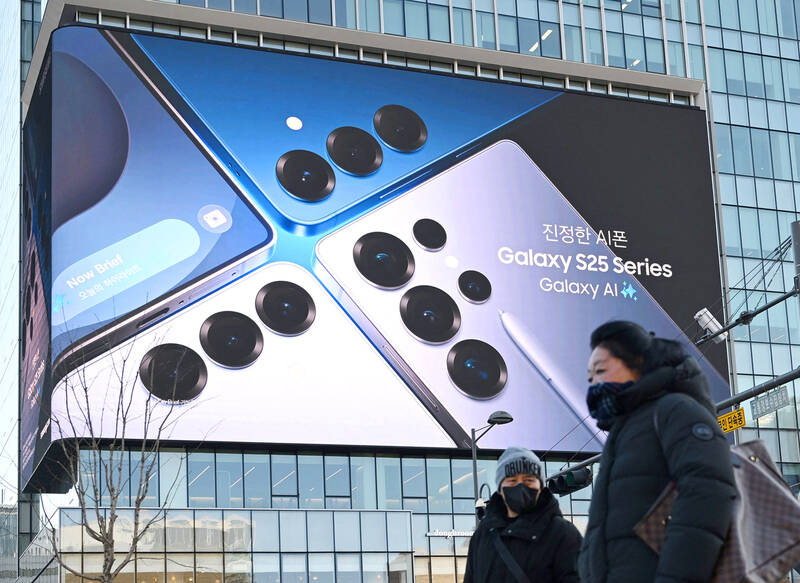
Photo: AFP
Samsung Electronics last week put out word that it expects sales revenue in the final quarter of last year to surge to 20 trillion won (US$13.81 billion) as prices of memory chips surge along with demand.
US-based Micron Technology, which makes advanced semiconductor memory and storage products, reported record revenue of US$13.6 billion in its last fiscal quarter, compared with US$8.7 billion in the same period a year earlier.
The revenue surge is fueled by an unprecedented memory chip shortage which, according to market tracker IDC, could persist well into next year. The reason for the shortfall cited by experts is that DRAM and memory chip makers have shifted manufacturing capacity to cater to AI data centers.
Meanwhile, AI features being added to all kinds of products have increased the need for DRAM and memory in devices from laptops to smart rings.
“An AI infrastructure boom has now rippled outward,” IDC analysts said in a blog post.
“For consumers and enterprises alike, this signals the end of an era of cheap, abundant memory and storage.”
Costs of computers, drives and memory cards have already risen for consumers, according to Other World Computing founder and chief Larry O’Connor.
SNIFF NOT BARK
Gadget makers are adapting to the shortage by either paying premiums for DRAM and memory, redesigning their products, or foregoing some features, according to Michal Siwinski of Arteris, which specializes in providing connectivity inside chips.
“Maybe the (robotic) dog you’ll get will sniff around and roll over, but it’s not going to bark a serenade because it doesn’t have enough memory,” Siwinski said.
The shortage is already forcing efficiencies such as engineers writing tighter code to use less memory, according to O’Connor.
“These aren’t bad things; they should have already happened,” O’Connor said.
“The entire industry has been built around cheap software that has become very bloated over the last 20 years.”
However, gadget makers must avoid their products underperforming due to memory compromises or pushing prices up too high by paying dearly for components, warned Techsponential analyst Avi Greengart.
“Here at CES we’re still seeing the usual claims that our thing is the best and damn the cost (of memory),” Greengart said on the show floor.
“However, if you spend time in suites talking to (device makers), retailers and component manufacturers” it’s clear features will be sacrificed to keep memory costs lower, according to Greengart.
AI SILICON NEXT?
The shortage is being watched warily by other sectors, particularly companies that rely on semiconductors needed to power AI.
These powerful semiconductors have “nothing to do” with DRAM, but companies are vigilant for any spillover effects, Infineon Technologies chief executive Jochen Hanebeck said.
The German semiconductor titan specializes in powering AI, a market where the computing needs are expected to skyrocket.
“Customers are asking about capacities, and I think they have seen the lessons learned on DRAM, and that’s why they are very mindful,” Hanebeck said.
“There is a good chance for a shortage; it is a real challenge to manage that supply chain.”

As mega K-pop group BTS returns to the stage after a hiatus of more than three years, one major market is conspicuously missing from its 12-month world tour: China. The omission of one of the group’s biggest fan bases comes as no surprise. In fact, just the opposite would have been huge news. China has blocked most South Korean entertainment since 2016 under an unofficial ban that also restricts movies and the country’s popular TV dramas. For some Chinese, that means flying to Seoul to see their favorite groups perform — as many were expected to do for three shows opening

Taiwan’s semiconductor industry consumes electricity at rates that would strain most national grids. Taiwan Semiconductor Manufacturing Co (TSMC) alone accounted for more than 9 percent, or 2,590 megawatts (MW), of the nation’s power demand last year. The factories that produce chips for the world’s phones and servers run around the clock. They cannot tolerate blackouts. Yet Taiwan imports 97 percent of its energy, with liquefied natural gas reserves measured in days. Underground, Taiwan has options. Studies from National Taiwan University estimate recoverable geothermal resources at more than 33,000 MW. Current installed capacity stands below 10 MW. OBSTACLES Despite Taiwan’s significant geothermal potential, the

The entire Li Zhenxiu (李貞秀) saga has been an ugly, complicated mess. Born in China’s Hunan Province, she moved to work in Shenzhen, where she met her future Taiwanese husband. Most accounts have her arriving in Taiwan and marrying somewhere between 1993 and 1999. She built a successful career in Taiwan in the tech industry before founding her own company. She also served in high-ranking positions on various environmentally-focused tech associations. She says she was inspired by the founding of the Taiwan People’s Party (TPP) in 2019 by Ko Wen-je (柯文哲), and began volunteering for the party soon after. Ko

Chinese Nationalist Party (KMT) Chair Cheng Li-wun (鄭麗文) returned from her trip to meet People’s Republic of China (PRC) dictator Xi Jinping (習近平) bearing “a gift” for the people of Taiwan: 10 measures the PRC proposed to “facilitate the peaceful development of cross-strait relations.” “China on Sunday unveiled 10 new incentive measures for Taiwan,” wrote Reuters, wrongly. The PRC’s longstanding habit with Taiwan relations is to repackage already extant or once-existing policies and declare that they are “new.” The list forwarded by Cheng reflects that practice. NEW MEASURES? Note the first item: establishing regular communication mechanisms between the Chinese Communist Party


 RSS
RSS