


A newly formed unit of the Marine Corps tasked with land-based security operations has recently replaced its aging, domestically produced rifles with more advanced, US-made M4A1 rifles, a source said yesterday.
The unnamed source familiar with the matter said the First Security Battalion of the Marine Corps’ Air Defense and Base Guard Group has replaced its older T65K2 rifles, which have been in service since the late 1980s, with the newly received M4A1s.
The source did not say exactly when the upgrade took place or how many M4A1s were issued to the battalion.
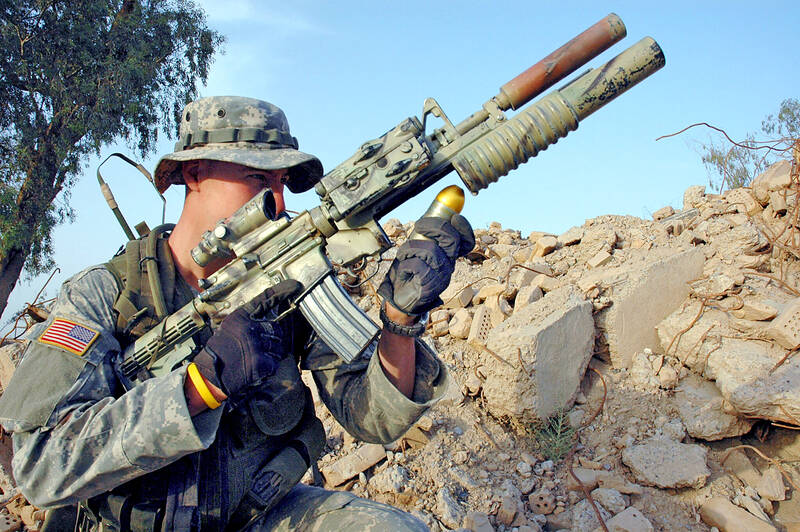
Photo: AFP
The confirmation came after Chinese-language media reported the upgrade of the rifles used by the Marine Corps battalion and published photos showing marines holding M4A1s.
The Air Defense and Base Guard Group’s First Security Battalion was established on Nov. 14 last year, as part of a structural reform of the Marine Corps.
The battalion is made up mainly of conscripts serving one-year compulsory service, and its main task is to provide security for land-based missile and radar crews, ensuring their mobility throughout the mission and the safety of their positions.
A second security battalion of the same type is expected to be formed later this year, the source said.
Su Tzu-yun (蘇紫雲), a research fellow at the government-funded Institute for National Defense and Security Research, said he believes this batch of M4A1s was acquired under the Foreign Military Financing programs approved during former US president Joe Biden’s term.
The M4A1 has a shorter barrel than the T65K2 rifles, giving it better handling and maneuverability, Su said, adding that it also features a Picatinny rail system that allows for accessory attachments, including a combat optical gunsight.
Separately, the Ministry of National Defense in its latest written report to the Legislative Yuan said that, given the difficulty of supplying ammunition by sea and air during wartime, it would continue to deepen cooperation with allies and partners, introduce technologies, and negotiate the establishment of “coproduction” partnerships to build local ammunition production lines and reduce reliance on external supplies.
Regarding channels for acquiring ammunition, the ministry said its objectives are to “meet combat training needs, prioritize domestic production, and maintain defense self-reliance capabilities.”
Procurement would primarily be commissioned through the Armaments Bureau and the Chungshan Institute of Science and Technology, supplemented by foreign military sales and commercial purchases, with multiple channels pursued in parallel, it said.
Due to the impact of the international situation, procurement of critical components for drones has become difficult, the report said.
For explosives required in the production of uncrewed aerial vehicles and surface vessels, the ministry said it has planned to establish multiple sources of supply.
To cope with high consumption during wartime, it also plans to expand production lines for various types of ammunition, propellants and explosives, thereby increasing domestic self-sufficiency in production capacity, the ministry said.
Additional reporting by Fan Wei-li
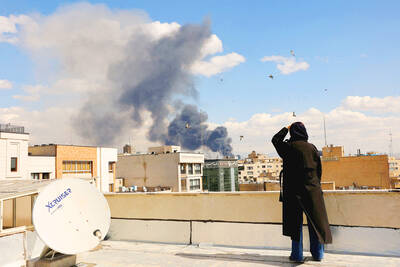
CHAOS: Iranians took to the streets playing celebratory music after reports of Khamenei’s death on Saturday, while mourners also gathered in Tehran yesterday Iranian Supreme Leader Ayatollah Ali Khamenei was killed in a major attack on Iran launched by Israel and the US, throwing the future of the Islamic republic into doubt and raising the risk of regional instability. Iranian state television and the state-run IRNA news agency announced the 86-year-old’s death early yesterday. US President Donald Trump said it gave Iranians their “greatest chance” to “take back” their country. The announcements came after a joint US and Israeli aerial bombardment that targeted Iranian military and governmental sites. Trump said the “heavy and pinpoint bombing” would continue through the week or as long
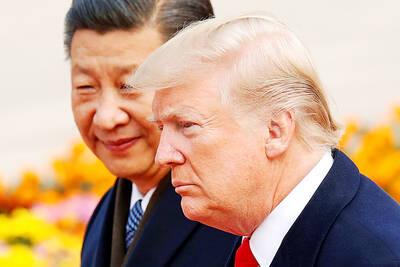
TRUST: The KMT said it respected the US’ timing and considerations, and hoped it would continue to honor its commitments to helping Taiwan bolster its defenses and deterrence US President Donald Trump is delaying a multibillion-dollar arms sale to Taiwan to ensure his visit to Beijing is successful, a New York Times report said. The weapons sales package has stalled in the US Department of State, the report said, citing US officials it did not identify. The White House has told agencies not to push forward ahead of Trump’s meeting with Chinese President Xi Jinping (習近平), it said. The two last month held a phone call to discuss trade and geopolitical flashpoints ahead of the summit. Xi raised the Taiwan issue and urged the US to handle arms sales to
BIG SPENDERS: Foreign investors bought the most Taiwan equities since 2005, signaling confidence that an AI boom would continue to benefit chipmakers Taiwan Semiconductor Manufacturing Co’s (TSMC, 台積電) market capitalization swelled to US$2 trillion for the first time following a 4.25 percent rally in its American depositary receipts (ADR) overnight, putting the world’s biggest contract chipmaker sixth on the list of the world’s biggest companies by market capitalization, just behind Amazon.com Inc. The site CompaniesMarketcap.com ranked TSMC ahead of Saudi Aramco and Meta Platforms Inc. The Taiwanese company’s ADRs on Tuesday surged to US$385.75 on the New York Stock Exchange, as strong demand for artificial intelligence (AI) applications led to chip supply constraints and boost revenue growth to record-breaking levels. Each TSMC ADR represents

State-run CPC Corp, Taiwan (CPC, 台灣中油) yesterday said that it had confirmed on Saturday night with its liquefied natural gas (LNG) and crude oil suppliers that shipments are proceeding as scheduled and that domestic supplies remain unaffected. The CPC yesterday announced the gasoline and diesel prices will rise by NT$0.2 and NT$0.4 per liter, respectively, starting Monday, citing Middle East tensions and blizzards in the eastern United States. CPC also iterated it has been reducing the proportion of crude oil imports from the Middle East and diversifying its supply sources in the past few years in response to geopolitical risks, expanding


 RSS
RSS