


The Lee (李) family migrated to Taiwan in trickles many decades ago. Born in Myanmar, they are ethnically Chinese and their first language is Yunnanese, from China’s Yunnan Province.
Today, they run a cozy little restaurant in Taipei’s student stomping ground, near National Taiwan University (NTU), serving up a daily pre-selected menu that pays homage to their blended Yunnan-Burmese heritage, where lemongrass and curry leaves sit beside century egg and pickled woodear mushrooms.
Wu Yun (巫雲) is more akin to a family home that has set up tables and chairs and welcomed strangers to cozy up and share a meal than a serious sit-down affair.
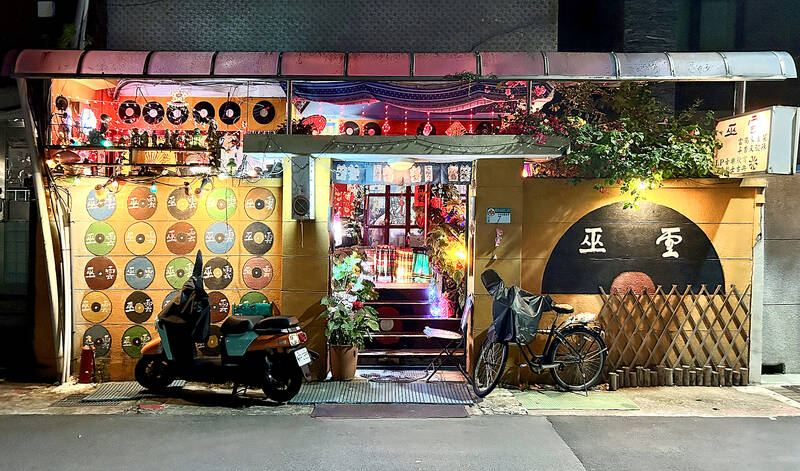
Photo: Hollie Younger, Taipei Times
The exterior looks like Santa’s grotto, all fairy lights and whimsical knick-knacks, and the inside is just as twee; vinyls plastered to the walls, an Italian record on play, not at all adjacent to the vibe, and an elderly man sitting on what looks to be a very supportive office chair to eat his dinner.
But the more you look, the more you discover. Woven Yunnan-Burmese clothing hangs on display and the staff are kitted out in traditional garb. Family photos adorn the walls, some rustically photoshopped to superimpose black and white headshots onto smiling groups of faces.
This place has been open longer than my lifetime, and the charming family atmosphere and seasonal rotating menu keep diners coming back year on year.
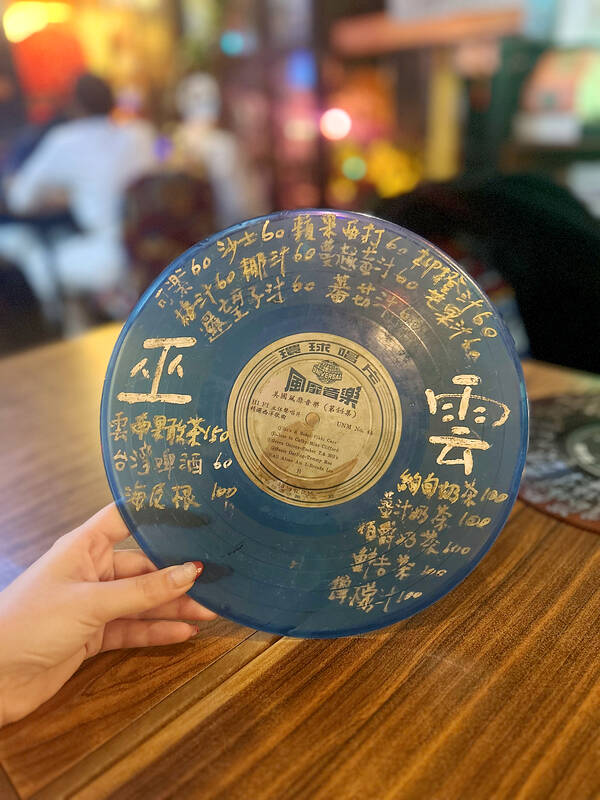
Photo: Hollie Younger, Taipei Times
The 61-year-old proprietor Lee Gui-hsing (李貴興) relocated to Taiwan 40 years ago to pursue an education in, ironically, journalism, though he favored a more relaxed lifestyle and never pursued it as a career, he laughs.
He took over this place two years ago, after the passing of his beloved older brother, who opened the spot back in 1995, with the help of his siblings and extended family — many of whom are also present at our dinner on Saturday night.
The food menu is perfect for the indecisive; there isn’t one.
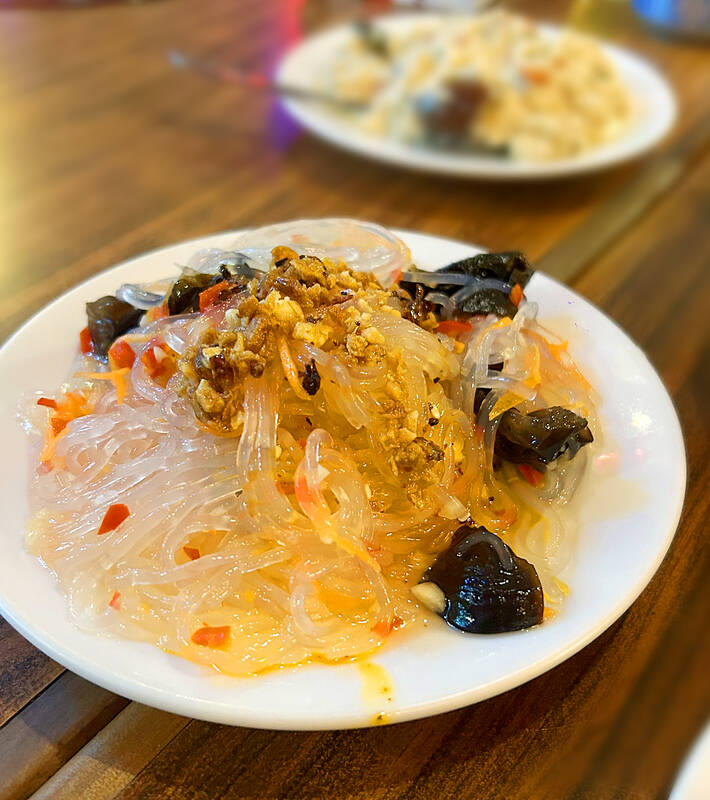
Photo: Hollie Younger, Taipei Times
Depending on the number of diners, they’ll rustle up a tasting menu that varies each day. It’s what the family decides to cook and eat themselves and between two we get five small plates, a dessert and unlimited white rice for just NT$300 a head.
The selection changes with the seasons, with more soups and curries on offer in winter and cold noodles and chilled plates in summer.
They ask upon ordering if you can eat meat, if you like spicy food and any personal preferences — they can also cater to vegetarians. We enthusiastically agree to try anything and everything.
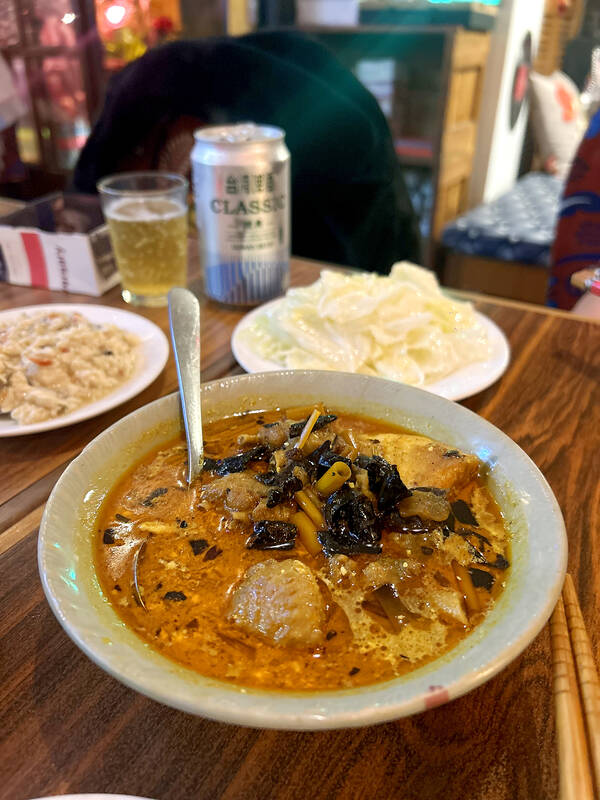
Photo: Hollie Younger, Taipei Times
The drinks menu comes in the form of an old vinyl with handwritten scrawls in white marker. We partake in a Classic Taiwan Beer (NT$60) each, served in a small can that really fits the “welcome to our home,” “let me see what I’ve got in the fridge” vibe.
The main dish served is a chicken and potato curry, comparable to a Thai massaman curry with less spice in the gravy but topped with dark red dried chilis. The chicken falls off the bone — and we place those bones into a lovingly prepared origami paper box we’re given to dispose of them in. The curry is packed with lemongrass and Southeast Asian aromatics and was the winner on our table.
The second favorite was a cold noodle dish of gelatinous vermicelli, fresh red chili, pickled woodear mushrooms and delightful little nuggets of crispy garlic that guide the flavor profile away from the more familiar taste of a Thai papaya salad.
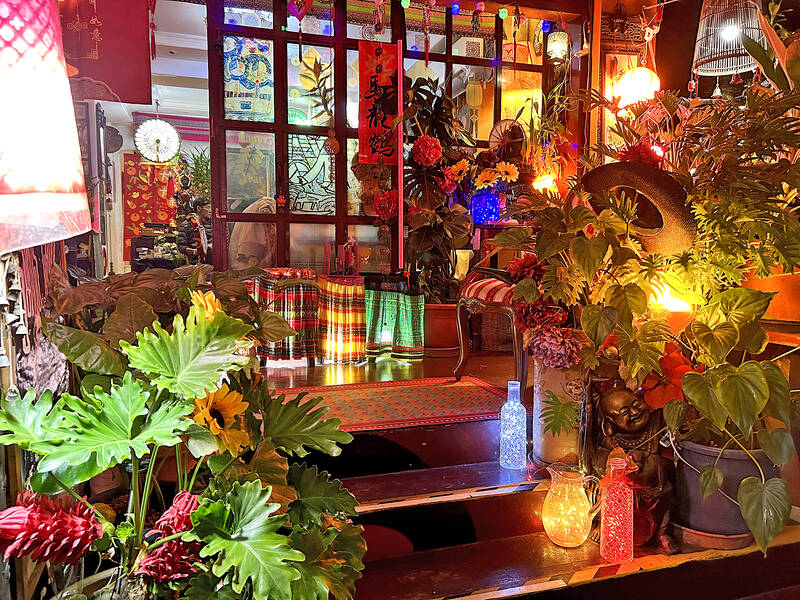
Photo: Hollie Younger, Taipei Times
Next up, a cold dish comprised of slices of cold pork, marbled with fat and served in a vibrant red, almost kimchi-like sauce with a tang of tomato. We’re also served a simple side of warm cabbage and the final dish, a dip of cold tofu and century egg. Cold, navy-blue preserved eggs — a familiar foe. Perhaps I shouldn’t have so boldly proffered that “I eat everything!” But my less octo-averse friend laps it up.
Dessert writes the perfect conclusion to Wu Yun: simple, homely, satisfying. A moreishly satiating, chewy, warm roti is topped with condensed milk.
Perhaps some more hot dishes and soup would’ve rounded out the meal, but on a day when the temperature oscillated between a balmy 25 degrees and brisk November chill, I suppose the winter menu was not yet in play.
Wu Yun offers an exciting blend of familiar East Asian and Southeast Asian flavors, with the fun pre-designed menu leading us to enjoy items we might not have picked off the menu — see cold pork and century egg.
Burmese culture and cuisine in Taiwan is often said to be best enjoyed in New Taipei’s “Myanmar Street,” a pocket of Burmese restaurants along Zhonghe District’s (中和) Huahsin Street (華新街). Here, opening times vary, it can get hectic and it’s difficult to know what to order and where.
But when in Taipei, to dip a tentative toe into Yunnan-Burmese cuisine, Wu Yun is the place to go.
It seems every few days one bumps into one of those “real man” comments in which Taiwan is urged to “face reality” or similar, and “make a deal,” with the speaker implying that soon it will be too late. “Deal” advocates always present themselves as having a superior grip on reality, and the manly ability to make the “hard choice.” Their testosterone-laden language often echoes that of Taiwan sellout advocates. Note that such commentary always specifies a process (“make a deal, work with, make progress”), never the end state of what occupation by a violent authoritarian colonialist state will entail. In
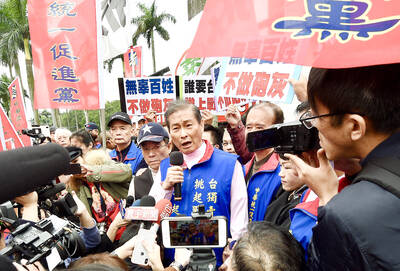
There are shadowy cabals plotting to sell out Taiwan to be annexed by China, by invasion if necessary. Fortunately, they are buffoons. In 2019, former Bamboo Union gangster and founder of the China Unification Promotion Party (CUPP), Chang An-le (張安樂, colorfully known as “White Wolf”), led a protest at the Legislative Yuan against comments made by then-premier Su Tseng-chang (蘇貞昌) that in the event of an attack by China, he would never surrender, but would protect the nation by fighting to the end, even if he only had a broom. Chang had party members bring a wooden casket that they
June 1 to June 7 "If all Taiwanese were as afraid of dying as you, then what would happen?” Physician Shih Chiang-nan (施江南) reportedly said this to his wife Chen Chiao-tung (陳焦桐) after she urged him to stop intervening on behalf of Taiwanese soldiers stranded overseas after serving in the Japanese Army during World War II. Shih had clashed with high-ranking officials over the issue, engaged in several heated arguments with Taiwan governor-general Chen Yi (陳儀) and allegedly shouted at general Ko Yuan-fen (柯遠芬), chief of staff of the Taiwan Garrison Command, over

Food prices have often played a major role in Taiwan’s history. The first major wave of migration from China occurred in 1628. A moderate drought, the Ming Dynasty maritime ban that prohibited fishing and trading (intended to reduce piracy) and a temporary tax, conspired to exhaust local resources, leading to famine in Fujian Province. The famed pirate and trader Zheng Zhilong (鄭芝龍), scooped up starving people from Fujian and transported them across the Taiwan Strait, where they settled under the Dutch. Two factors enabled Zheng. First, by 1624 he had settlements around today’s Beigang (北港) in Yunlin County with a small


 RSS
RSS