


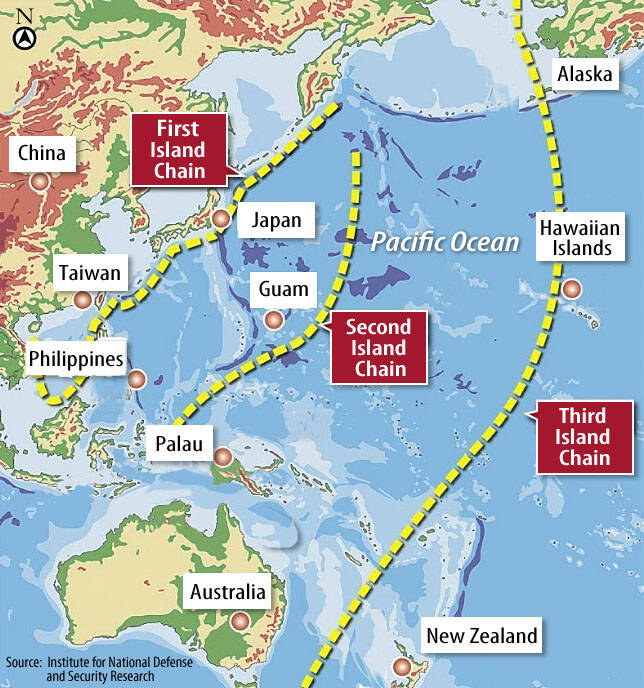
Deterring conflict over Taiwan is a priority, the White House said in its National Security Strategy published yesterday, which also called on Japan and South Korea to increase their defense spending to help protect the first island chain.
Taiwan is strategically positioned between Northeast and Southeast Asia, and provides direct access to the second island chain, with one-third of global shipping passing through the South China Sea, the report said.
Given the implications for the US economy, along with Taiwan’s dominance in semiconductors, “deterring a conflict over Taiwan, ideally by preserving military overmatch, is a priority,” it said.
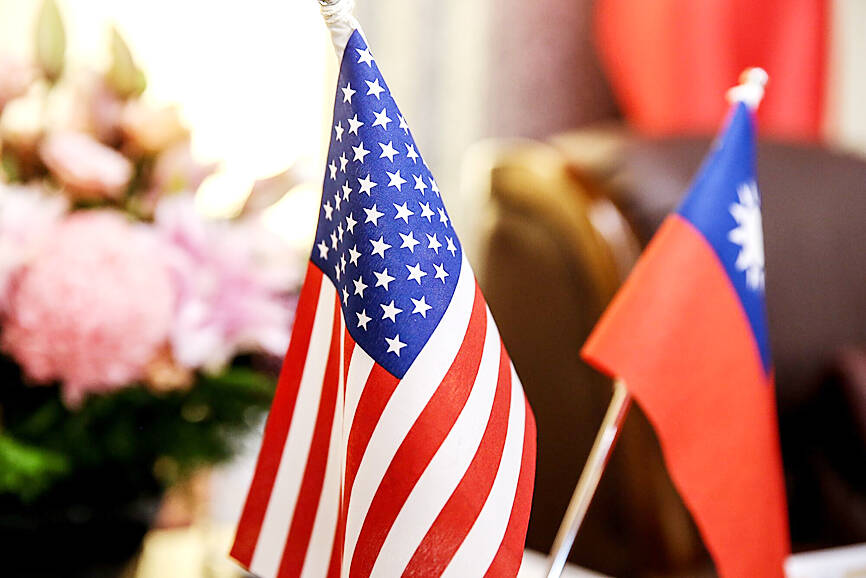
Photo: I-Hwa Cheng, Bloomberg
However, the strategy also reiterated Washington’s decades-long policy that the US “does not support any unilateral change to the status quo.”
It continued to urge for more support from its allies, calling for US diplomatic efforts to focus on pressuring its partners in the first island chain to grant the US military greater access to their facilities and spend more on defense.
Deterrence is necessary to protect Taiwan and keep the South China Sea open, both of which are in the US’ best interests, the report said.
“This will require not just further investment in our military — especially naval — capabilities, but also strong cooperation with every nation that stands to suffer, from India to Japan and beyond, if this problem is not addressed,” it said.
The strategy said Japan and South Korea should increase their defense spending, with a focus on deterrence and protecting the first island chain.
As for Taiwan and Australia, it said the US would continue its “determined rhetoric on increased defense spending.”
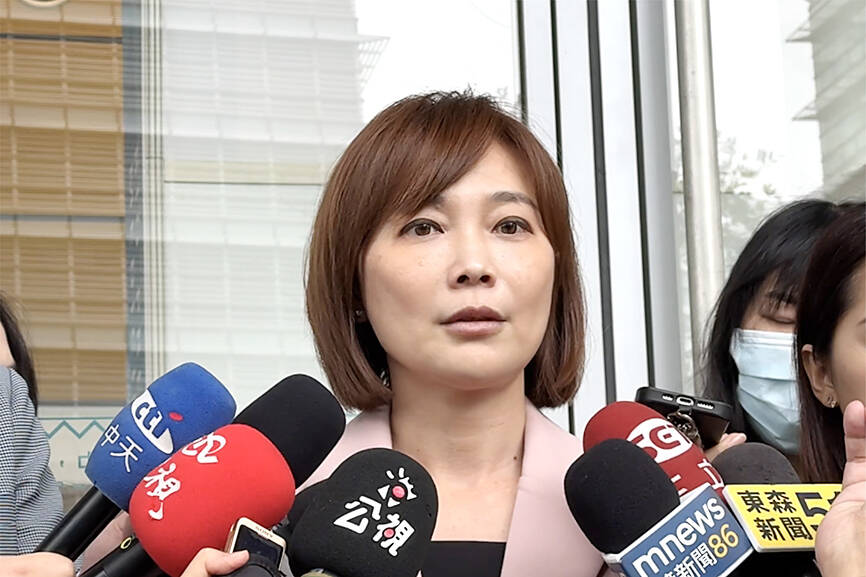
Photo: Chiu Chih-jou, Taipei Times
In other news, Taiwan and Japan yesterday voiced concerns over Chinese military activities in the region, after Reuters reported that Beijing had deployed a large number of vessels across East Asian waters this week, in its largest maritime show of force to date.
Reuters on Thursday reported that China was deploying a large number of naval and coast guard ships across East Asian waters — at one point more than 100 — citing sources and intelligence reports.
Presidential Office spokeswoman Karen Kuo (郭雅慧) told reporters that the Chinese activity stretched from the Yellow Sea down through waters near the disputed Diaoyutai Islands (釣魚台) in the East China Sea, and into the South China Sea and the western Pacific.
“This indeed poses a threat and impact to the Indo-Pacific and the whole region,” she said. “We also especially call on China to live up to its responsibilities as a major power and to exercise restraint in its actions.”
Kuo said President William Lai (賴清德) had instructed the military to maintain full situational awareness and provide timely updates.
Taiwan would keep close contact and cooperation with unspecified “friendly partners” to jointly safeguard peace and stability in the Indo-Pacific region, she said.
Japanese Minister of Defense Shinjiro Koizumi said Tokyo was aware of the reports and was watching Chinese military movements “with great attention,” but declined to comment on deployment.
“China has been expanding and stepping up its military activities in the areas surrounding Japan, and we make a constant effort to gather and analyze information on Chinese military movements with great attention,” Koizumi said. “In any event, the government will continue to monitor developments around Japan with deep concern and will make every effort to ensure thorough information gathering and surveillance.”
China’s military has not commented, but Chinese Ministry of Foreign Affairs spokesman Lin Jian (林劍) said navy and coast guard activities in “relevant maritime areas” adhered strictly to domestic and international law.
“There is no need for any party to overreact, overinterpret or engage in baseless speculation,” he said.
November and December are traditionally a busy season for Chinese military exercises, although the Chinese People’s Liberation Army has not made any announcements of large-scale officially named drills.
The operations exceed China’s mass naval deployment in December last year that prompted Taiwan to raise its alert level, the sources said.

‘NO SECURITY RISK’: The Railway Bureau reassured the public that the technicians’ activities were limited to technical guidance and did not involve sensitive systems The Railway Bureau yesterday said it had invited eight Chinese technicians to assist with an airport MRT construction project. The bureau issued the confirmation after an Internet user said Chinese nationals had entered the construction zone of Taiwan Taoyuan International Airport’s Terminal 3 project. They asked why “individuals from an enemy state” were allowed access to such a major national infrastructure project, which raised serious concerns over Taiwan’s industrial safety, sensitive systems and information security. The bureau’s Northern Region Engineering Branch Office said subcontractor Taiwan Handle Industrial Co (台灣手把工業) of the Taoyuan airport MRT’s “Contract No. CU05 Project A14 Station Civil, MEP &

The National Chungshan Institute of Science and Technology yesterday showcased its locally developed variants of the Vision 60 robotic patrol dog, which it plans to deploy on the nation’s outlying territories in the South China Sea. The variants were produced under the Joint Lab project — created by the institute and domestic companies — and assembled with domestically produced motors, lenses and artificial intelligence (AI) systems alongside licensed tech from the US, Missile and Rocket Systems Research Division deputy director Jen Kuo-kang (任國光) told the media event at a military base in Taipei’s Dazhi (大直) area. Taiwan has built up its strengths

NOT IMMEDIATE: Taiwan has a chance to appeal the proposed 10 percent tariff before it starts, while other countries face a 12.5 percent tariff from the trade office Taiwan is among 60 economies determined by the US to have failed to impose or enforce a ban on the importation of goods produced with forced labor, according to a notice released on Tuesday by the Office of the US Trade Representative (USTR), which proposed imposing an additional 10 percent or more tariff on them. The USTR in a statement said that following an investigation, it had determined under Section 301 of the Trade Act of 1974 that the failure of the 60 economies to impose and effectively enforce a prohibition on the importation of goods produced with forced labor is
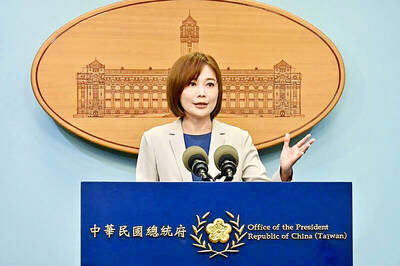
TIT-FOR-TAT: The US allegedly revoked the visa of a Chinese national working at Xinhua News Agency in the US in response to Beijing’s expulsion of Vivian Wang The Presidential Office yesterday condemned China for expelling a New York Times correspondent from Beijing following the newspaper’s interview with President William Lai (賴清德), saying the move highlighted Beijing’s suppression of press freedom and its threat to international news media. Taiwan has noted a series of recent incidents in which Beijing used similar tactics to “threaten and pressure international media outlets and journalists,” Presidential Office spokeswoman Karen Kuo (郭雅慧) said in a statement. “This concerns not only press freedom and freedom of expression, but also the safety of journalists, and Taiwan and relevant partners are paying close attention to the situation,” she


 RSS
RSS