


Washington has no intention of changing the “status quo” in the Taiwan Strait, US Secretary of Defense Pete Hegseth said on Saturday, adding that one of the US military’s main priorities is to deter China “through strength, not through confrontation.”
Speaking at the annual Reagan National Defense Forum in Simi Valley, California, Hegseth outlined the US Department of Defense’s priorities under US President Donald Trump.
“First, defending the US homeland and our hemisphere. Second, deterring China through strength, not confrontation. Third, increased burden sharing for us, allies and partners. And fourth, supercharging the US defense industrial base,” he said.
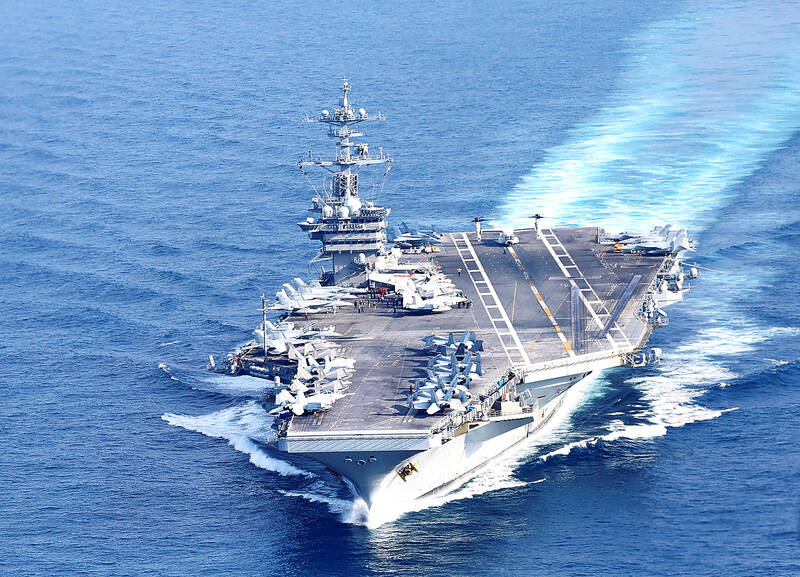
Photo: REUTERS
US-China relations under Trump are “better and stronger,” as the administration seeks “stability, peace, fair trade and respectful relations with China,” Hegseth said.
Reciprocal visits planned between Trump and Chinese President Xi Jinping (習近平) next year are an opportunity to continue to progress bilateral relations, he added.
The department is likewise expanding communication with the Chinese military to prevent conflict and reduce tension, he said.
“This line of effort is based on flexible realism, not naivete, an approach aimed not at domination, but rather at a balance of power,” Hegseth said.
Repeating what he said at the Shangri-La Dialogue in Singapore earlier this year, Hegseth said the US is not trying to “strangle China’s growth, or dominate or humiliate them, nor are we trying to change the status quo over Taiwan.”
US interests in the Indo-Pacific region are “significant, but also scoped and reasonable,” he said.
“This means ensuring none of our allies are vulnerable to sustained, successful military aggression,” Hegseth said.
He emphasized that the US would ensure its forces could operate continually throughout the first island chain and the entire Indo-Pacific region when necessary, making peace the preferable option to aggression.
US General Dan Caine, chairman of the US Joint Chiefs of Staff, also spoke at the forum, saying that while US-China economic relations are moving in the right direction, China is still building up its military capacity on a large scale.
According to the National Security Strategy report released by the Trump administration on Friday, the US military has a responsibility to ensure a free, safe and prosperous Indo-Pacific region, Caine said.
That responsibility would guide him when considering action in the region, Caine added.
The report said that “deterring a conflict over Taiwan, ideally by preserving military overmatch, is a priority.”
The US would “maintain our longstanding declaratory policy on Taiwan, meaning that the US does not support any unilateral change to the status quo in the Taiwan Strait,” the report said.
The version released under former US president Joe Biden said the US “opposes” any unilateral change to the “status quo,” while the Trump administration’s version says the US “does not support” it.
American Enterprise Institute fellow Ryan Fedasiuk on Friday said the shift from “oppose” to “does not support” was “a meaningful downgrade.”
“Opposes” implies active opposition with potential consequences, but “does not support” suggests passive disapproval without commitment to take any action, he said.
Regarding whether this wording change signals a shift in US policy toward Taiwan, a US Department of State spokesperson on Saturday told the Central News Agency that the US is committed to maintaining peace and stability in the Taiwan Strait.
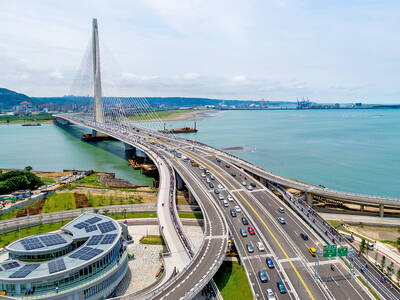
The Ministry of Transportation and Communications yesterday inaugurated the Danjiang Bridge across the Tamsui River in New Taipei City, saying that the structure would be an architectural icon and traffic artery for Taiwan. Feted as a major engineering achievement, the Danjiang Bridge is 920m long, 211m tall at the top of its pylon, and is the longest single-pylon asymmetric cable-stayed bridge in the world, the government’s Web site for the structure said. It was designed by late Iraqi-British architect Zaha Hadid. The structure, with a maximum deck of 70m, accommodates road and light rail traffic, and affords a 200m navigation channel for boats,
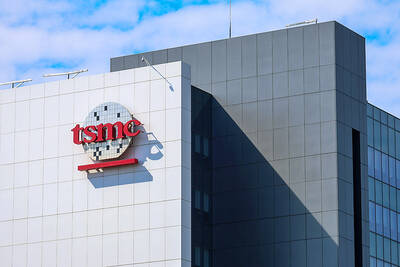
Taiwan Semiconductor Manufacturing Co (TSMC, 台積電), the world’s largest foundry service provider, yesterday said that global semiconductor revenue is projected to hit US$1.5 trillion in 2030, after the figure exceeds US$1 trillion this year, as artificial intelligence (AI) demand boosts consumption of token and compute power. “We are still at the beginning of the AI revolution, but we already see a significant impact across the whole semiconductor ecosystem,” TSMC deputy cochief operating officer Kevin Zhang (張曉強) said at the company’s annual technology symposium in Hsinchu City. “It is fair to say that in the past decade, smartphones and other mobile devices were
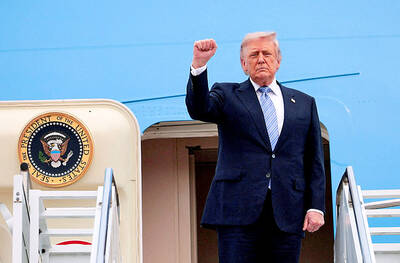
US-CHINA SUMMIT: MOFA welcomed US reassurance of no change in its Taiwan policy; Trump said he did not comment when Xi talked of opposing independence US President Donald Trump yesterday said he has not made a decision on whether to move forward with a major arms package for Taiwan after hearing concerns about it from Chinese President Xi Jinping (習近平). Trump’s comments on Taiwan came as he flew back to Washington after wrapping up critical talks in which both leaders said important progress was made in stabilizing US-China relations even as deep differences persist between the world’s two biggest powers on Iran and Taiwan. “I will make a determination,” Trump said, adding: “I’ll be making decisions. But, you know, I think the last thing we need right

TAIWAN ISSUE: US treasury secretary Scott Bessent said on the first day of meetings that ‘it wouldn’t be a US-China summit without the Taiwan issue coming up’ There were no surprises on the first day of the summit between US President Donald Trump and Chinese President Xi Jinping (習近平), the Mainland Affairs Council (MAC) said yesterday, as the government reiterated that cross-strait stability is crucial to the Asia-Pacific region, as well as the world. As the two presidents met for a highly anticipated summit yesterday, Chinese state media reported that Xi warned Trump that missteps regarding Taiwan could push their two countries into “conflict.” Trump arrived in China with accolades for his host, calling Xi a “great leader” and “friend,” and extending an invitation to visit the White House


 RSS
RSS