


Beijing allegedly agreed to let Chinese Nationalist Party (KMT) Chairwoman Cheng Li-wun (鄭麗文) meet with Chinese President Xi Jinping (習近平) around the Lunar New Year holiday next year on three conditions, including that the KMT block Taiwan’s arms purchases, a source said yesterday.
Cheng has expressed interest in meeting Xi since she won the KMT’s chairmanship election in October.
A source, speaking on condition of anonymity, said a consensus on a meeting was allegedly reached after two KMT vice chairmen visited China’s Taiwan Affairs Office Director Song Tao (宋濤) in China last month.
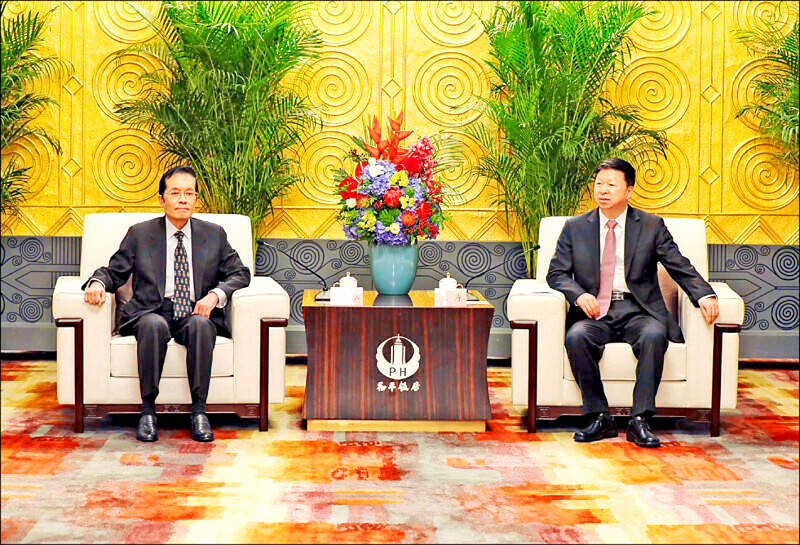
Photo courtesy of the KMT
Beijing allegedly gave the KMT three conditions it had to meet to show that the party is “steadily moving on the right track of history,” given that Cheng is a former Democratic Progressive Party (DPP) member.
Cheng entered politics as a member of the DPP, but left in 2002 and joined the KMT in 2005.
Beijing said it made the proposal to prevent the KMT from “going off track” during campaigns for next year’s nine-in-one elections, the source said.
One of the conditions is to block the defense budget for arms purchases proposed by the DPP administration, to “eradicate” President William Lai’s (賴清德) “provocative attempts to achieve Taiwanese independence by force or with US support,” the source said.
The KMT must also boycott legislation aimed at “discriminating against Chinese spouses in Taiwan or limiting their freedoms,” as well as those that hinder Chinese commercial activities or investments in Taiwan, they said.
The last condition requires the KMT to initiate reforms or take action to remove institutional obstacles to “Chinese unification,” the source said.
After discussing China’s proposal, the party sent KMT Vice Chairman Chang Jung-kung (張榮恭) to Beijing on Nov. 13 to report their decision in person to high-ranking Chinese officials, including Song, the source said, adding that Chang allegedly immediately received approval for a Cheng-Xi meeting around the Lunar New Year holiday.
The source cited Song as saying that Beijing would shape the Cross-Strait Economic, Trade and Culture Forum as the most important and representative cross-strait exchange platform, based on the so-called “1992 consensus” and the concept of “each side interpreting the ‘one China’ separately.”
The KMT “must take further actions” to promote Cheng’s idea of “making all Taiwanese say ‘I’m a Chinese,’” the source quoted Song as saying.
The “1992 consensus,” a term former Mainland Affairs Council chairman Su Chi (蘇起) in 2006 admitted making up in 2000, refers to a tacit understanding between the KMT and the Chinese government that both sides of the Strait acknowledge there is “one China,” with each side having its own interpretation of what “China” means.
It is reported a discourse group led by Chang not only plans to shift party stance from "one China with respective interpretations (一中各表)" to "each side interpreting the ‘one China’ separately (各表一中)," which is acceptable to Beijing, but also to remove the phrase "opposing communism" from the party charter's Article 2.
This is seen as paving the way for future discourse on China's unification, the source said, adding that party members who are considering running in next year's local elections are highly concerned about being labeled as "red unificationists."
The KMT yesterday denied the news report, saying it was completely fabricated and aimed to manipulate politics.
The party’s vice chairmen traveled to China much earlier than Lai’s article on the Washington Post announcing Taiwan’s planned US$40 billion special defense budget, it said, adding that it was ridiculous to associate the visits with the defense budget.
The KMT’s pursuit of cross-strait peace without undermining national dignity would not change, the party said.
The party is willing to take responsibility for facilitating cross-strait peace and improving people’s livelihoods, it said, adding that it despised the fabricated story of the “three conditions.”

A signaling system malfunction disrupted high-speed rail (HSR) services beginning at 8am today, with trains temporarily reduced to three northbound and three southbound trains per hour as authorities conduct inspections. The malfunction occurred on a section of track in Miaoli County during pre-operation checks early this morning, forcing northbound and southbound trains to use a single track, the HSR operator said. The regular schedule has been replaced with three hourly trains offering only nonreserved seating in each direction, stopping at every station, it said, adding that business class cars would still have reserved seating. Departures from terminal stations are scheduled at the top

Taiwan is still in the process of assessing the possibility of recruiting workers from Eswatini, the Ministry of Foreign Affairs said yesterday, adding that its goal is to help Eswatini upgrade its vocational training centers. If there are plans to recruit workers from Eswatini, safeguarding national security, protecting public health and ensuring the employment rights of Taiwanese would be prerequisites, Department of West Asian and African Affairs Director-General Yen Chia-liang (顏嘉良) told a news conference. Key considerations would also include filling labor shortages in specific industries, and fostering bilateral professional and technical exchanges, he said. Yen was asked about the progress of labor

A US uncrewed surface vessel (USV) encountered multiple Chinese warships during an autonomous transit of the Taiwan Strait, US defense company Seasats said in a statement on Wednesday. Seasats announced that a Lightfish USV had completed the first autonomous transit of the Taiwan Strait. Over five days, the USV traversed the entire length of the Strait while constantly monitoring surface vessel traffic, the company said. The Lightfish encountered multiple Chinese warships, one of which was a Chinese People’s Liberation Army Navy (PLAN) Type 056 corvette, it said. The Chinese vessels were operating “well within Taiwan’s exclusive economic zone without transmitting their identity via the

VERBOSE VESSELS: A CGA cutter and a China Coast Guard exchanged verbal barbs for more than a day in Taiwanese-controlled waters before the Chinese vessel left The Taiwanese and Chinese coast guards had a standoff near the strategically located Pratas Islands (Dongsha Islands, 東沙群島) in the north of the South China Sea, the Coast Guard Administration (CGA) said yesterday. The two sides engaged in intense radio exchanges over sovereignty claims during the 33-hour standoff. China Coast Guard vessel 3501 eventually left the restricted waters, 26.6 nautical miles (49.2km) west of the Pratas Islands, at 5pm yesterday, the CGA said. Lying approximately between southern Taiwan and Hong Kong, the Taiwan-controlled Pratas are seen by some security experts as vulnerable to Chinese attack due to their distance — more than


 RSS
RSS