


High in the mountains of the Ecuadorian Andes, a group of young Otavalo Indigenous people is using anime to inspire pride in their ancient culture and language, especially among Otavalo children.
They produced an animated short film titled We’re Aya that follows the adventures of Aya, a mythical Otavalo warrior, and other characters who interact under the watchful eye of a condor — an iconic bird for Andean Indigenous cultures that symbolizes power and energy.
Inspired by the work of legendary Japanese animator Hayao Miyazaki, the story takes place in the mountains of Imbabura, a province in the northern Andes home to the Otavalo people, known for their handicrafts and textiles.

Photo: AP
Tupac Amaru, director and producer of the nine-minute film, said the movie is part of an effort to maintain Otavalo customs and language, which began to erode as globalization created a more interconnected world and influenced their culture.
His people faced two options: “lock ourselves out [from the world] and defend our culture, language, spirituality and clothing or stand tall and fight back,” Amaru said.
The film with 12 Quichua-speaking characters is a first step in helping Otavalo children to appreciate their heritage, he said. Indigenous themes have been explored before in short and feature-length films produced in Peru and Ecuador, but most featured Spanish-speaking characters.
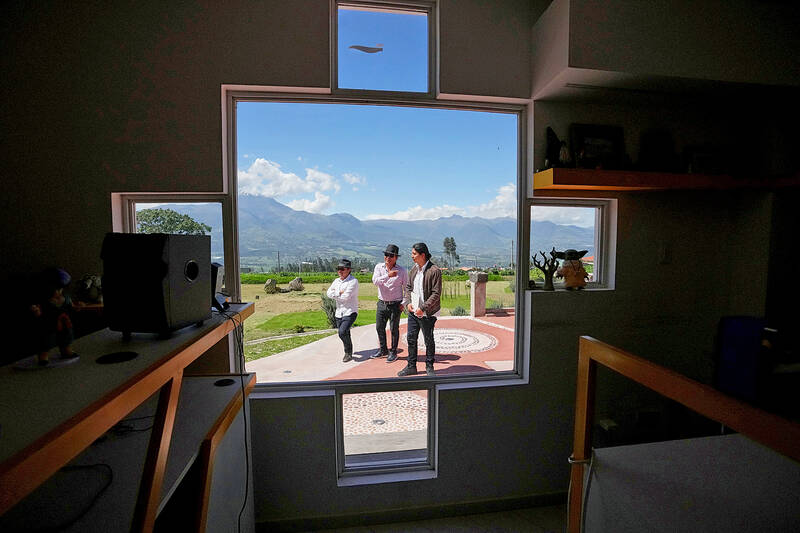
Photo: AP
“Quichua is the vibration that gives meaning to existence and without the language, the meaning of life and our energy comes to an end,” Amaru said.
“Our children no longer know Quichua,” which means they have lost a communication tool and “are losing their sense of belonging, their energy,” he added.
Quichua, an Indigenous language that is part of the Quechua language family, is primarily spoken in Ecuador.
Yarik Sisa, creative manager for the film, said the story is inspired by ancestral practices that survived the passage of time, including taking musical instruments to energetic points of the land the night before a celebration so that the instruments are endowed with “soul.”
The film also includes characters such as Ayaruku, which represents an indomitable spirit; Ayawa, a representation of the sublime and the feminine; and Ayaku, a child symbolizing tenderness.
These characters play their traditional instruments and stomp their feet as part of a rhythmic dance as they enter a dark cavern, which symbolizes globalization, where the spirits give them the mission of becoming new seeds of their people.
The film then shows an Indigenous grandfather talking to his granddaughter who promises her elder she will become a woman strong as a rock and a defender of their culture. Her grandfather then asks her to never stray from that path.
The team behind We’re Aya hopes to release more films and even video games in Quichua in the coming years and even enter the international video game market with games “made by Quichuas in a Quichua environment,” said Malkik Anrango, the film’s creative director.

This is the year that the demographic crisis will begin to impact people’s lives. This will create pressures on treatment and hiring of foreigners. Regardless of whatever technological breakthroughs happen, the real value will come from digesting and productively applying existing technologies in new and creative ways. INTRODUCING BASIC SERVICES BREAKDOWNS At some point soon, we will begin to witness a breakdown in basic services. Initially, it will be limited and sporadic, but the frequency and newsworthiness of the incidents will only continue to accelerate dramatically in the coming years. Here in central Taiwan, many basic services are severely understaffed, and

Jan. 5 to Jan. 11 Of the more than 3,000km of sugar railway that once criss-crossed central and southern Taiwan, just 16.1km remain in operation today. By the time Dafydd Fell began photographing the network in earnest in 1994, it was already well past its heyday. The system had been significantly cut back, leaving behind abandoned stations, rusting rolling stock and crumbling facilities. This reduction continued during the five years of his documentation, adding urgency to his task. As passenger services had already ceased by then, Fell had to wait for the sugarcane harvest season each year, which typically ran from

It is a soulful folk song, filled with feeling and history: A love-stricken young man tells God about his hopes and dreams of happiness. Generations of Uighurs, the Turkic ethnic minority in China’s Xinjiang region, have played it at parties and weddings. But today, if they download it, play it or share it online, they risk ending up in prison. Besh pede, a popular Uighur folk ballad, is among dozens of Uighur-language songs that have been deemed “problematic” by Xinjiang authorities, according to a recording of a meeting held by police and other local officials in the historic city of Kashgar in

It’s a good thing that 2025 is over. Yes, I fully expect we will look back on the year with nostalgia, once we have experienced this year and 2027. Traditionally at New Years much discourse is devoted to discussing what happened the previous year. Let’s have a look at what didn’t happen. Many bad things did not happen. The People’s Republic of China (PRC) did not attack Taiwan. We didn’t have a massive, destructive earthquake or drought. We didn’t have a major human pandemic. No widespread unemployment or other destructive social events. Nothing serious was done about Taiwan’s swelling birth rate catastrophe.


 RSS
RSS