


The Ministry of Foreign Affairs (MOFA) yesterday said it is closely monitoring developments in Venezuela, and would continue to cooperate with democratic allies and work together for regional and global security, stability, and prosperity.
The remarks came after the US on Saturday launched a series of airstrikes in Venezuela and kidnapped Venezuelan President Nicolas Maduro, who was later flown to New York along with his wife. The pair face US charges related to drug trafficking and alleged cooperation with gangs designated as terrorist organizations. Maduro has denied the allegations.
The ministry said that it is closely monitoring the political and economic situation in Venezuela, including the country’s role in international drug trafficking and the humanitarian crisis under its authoritarian government.
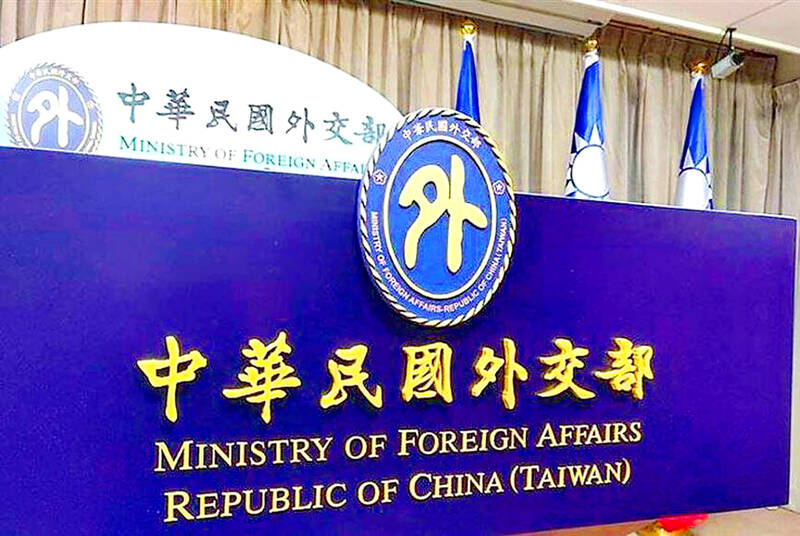
Photo: CNA
Venezuela’s situation has long affected regional stability and Taiwan would continue monitoring developments to safeguard Taiwanese there, the ministry said.
It also expressed hope that Venezuela could “smoothly and peacefully transition to democracy,” adding that Taiwan would continue working with the US and other democratic partners to promote regional and global security and stability.
Meanwhile, the US’ capture of Maduro has sparked widespread discussion on social media in China, with some users saying the operation offered a template for how Beijing could handle tensions with Taiwan.
“I suggest using the same method to reclaim Taiwan in the future,” one user said in reply to a post on Weibo platform. .
“Since the US doesn’t take international law seriously, why should we care about it?” another user said.
China’s Ministry of Foreign Affairs urged the US to release Maduro and his wife, and to ensure their safety.
The raid on Venezuela clearly violates international law and the basic norms governing international relations, as well as the purposes and principles of the UN Charter, it said in a statement.
It condemned US President Donald Trump’s strike, saying it was “deeply shocked” by the “blatant use of force against a sovereign state.”
US Congressman Don Bacon, while praising Trump’s decision as “great for the future of Venezuelans and the region,” warned it could have broader implications.
“My main concern is now Russia will use this to justify their illegal and barbaric military actions against Ukraine, or China to justify an invasion of Taiwan,” Bacon wrote on social media.
Bonnie Glaser, managing director of the Indo-Pacific Program at the U.S.-based German Marshall Fund, said China was unlikely to change its Taiwan policy in response to events in Venezuela.
“The Chinese are playing the long game, and they continue to believe that international trends favor China’s goals of national reunification and national rejuvenation,” she said.
“While it’s possible that Xi could change course in the future, he is unlikely to do so in response to U.S. actions in Venezuela,” Glaser added.
To Chinese President Xi Jinping (習近平), Trump’s actions could be viewed as consistent with great powers intervening in neighboring countries in the name of national security, said Lyle Morris, a senior fellow at the Asia Society Policy Institute, adding that this was how Beijing perceived Russia’s invasion of Ukraine.
“A potential Chinese invasion of Taiwan could fall into the same bucket,” he added.
“I don’t think it’s hyperbole to speculate that this opens the window for Xi to contemplate military action toward Taiwan, especially if the global response to the US action is muted,” Morris said.
Asked whether the US operation could encourage Beijing to take similar action against Taipei, former American Institute in Taiwan (AIT) chairman Richard Bush said the circumstances were fundamentally different.
Bush said Xi has incentives to pursue a long-term approach, adding that the Democratic Progressive Party’s (DPP) control of the presidency after 2028 “is not guaranteed.”
Ryan Hass, director of the John L. Thornton China Center at the Brookings Institution in Washington, also cautioned against drawing parallels between the two situations.
“I don’t expect today’s events in Venezuela will dramatically alter Beijing’s calculus on Taiwan,” he wrote on social media.
“Xi’s comments in the New Year’s address suggest broad continuity in the Chinese approach to Taiwan. If Beijing shifts its approach, it will not be because of U.S. actions in Venezuela,” Hass wrote.
Beijing would likely focus on protecting its interests, condemning US actions and sharpening contrasts with Washington in the international system, rather than drawing inspiration from events in Venezuela to alter its Taiwan policy, he said.
Others were skeptical Beijing has the military know-how for such an operation.
The US strike was the result of months of intelligence work and carried out by more than 150 aircraft, US Chairman of the Joint Chiefs of Staff Dan Caine said at a Saturday briefing.
A helicopter force approached Maduro’s home shortly after 2am in Caracas before taking fire, he added.
Maduro and his wife then “gave up,” Caine said.
The US forces involved likely had extensive experience operating in hostile environments, according to Drew Thompson, a senior fellow at the S. Rajaratnam School of International Studies in Singapore.
“I don’t think the PLA has any experience like that,” he said, referring to the Chinese People’s Liberation Army.
“Beijing has other options for neutralizing Taiwan’s leader,” he added, saying China would have a higher chance of success with assassinations.
DPP Legislator Wang Ting-yu (王定宇) yesterday said that “Taiwan does not need to worry about China ‘modeling itself after the US.’”
Taiwan is different from Venezuela in that Taiwan’s political leaders come from free and fair democratic elections, and are not international criminals on the run, he wrote on social media.
The US characterized the option as “criminal law enforcement” rather than “a declaration of war,” with the US Department of Justice classifying Maduro as a criminal under Title 21 of the US Code, charging him with “drug terrorism” and other offenses, he said.
The more important factor is the gap in capabilities, he said, adding that China has never lacked malice toward Taiwan, but what it truly lacks is “feasible capability.”
“Democracy, alliances, capabilities, and the rule of law — Taiwan is completely different from Venezuela,” he said. “To deliberately equate the two is nothing but misleading.”
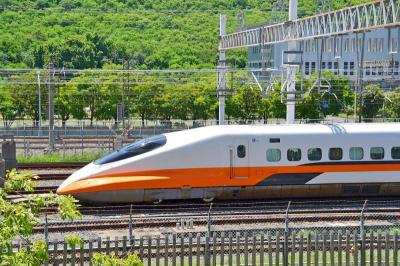
A signaling system malfunction disrupted high-speed rail (HSR) services beginning at 8am today, with trains temporarily reduced to three northbound and three southbound trains per hour as authorities conduct inspections. The malfunction occurred on a section of track in Miaoli County during pre-operation checks early this morning, forcing northbound and southbound trains to use a single track, the HSR operator said. The regular schedule has been replaced with three hourly trains offering only nonreserved seating in each direction, stopping at every station, it said, adding that business class cars would still have reserved seating. Departures from terminal stations are scheduled at the top
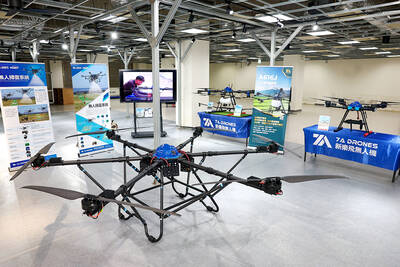
DRONE CENTRAL: Taiwan aims to become Asia’s democratic hub for drones, with most exports focused on high-quality military-grade models, an official said Taiwan’s drone industry is expected to expand significantly by 2030, producing 100,000 units per month and exporting half of them, the Ministry of Economic Affairs said yesterday. Current drone production capacity is about 15,000 units per month, but the industry can quickly scale up as demand increases, Industrial Development Administration Director-General Chiou Chyou-huey (邱求慧) told a news conference in Taipei. Taiwan’s drone output grew 2.5-fold last year to NT$12.9 billion (US$408.3 million) under a government program to develop the uncrewed vehicle sector, he said. The Executive Yuan in October last year approved plans to invest NT$44.2 billion into domestic production of uncrewed aerial
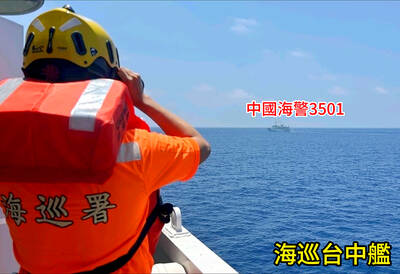
VERBOSE VESSELS: A CGA cutter and a China Coast Guard exchanged verbal barbs for more than a day in Taiwanese-controlled waters before the Chinese vessel left The Taiwanese and Chinese coast guards had a standoff near the strategically located Pratas Islands (Dongsha Islands, 東沙群島) in the north of the South China Sea, the Coast Guard Administration (CGA) said yesterday. The two sides engaged in intense radio exchanges over sovereignty claims during the 33-hour standoff. China Coast Guard vessel 3501 eventually left the restricted waters, 26.6 nautical miles (49.2km) west of the Pratas Islands, at 5pm yesterday, the CGA said. Lying approximately between southern Taiwan and Hong Kong, the Taiwan-controlled Pratas are seen by some security experts as vulnerable to Chinese attack due to their distance — more than
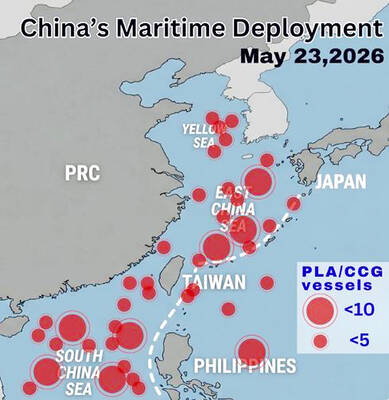
WARNING: China should stop engaging in actions that undermine regional peace and stability, as it would only build resentment among people across the Strait, the CGA said China has deployed more than 100 navy, coast guard and other vessels in waters from the Yellow Sea to the South China Sea and the western Pacific since US President Donald Trump and Chinese President Xi Jinping (習近平) met in Beijing, National Security Council Secretary-General Joseph Wu (吳釗燮) said yesterday. “In this part of the world, #China is the one & only PROBLEM wrecking the #StatusQuo & threatening regional peace & stability,” Wu wrote on X. In a separate post, he said Beijing was coercing Taiwan’s maritime domain, calling it illegal and provocative, after the Coast Guard Administration (CGA) expelled a


 RSS
RSS