


The number of climate lawsuits filed against companies around the world is rising swiftly, a report has found, and a majority of cases that have concluded have been successful.
About 230 climate-aligned lawsuits have been filed against corporations and trade associations since 2015, two-thirds of which have been initiated since 2020, according to the analysis published on Thursday by the Grantham Research Institute on Climate Change and the Environment.
One of the most rapidly growing forms of litigation is over “climate-washing” — when companies are accused of misrepresenting their progress towards environmental targets — and the analysis found that 47 such cases were filed against companies and governments last year.
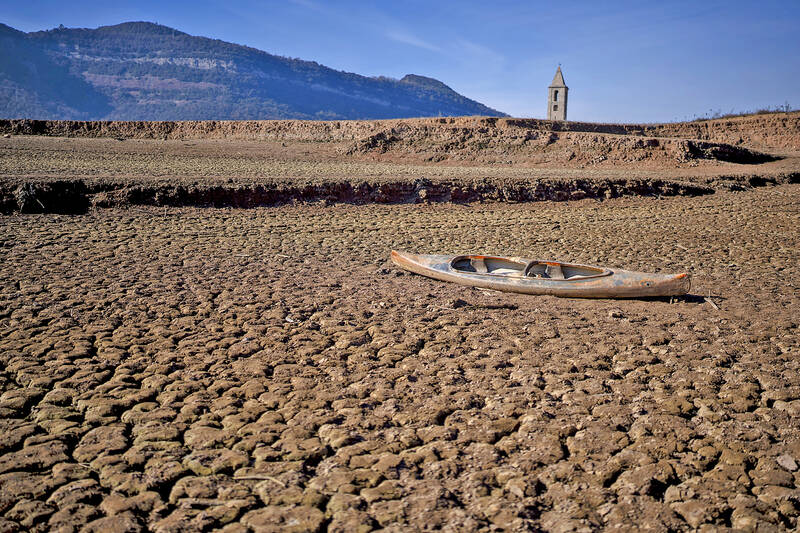
Photo: AP
As climate communications are increasingly scrutinized, there has been a rise in climate-washing litigation, often with positive outcomes for those bringing the cases. Of the 140 climate-washing cases reviewed between 2016 and last year, 77 have officially concluded, 54 of which ended with a ruling in favor of the claimant.
More than 30 cases in 2023 concerned the “polluter pays” principle, whereby companies are held accountable for climate damage caused by high greenhouse gas emissions. The authors also highlighted six “turning off the taps” cases, which challenge the flow of finance to areas which hinder climate goals.
The US accounted for the vast majority of litigation cases filed last year, with 129 cases. The UK was second, with 24 cases while 10 were filed in Brazil.

Photo: AP
Climate litigation cases were filed for the first time in Panama and Portugal last year. This means that 55 countries have now recorded climate cases, with a growing number of litigation cases arising in the global south, which accounts for about 8 percent of all cases.
While the majority of climate litigation cases are still filed against governments, an increasing number are being filed against companies, with an imbalance between the US and the rest of the world — 40 percent of cases outside the US were filed against companies, while in the US just 15 percent of cases involved companies.
The authors cautioned that while “some types of cases, such as government framework cases, have already had lasting impacts on domestic climate governance … the long-term implications of other case types, such as climate-washing cases, remain unclear.”

Photo: AP
A report published by the UN environment program (Unep) and the Sabin Center for Climate Change Law at Columbia University last year highlighted the importance of litigation for climate action around the world.
“Climate litigation … has become an undeniably significant trend in how stakeholders are seeking to advance climate action and accountability,” said Andy Raine, the head of international environment law at Unep.
One of the most prominent litigation cases of last year was the Montana ruling, where a judge ruled in favor of young Montana residents’ claims that state officials had infringed on their right to a clean and healthy environment by promoting fossil fuels.
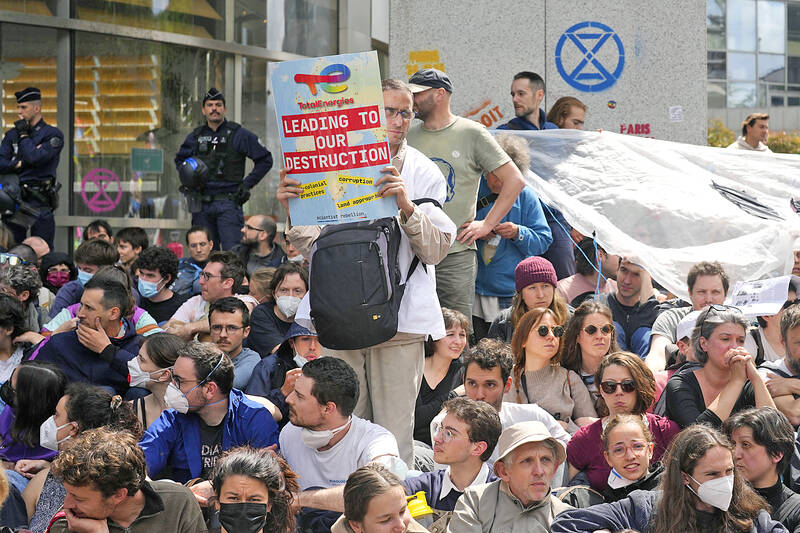
Photo: AP
Last week, the UK’s supreme court handed down a landmark judgment ruling that the emissions impact of burning coal, oil and gas should be factored into planning applications for new extraction projects, after a local campaigner challenged Surrey county council’s decision to give planning permission to an oil-drilling well at Horse Hill.
Lawsuits against companies are less established, but have met with some success in shifting corporate behaviors. Shell, the Dutch airline KLM and the Australian oil company Santos are just a few of the targets of a plethora of climate-related legal challenges in the private sector.
Last year, the London School of Economics and Political Science in a paper showed that climate litigation filings or unfavorable court decisions reduced firms’ value on the stock market by an average of -0.41 percent.


The US war on Iran has illuminated the deep interdependence of Asia on flows of oil and related items as raw materials that become the basis of modern human civilization. Australians and New Zealanders had a wake up call. The crisis also emphasizes how the Philippines is a swatch of islands linked by jet fuel. These revelations have deep implications for an invasion of Taiwan. Much of the commentary on the Taiwan scenario has looked at the disruptions to world trade, which will be in the trillions. However, the Iran war offers additional specific lessons for a Taiwan scenario. An insightful

The problem with Marx’s famous remark that history repeats itself, first as tragedy, the second time as farce, is that the first time is usually farce as well. This week Chinese Nationalist Party (KMT) Chair Cheng Li-wun (鄭麗文) made a pilgrimage to the People’s Republic of China (PRC) “to confer, converse and otherwise hob-nob” with Chinese Communist Party (CCP) officials. The visit was an instant international media hit, with major media reporting almost entirely shorn of context. “Taiwan’s main opposition leader landed in China Tuesday for a rare visit aimed at cross-strait ‘peace’”, crowed Agence-France Presse (AFP) from Shanghai. Rare!

Polling data often confirms what we expect, but sometimes it throws up surprises. When examined over time, some patterns appear that speak to something bigger going on. In this column, whenever possible, Formosa’s polls are used. Despite the sometimes cringeworthy antics of Formosa’s Chairman, Wu Tzu-Chia (吳子嘉), the data produced includes detailed breakdowns crucial for analysis. It has also been conducted monthly 11-12 times a year for many years with many of the same questions, allowing for analysis over time. When big shifts do occur between one month and the next it is usually in response to some event in

April 6 to April 13 Few expected a Japanese manga adaptation featuring four tall, long-haired heartthrobs and a plucky heroine to transform Taiwan’s television industry. But Meteor Garden (流星花園) took the nation by storm after premiering on April 12, 2001, single-handedly creating the “idol drama” (偶像劇) craze that captivated young viewers across Asia. The show was so successful that Japan produced its own remake in 2005, followed by South Korea, China and Thailand. Other channels quickly followed suit, with more than 50 such shows appearing over the following two years. Departing from the melodramatic


 RSS
RSS