


Mark O’Neill is full of gratitude.
He is grateful for his opportunities as a young journalist reporting from Northern Ireland during the Troubles; grateful to his boss at BBC Ulster who recommended O’Neill for a job at Radio Television Hong Kong; grateful to his colleagues at the station for “leading this blind man through the forest;” grateful to a Taiwanese friend who encouraged him to study Mandarin in Taiwan in 1981; and he is grateful for “the friendship of many kind Taiwanese” he met during the two-and-a-half years he spent here during his first stay.
This positive impression of Taiwan and its people has endured.
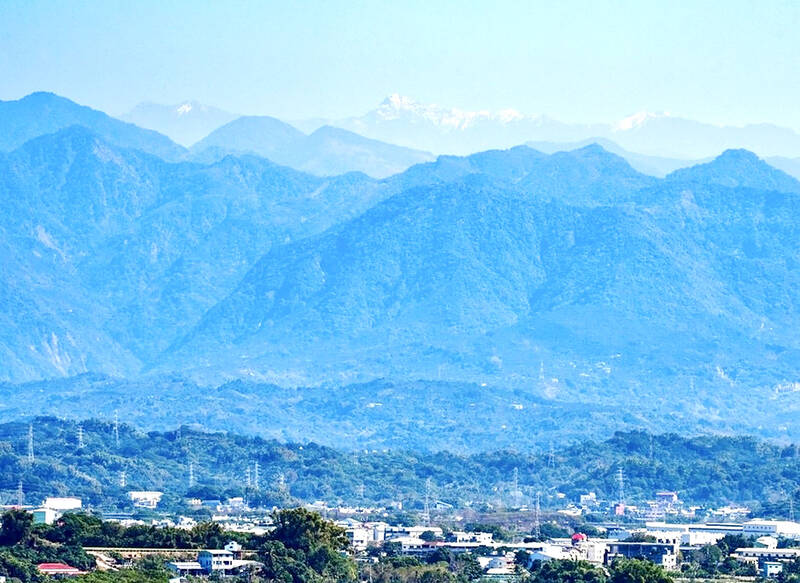
Photo courtesy of reader
“The people have always been polite, friendly and humorous,” O’Neill tells the Taipei Times.
On subsequent visits, he has found that little has changed in that regard.
“The only difference since July 1987 [when martial law was lifted] is that they have become more relaxed, freer to speak, think and wear as they wish.”
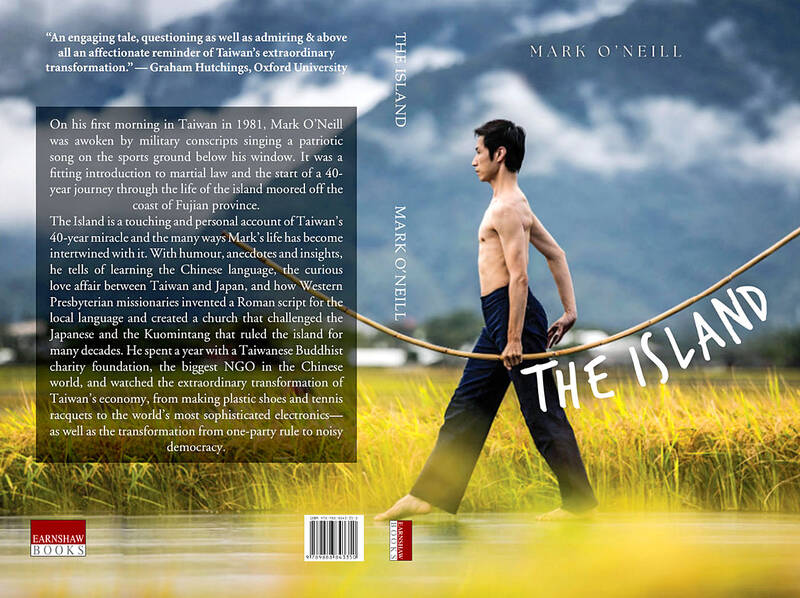
Photo courtesy of Earnshaw Books
For this reason, O’Neill is delighted to have finally produced a testament to Taiwan and its people: The Island — the story of Taiwan’s transition into a democracy and economic powerhouse. It is, writes O’Neill in the book’s foreword, “one of the most remarkable transformations in the world.”
To introduce the book, O’Neill will give a presentation on Thursday from 2pm to 5:30pm at Sense Forest Coffee Shop (思享森林咖啡共享空間), 2F, 245 Roosevelt Road, Sec 3, Taipei City (台北市羅斯福路三段245號2樓). Admission is free. O’Neill will also introduce the book at the expat run Breakfast Club in Taipei on Sunday. For more information, contact Linda: linda2007@tmu.edu.tw.
Emphasizing that the book is a personal account, as he is neither “knowledgeable nor qualified enough to write a comprehensive history,” O’Neill nonetheless hopes his reflections will help explain Taiwan’s transformation.
Photo: Huang Ming-tang, Taipei Times
Having previously published books on Taiwan-related subjects, including a history of the (National) Palace Museums in Taipei and Beijing and a biography of Faina Chiang Fang-liang (蔣方良), the wife of Taiwan’s late president Chiang Ching-kuo (蔣經國) (reviewed in Taipei Times Aug. 6, 2020), O’Neill again speaks appreciatively of the assistance he received with his research.
INSPIRATIONAL MEETING
“Everyone was most helpful in providing material and answering questions,” he says.
In fact, the idea for the work on the museums emerged from an “inspirational” encounter with Chou Kung-hsin (周功鑫), former director of Taiwan’s National Palace Museum.
“[Chou] told the story of the 16-year odyssey of the art treasures across the mainland [sic], and finally Taiwan; it was hypnotic.”
Since the publication of his first book in 2006, an account of the Buddhist Compassion Relief Tzu Chi Foundation (佛教慈濟慈善事業基金會), O’Neill has been prolific. To date, he has released 15 titles, more than half of them in both Chinese and English.
He credits Hong Kong’s Joint Publishing —the publisher for nine of his books —and former deputy chief editor Anne Lee (李安), who “graciously took a bet on a person she barely knew.”
BIOGRAPHICAL FOCUS
Reflecting on a fruitful working relationship, he says Lee helped shape his focus on biographies of historical figures. These include studies of Irish-born British diplomat and Qing Dynasty official Sir Robert Hart; twentieth century China’s most influential intellectual, Hu Shih (胡適); and O’Neill’s own grandfather, Frederick, an Irish missionary in Manchuria from 1897 until his expulsion by the Japanese in 1942.
“Anne liked biographies of eminent people, so we chose grandfather, Sir Robert Hart and Hu Shih,” O’Neill says.
His latest biography, The Man Who Made a Literate Nation — on the life of Zhou Youguang (周有光), the developer of the Hanyu Pinyin romanization system — will be spotlighted in a talk at the Taipei International Book Exhibition on Friday at 2:15pm.
Another life story — on Liang Sicheng (梁思成), considered the father of modern Chinese architecture — is in the works. Again, O’Neill praises Lee for setting the process in motion.
“God bless Anne Lee!” he says. “Without her, none of this would have happened.”
SPIRITUAL BENT
As this last exclamation demonstrates, O’Neill also recognizes a higher power as having steered and smoothed his path as a writer.
Entwined with connections to Ireland and China, religion pervades O’Neill’s life and family history. Both his missionary grandfather and father studied at Belfast’s Queen’s University, and — as mentioned — the younger O’Neill cut his teeth covering the Northern Ireland at the height of the Troubles.
He explores these and other connections between Ireland and China in Out of Ireland (2023). Following the release of Frederick: The Life of My Missionary Grandfather in 2012, O’Neill visited the church his forbear founded in Faku County (法庫) in Liaoning Province (遼寧), China. There, he presented 20 copies of the book to the pastor and his congregation.
“Some members wept; they said that it was the first time they learned of how the Word came to their town,” says O’Neill. “That day God, and grandfather, were smiling on us, one of the most unforgettable of our lives.”
Despite the strong Christian bent of O’Neill’s language, he is not exclusively attached to one religion and sees “no conflict” in a spirituality that encompasses multiple expressions of faith.
SOFT POWER PROJECTION
His year working alongside Tzu Chi volunteers, during which he accompanied them on trips to Jakarta, Durban and Los Angeles, was revelatory.
In particular, he was immediately impressed by the movement’s founder Dharma Master Cheng Yen (證嚴).
“After entering her room, I realized I was in the presence of an extraordinary person,” he says.
The charitable works he observed also left him profoundly moved, and he recalls one South African volunteer saying, “when I die, I do not want to go to Heaven, but to Hualien,” where Tzu Chi was founded.
He believes that such efforts are “among the greatest contributions of Taiwan to the world.” More generally, he believes Taiwan’s civil society has helped project the country’s image and influence.
“Much of Taiwan’s soft power abroad comes from its NGOs,” he says.
Looking forward to his latest visit, O’Neill reflects on Taiwan’s progress since he first arrived more than 40 years ago. The recent presidential election is, he thinks, a perfect example.
“The campaigning was passionate, non-violent and transparent; there was a high turnout; and after the result was announced, [Chinese Nationalist Party KMT candidate] Hou You-yi (候友宜) accepted it and apologized to his supporters,” says O’Neill “Western democracies should learn from this.”
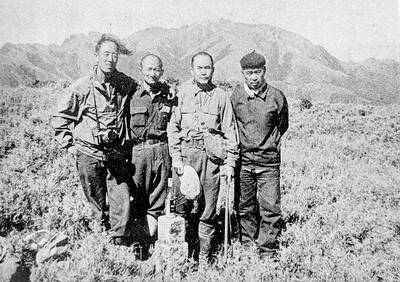
May 18 to May 24 Gathered on Yangtou Mountain (羊頭山) on Dec. 5, 1972, Taiwan’s hiking enthusiasts formally declared the formation of the “100 Peaks Club” (百岳俱樂部) and unveiled the final list of mountains. Famed mountaineer Lin Wen-an (林文安) led this effort for the Chinese Alpine Association (中華山岳協會). Working with other experienced climbers, he chose 100 peaks above 10,000 feet (3,048m) that featured triangulation points and varied in difficulty and character. The list sparked an alpine hiking craze, inspiring many to take up mountaineering and competing to “conquer” the summits. A common misconception is that the 100 Peaks represent Taiwan’s 100 tallest

Yesterday, the Democratic Progressive Party (DPP) nominated legislator Puma Shen (沈伯洋) as their Taipei mayoral candidate, the Chinese Nationalist Party (KMT) put their stamp of approval on Wei Ping-cheng (魏平政) as their candidate for Changhua County commissioner and former legislator Tsai Pi-ru (蔡壁如) of the Taiwan People’s Party (TPP) has begun the process to also run in Changhua, though she has not yet been formally nominated. All three news items are bizarre. The DPP has struggled with settling on a Taipei nominee. The only candidate who declared interest was Enoch Wu (吳怡農), but the party seemed determined to nominate anyone
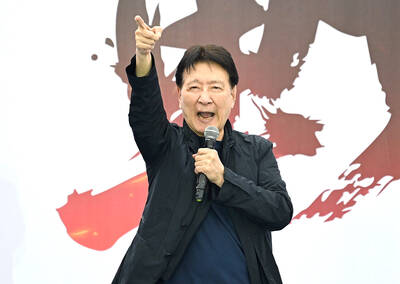
In a sudden move last week, opposition lawmakers of the Chinese Nationalist Party (KMT) and Taiwan People’s Party (TPP) passed a NT$780 billion special defense budget as a preemptive measure to stop either Chinese leader Xi Jinping (習近平) or US President Donald Trump from blocking US arms sales to Taiwan at their summit in Beijing, said KMT heavyweight Jaw Shaw-kong (趙少康), speaking to the Taipei Foreign Correspondents Club on Wednesday night in Taipei. The 76-year-old Jaw, a political talk show host who ran as the KMT’s vice presidential candidate in 2024, says that he personally brokered the deal to resolve
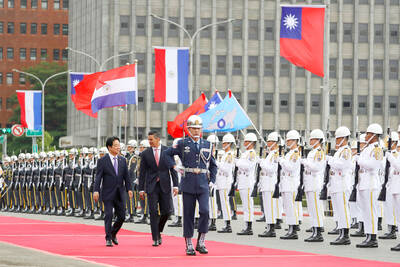
“China wants to unify with Taiwan at the lowest possible cost, and it currently believes that unification will become easier and less costly as time passes,” wrote Amanda Hsiao (蕭嫣然) and Bonnie Glaser in Foreign Affairs (“Why China Waits”) this month, describing how the People’s Republic of China (PRC) is playing the long game in its quest to seize Taiwan. This has been a favorite claim of many writers over the years, easy to argue because it is so trite. Very obviously, if the PRC isn’t attacking Taiwan, it is waiting. But for what? Hsiao and Glaser’s main point is trivial,


 RSS
RSS