


Every day, nearly 60 fully loaded very large crude-oil carriers sail between the Persian Gulf and Chinese ports, carrying about half of the oil that powers the world’s second-largest economy.
As the vessels enter the South China Sea, they ply waters increasingly controlled by China’s growing military, from the missile batteries and airfields at its bases on disputed islands to its stealthy Type 055 destroyers.
But when crossing the Indian Ocean, joined by others headed to China from Africa and Brazil, these tankers lack protection in a naval theater dominated by the US.
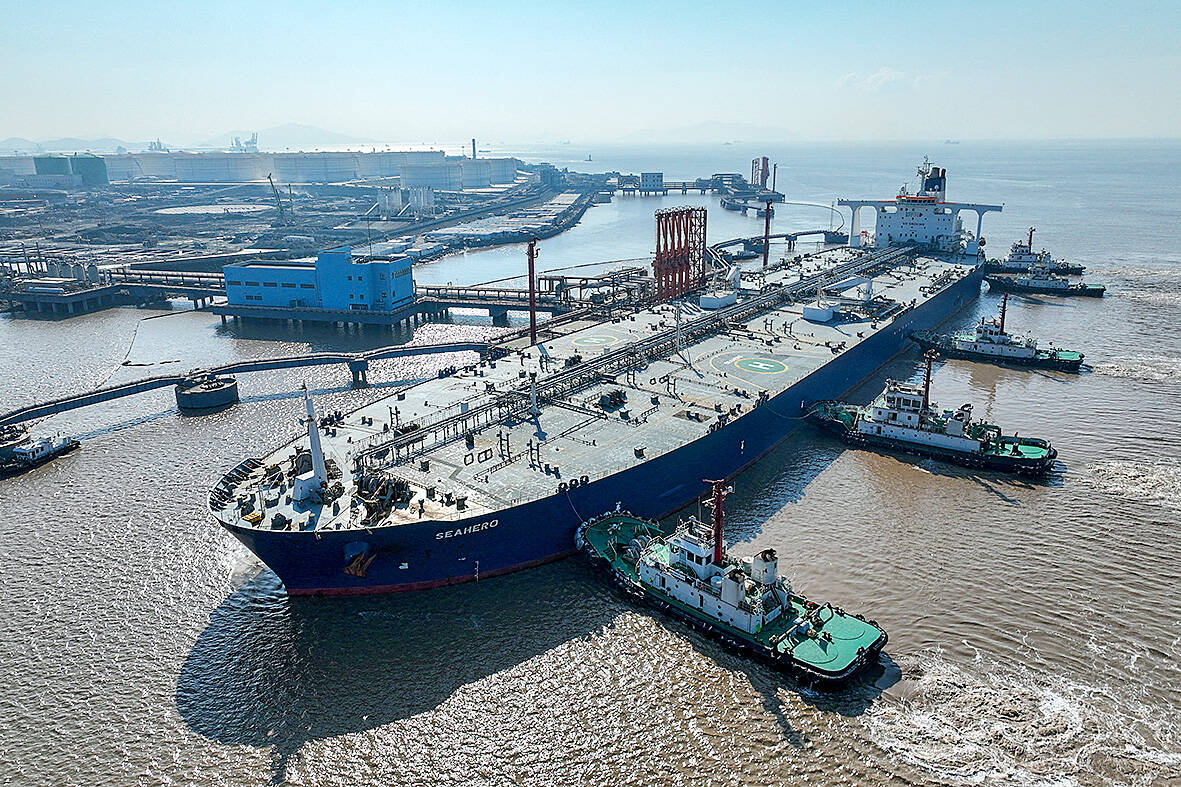
Photo: Reuters
A dozen military attaches and scholars say that vulnerability is now being scrutinized as Western military and academic strategists discreetly game scenarios about how a conflict with China over Taiwan, or elsewhere in East Asia, could evolve or escalate.
In a major war, Chinese oil tankers in the Indian Ocean “would find themselves very vulnerable,” said David Brewster, a security scholar at the Australian National University.
“Chinese naval vessels would effectively be trapped in the Indian Ocean and ... they would have little or no air support, because there are no bases or facilities of its own that (China) could rely on.”
Four envoys and eight analysts familiar with discussions in Western and Asian capitals, some speaking on the condition of anonymity to discuss a sensitive topic, said this enduring weakness gives China’s adversaries a ladder of escalatory options, especially in a drawn-out conflict, like Russia’s war on Ukraine.
These scenarios range from harassment and interdiction operations against Chinese shipping that could divert Chinese naval vessels to the region, up to a blockade and beyond.
In a full-scale war, the tankers — capable of carrying 2 million barrels of oil — would be prizes to be sunk or captured, reflecting naval actions of last century in which combatants targeted their enemies’ economic resources, three analysts said.
These options could be used to dissuade China from launching action, or later to raise costs on an invasion of Taiwan.
Less clear is how this vulnerability shifts Beijing’s calculations toward Taiwan, the people said.
China’s defense ministry did not respond to questions about its position in the Indian Ocean.
Chinese strategists are aware of the problem but ultimately any decision to launch military action would be taken by President Xi Jinping (習近平), according to People’s Liberation Army (PLA) documents and retired officers.
Xi has instructed the PLA to be ready to invade Taiwan by 2027, US Central Intelligence Agency Director William Burns said in February. China has been increasing military manoeuvers ahead of the nation’s elections in January.
Since taking power in 2013, Xi and other Communist Party leaders have stressed the importance of a modernized military that can project power globally and secure China’s vital trade routes.
But amid fears of conflict, some of the analysts said China would struggle to protect these lifelines even as its energy demands increase, making a protracted war over Taiwan difficult to sustain.
China imported 515.65 million tons of crude oil in the 11 months through last month, or 11.27 million barrels per day, official data show, an annual increase of 12.1 percent.
The Pentagon estimates about 62 percent of China’s oil and 17 percent of its natural gas imports transit the Malacca Strait and South China Sea, key Indian Ocean gateways.
China is moving to diversify supplies, with three pipelines from Russia, Myanmar and Kazakhstan accounting for roughly 10 percent of its crude-oil imports last year, according to customs data and state media.
Western sanctions on Moscow after its invasion of Ukraine have also led China to stockpile more cheap oil from Russia, its top supplier.
Food is a more complex picture. China’s soybean imports — used for animal feed — are shipped in part via the Indian Ocean but other commodities such as potash, needed for fertilizer, arrive via other routes.
BASE SURROUNDED
China has an extensive network of military satellites but just one dedicated military base, and no air cover from land or sea, for Indian Ocean naval deployments.
In its October annual report on China’s military, the Pentagon lists 11 potential Chinese bases on the ocean’s fringes, including Pakistan, Tanzania and Sri Lanka. Those locations reflect Chinese diplomatic and commercial outreach under Xi’s Belt and Road Initiative.
But these have not emerged as hard military assets, with neither a permanent PLA presence nor publicly known guarantees of access in a conflict, the attaches and an Asian diplomat said.
The Pentagon report notes, in language used for the first time this year, that China still “has little power projection capability” in the Indian Ocean.
China’s initial overseas base in Djibouti, on the ocean’s western edge, opened in 2017 and hosts 400 marines, reflecting Chinese involvement in international piracy patrols around the Horn of Africa since 2008.
But the base has no airfield and is flanked by military facilities of seven other countries, including the US, France and Britain.
The US Indian Ocean presence remains in stark contrast, reflecting its Cold War build-up.
The US 5th Fleet is based in Bahrain while the Japan-headquartered 7th Fleet operates out of Diego Garcia, a UK-administered atoll with runways for long-range bombers and a lagoon adapted to house US aircraft carriers.
To the east, Australia is increasing patrols using its submarine-hunting P-8 Poseidon aircraft and is expanding a west-coast base for British and US nuclear-powered submarines and, eventually, Australian nuclear-powered boats.
WORK IN PROGRESS
Zhou Bo, a retired PLA senior colonel and a security fellow at Beijing’s Tsinghua University, said he was aware of foreign debates about China’s vulnerabilities but the scenarios were hypothetical.
Should China and the West clash militarily in the Indian Ocean, such a conflict by nature would be “almost uncontrollable” in scale and location, Zhou said.
“At that point it is a major war involving a lot of countries,” he said.
Still, he said, China would gradually expand deployments and basing options to strengthen its position.
Military attaches and analysts tracking Indian Ocean deployments say China generally maintains four or five surveillance vessels and a similar number of warships and an attack submarine at any time. But China is yet to test its most potent assets in the Indian Ocean, one former Western intelligence analyst said.
Some analysts expect that to change, particularly as PLA documents stress the piracy patrols’ importance in protecting Indian Ocean supply lines. China could expand patrols if “hegemonic countries” exercise control over its vital transit routes, according to the 2020 Science of Military Strategy, an official paper outlining China’s strategic priorities.
While China’s navy keeps its nuclear-armed ballistic-missile submarines near their Hainan Island base, its attack submarines are expected to range more widely as they improve, a challenge to the US.
“We can see they are being cautious, definitely more cautious than expected,” said retired US Rear Admiral Michael McDevitt, who in a 2020 book predicted an eventual major Chinese military presence to protect Indian Ocean sea lanes.
“I’m not saying they are not going to get there, but it does seem they are not comfortable yet, particularly with their aircraft carriers - and extending air cover will be vital for them in a conflict.”

What was the population of Taiwan when the first Negritos arrived? In 500BC? The 1st century? The 18th? These questions are important, because they can contextualize the number of babies born last month, 6,523, to all the people on Taiwan, indigenous and colonial alike. That figure represents a year on year drop of 3,884 babies, prefiguring total births under 90,000 for the year. It also represents the 26th straight month of deaths exceeding births. Why isn’t this a bigger crisis? Because we don’t experience it. Instead, what we experience is a growing and more diverse population. POPULATION What is Taiwan’s actual population?

For the past five years, Sammy Jou (周祥敏) has climbed Kinmen’s highest peak, Taiwu Mountain (太武山) at 6am before heading to work. In the winter, it’s dark when he sets out but even at this hour, other climbers are already coming down the mountain. All of this is a big change from Jou’s childhood during the Martial Law period, when the military requisitioned the mountain for strategic purposes and most of it was off-limits. Back then, only two mountain trails were open, and they were open only during special occasions, such as for prayers to one’s ancestors during Lunar New Year.

You would never believe Yancheng District (鹽埕) used to be a salt field. Today, it is a bustling, artsy, Kowloon-ish “old town” of Kaohsiung — full of neon lights, small shops, scooters and street food. Two hundred years ago, before Japanese occupiers developed a shipping powerhouse around it, Yancheng was a flat triangle where seawater was captured and dried to collect salt. This is what local art galleries are revealing during the first edition of the Yancheng Arts Festival. Shen Yu-rung (沈裕融), the main curator, says: “We chose the connection with salt as a theme. The ocean is still very near, just a
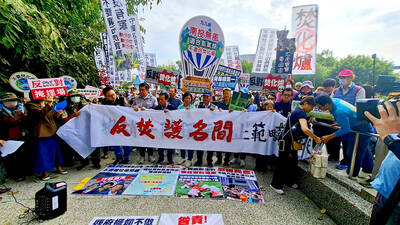
A key feature of Taiwan’s environmental impact assessments (EIA) is that they seldom stop projects, especially once the project has passed its second stage EIA review (the original Suhua Highway proposal, killed after passing the second stage review, seems to be the lone exception). Mingjian Township (名間鄉) in Nantou County has been the site of rising public anger over the proposed construction of a waste incinerator in an important agricultural area. The township is a key producer of tea (over 40 percent of the island’s production), ginger and turmeric. The incinerator project is currently in its second stage EIA. The incinerator


 RSS
RSS