


China has developed a network-mapping project targeting political figures and parties in Taiwan to monitor public opinion during elections and to craft tailored influence campaigns aimed at dividing Taiwanese society, according to documents leaked by Chinese technology firm GoLaxy (中科天璣).
The documents, collected by Taipei-based Doublethink Lab, showed a database was specifically created to gather detailed information on Taiwanese political figures, including their political affiliations, job histories, birthplaces, residences, education, religion and a brief biography about them.
Several notable Taiwanese politicians are in the database, including President William Lai (賴清德), former president Tsai Ing-wen (蔡英文), Minister of Foreign Affairs Lin Chia-lung (林佳龍), Minister Without Portfolio Chen Shih-chung (陳時中), former Taipei mayor Ko Wen-je (柯文哲) and Kaohsiung Mayor Chen Chi-mai (陳其邁).
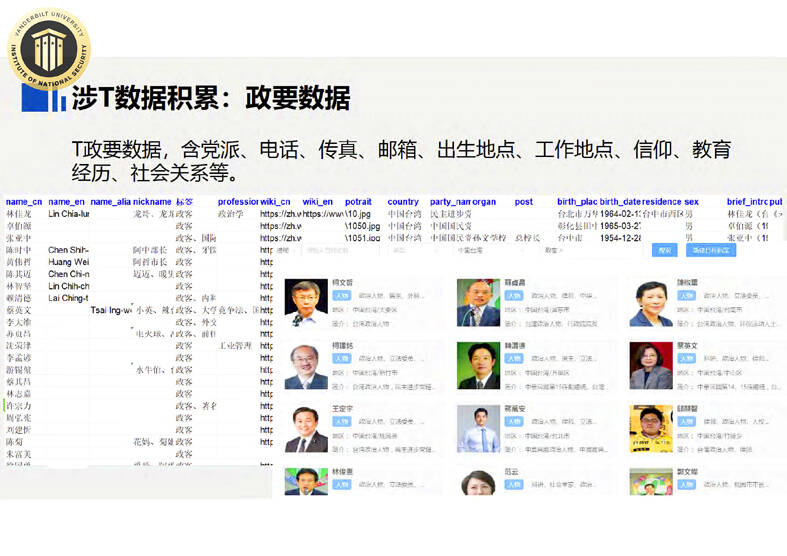
Photo: screen grab from GoLaxy documents
It also includes records of tens of thousands of Taiwanese prominent in religion, academia and business.
The Beijing-based data firm also created a Taiwan-related knowledge graph about Taiwanese political parties, both large and small.
Aside from a political party’s date of establishment, founders, current leaders, estimated number of members, contact information and attitude toward China, the graph also supports inquiries by connecting party leaders, their offices and geographical coordinates. The function allows its users to find the “pan-green” politicians organizing anti-China campaigns in specific localities and identify “pan-blue” politicians controlling key choke points of the Taiwanese political system.
The structured dataset further enables users to conduct virtual-real mapping with more than 6.2 million news articles and social media posts, at least 10,000 Taiwan-related sources worldwide, and about 5,000 key social media accounts identified as targets, the GoLaxy papers showed.
Overall, the database contains 170 detailed files of Taiwanese politicians, about 23 million records of Taiwan household registration data from closed sources, as well as information about 75 Taiwanese political parties, 1,478 Taiwanese firms, 13,000 Taiwanese religious groups and nearly 24,000 Taiwanese civic organizations.
Meanwhile, the leaked papers showed a Taiwan Online Public Opinion Weekly Report, which was published at the end of 2023 before the 2024 presidential and legislative elections. The report said it had tracked 634,448 records of online content posted between Nov. 25 and Dec. 1, 2023, including original posts and responses to those posts.
The report also tracked and analyzed the competing narratives among the presidential candidates of the Democratic Progressive Party, the Chinese Nationalist Party (KMT) and the Taiwan’s People Party (TPP), the papers showed.
It identified moments when there was a sudden rise of media exposure for Ko, the then-TPP presidential candidate, and then-KMT presidential and vice presidential candidates Hou You-yi (侯友宜) and Jaw Shaw-kang (趙少康), while assessing how the DPP was able to shape public opinion through issues such as the cross-strait service trade agreement.
The report also prioritized attacks against Jaw and former TPP legislator Cynthia Wu (吳欣盈), who at the time was Ko’s vice presidential candidate, their responses and evaluated how the interactions swayed voters.
GoLaxy said that the information of Taiwanese politicians was collected to support the narrative wars in Taiwan.
One of the projects was to collect at least 50,000 Taiwan-related news articles and put the people mentioned into “hardliner,” “friendly faction,” “swing group” and “objective group” categories.
Each category contained at least 1,000 key personnel, making it easier to associate with divisive campaigns.
Another project is to simulate the preferences, cognition and language styles of target audiences and create virtual characters speaking in Mandarin, Hoklo (commonly known as Taiwanese) and English to interact with them in scripted dialogues.
At least 100 virtual characters were created to interact with target audiences using text, photographs, audio files and videos in more than 10 virtual scenarios, the papers showed.
Separately, an investigation by Reporters Without Borders said that Beijing is seeking to export its model of media control by expanding the global reach of state-run China Global Television Network (CGTN) to push its narratives, spread biased reporting, shape international opinion and conceal its human rights abuses.
“CGTN effectively advances state narratives and serves as a mouthpiece for the [Chinese Communist] Party’s propaganda apparatus. Diktats include instructions on the vocabulary to use and the information to report when covering ‘sensitive’ subjects such as Tibet, repressions in the Uighur region, Taiwan or pro-democracy movements, often portraying the government in a positive light despite the constant criticism of its human rights abuses,” the reporters Without Borders report said.
“It also amplifies the narratives of allied authoritarian regimes, including Russia. One month after the Russian invasion of Ukraine, a CGTN social media account repeated Russian President Vladimir Putin’s unsubstantiated accusation that ‘Ukrainian neo-nazis opened fire on Chinese students,’” it said.

DRONE CENTRAL: Taiwan aims to become Asia’s democratic hub for drones, with most exports focused on high-quality military-grade models, an official said Taiwan’s drone industry is expected to expand significantly by 2030, producing 100,000 units per month and exporting half of them, the Ministry of Economic Affairs said yesterday. Current drone production capacity is about 15,000 units per month, but the industry can quickly scale up as demand increases, Industrial Development Administration Director-General Chiou Chyou-huey (邱求慧) told a news conference in Taipei. Taiwan’s drone output grew 2.5-fold last year to NT$12.9 billion (US$408.3 million) under a government program to develop the uncrewed vehicle sector, he said. The Executive Yuan in October last year approved plans to invest NT$44.2 billion into domestic production of uncrewed aerial
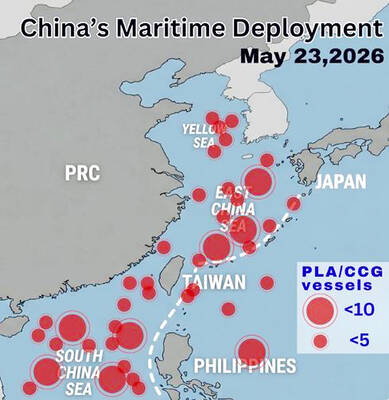
WARNING: China should stop engaging in actions that undermine regional peace and stability, as it would only build resentment among people across the Strait, the CGA said China has deployed more than 100 navy, coast guard and other vessels in waters from the Yellow Sea to the South China Sea and the western Pacific since US President Donald Trump and Chinese President Xi Jinping (習近平) met in Beijing, National Security Council Secretary-General Joseph Wu (吳釗燮) said yesterday. “In this part of the world, #China is the one & only PROBLEM wrecking the #StatusQuo & threatening regional peace & stability,” Wu wrote on X. In a separate post, he said Beijing was coercing Taiwan’s maritime domain, calling it illegal and provocative, after the Coast Guard Administration (CGA) expelled a

VERBOSE VESSELS: A CGA cutter and a China Coast Guard exchanged verbal barbs for more than a day in Taiwanese-controlled waters before the Chinese vessel left The Taiwanese and Chinese coast guards had a standoff near the strategically located Pratas Islands (Dongsha Islands, 東沙群島) in the north of the South China Sea, the Coast Guard Administration (CGA) said yesterday. The two sides engaged in intense radio exchanges over sovereignty claims during the 33-hour standoff. China Coast Guard vessel 3501 eventually left the restricted waters, 26.6 nautical miles (49.2km) west of the Pratas Islands, at 5pm yesterday, the CGA said. Lying approximately between southern Taiwan and Hong Kong, the Taiwan-controlled Pratas are seen by some security experts as vulnerable to Chinese attack due to their distance — more than
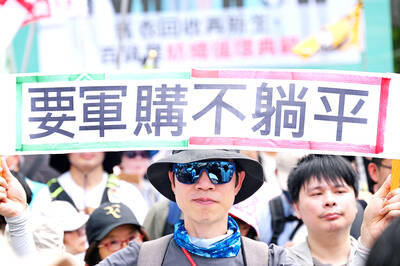
More than 8,000 people took part in a rally in Taipei yesterday to express support for more defense spending, after the opposition slashed the Cabinet’s proposed NT$1.25 trillion (US$39.6 billion) special defense budget and capped it at NT$780 billion. The demonstrators urged the Cabinet to propose another bill. Taiwan Economic Democracy Union convener Lai Chung-chiang (賴中強) said the main problem of the passed budget plan is the removal of funding for critical items, not just that the total amount is smaller. Critical budget items included purchasing or developing uncrewed vehicles, Strong Bow (強弓) missile systems, additional ammunition, artificial intelligence-powered combat systems and Taiwan-US


 RSS
RSS