


The US Army is planning to build new facilities to boost explosives production and strengthen its supply chain, a move aimed at addressing munitions shortages and supporting obligations to partners including Taiwan, Ukraine and Israel, Defense News reported.
The army has issued a sources sought notice for a proposed Center of Excellence at the Blue Grass Army Depot in Kentucky, the report said.
The facility would serve as a hub within the US industrial base for the production of key military explosives, including research department explosives (RDX) and high melting explosives (HMX), while also supporting research and development of next-generation materials.
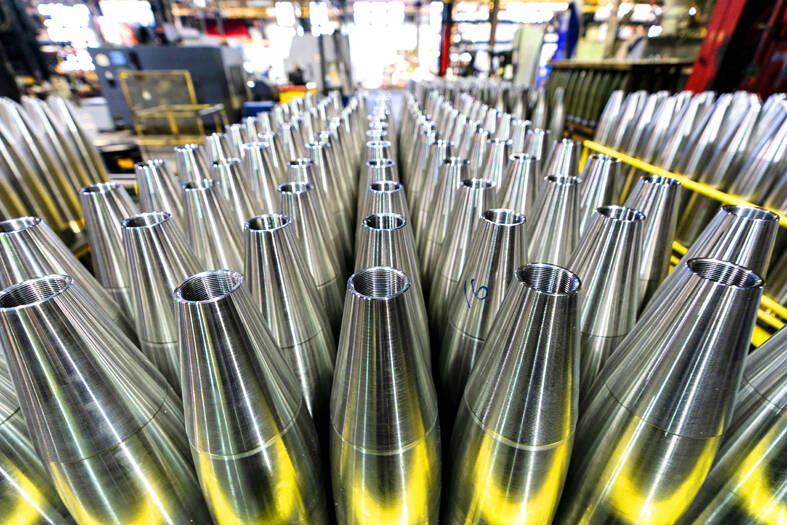
Photo: AP
The proposed center would integrate research laboratories, pilot production lines, full-scale manufacturing, testing, packaging and waste treatment into a single supply chain, the report said.
The army aims to complete the facility by 2031 and prefers a single, integrated campus model, although distributed or networked alternatives would also be considered.
Contractors would be required to submit design proposals and cost estimates, including projected unit costs for RDX and HMX over the next five to 10 years, as well as funding sources and investment plans.
The report said global conflicts have sharply increased demand for munitions, creating bottlenecks in supply.
The US faces additional challenges due to environmental and safety regulations, with its last TNT production facility having closed in the 1980s.
Supply has also been affected by geopolitical factors, as major exporters such as China and Russia have halted shipments to the US, while Poland — a key supplier for NATO — has prioritized domestic needs and support for Ukraine.
Meanwhile the Chungshan Institute of Science and Technology is reportedly to conduct a key live-fire test of the air-launched Hsiung Feng III anti-ship missile on Thursday next week.
If the live-fire test is successful, the missile could be included in the fiscal 2027 defense budget for mass production, sources said.
The upgraded missile is expected to outperform the Harpoon missile, as it is supersonic while the Harpoon is subsonic, former Hsiung Feng III project chief engineer Chang Cheng (張誠) said.
The missile would pose a significant threat to the Chinese People’s Liberation Army Navy and enhance Taiwan’s anti-ship capabilities, Chang said.
Separately yesterday, Minister of National Defense Wellington Koo (顧立雄) said he believed that the US’ internal review process for the sale of a second package of arms to Taiwan is proceeding on schedule.
A major US arms package for Taiwan worth about US$14 billion that includes advanced interceptor missiles is ready for US President Donald Trump’s approval and could be signed after his upcoming trip to China, Reuters reported last week, citing sources briefed on the discussions.
However, Trump on Monday said that he was seeking to delay his visit to China in early next month by about a month because of the Iran war.
Asked if the trip’s postponement could impact the new arms sales to Taiwan, Koo said the government had been coordinating closely with the US.
“As we understand it, their internal review procedures are proceeding on schedule,” he said. “I don’t think we have received any information indicating delays.”
Additional reporting by Reuters

A signaling system malfunction disrupted high-speed rail (HSR) services beginning at 8am today, with trains temporarily reduced to three northbound and three southbound trains per hour as authorities conduct inspections. The malfunction occurred on a section of track in Miaoli County during pre-operation checks early this morning, forcing northbound and southbound trains to use a single track, the HSR operator said. The regular schedule has been replaced with three hourly trains offering only nonreserved seating in each direction, stopping at every station, it said, adding that business class cars would still have reserved seating. Departures from terminal stations are scheduled at the top

Taiwan is still in the process of assessing the possibility of recruiting workers from Eswatini, the Ministry of Foreign Affairs said yesterday, adding that its goal is to help Eswatini upgrade its vocational training centers. If there are plans to recruit workers from Eswatini, safeguarding national security, protecting public health and ensuring the employment rights of Taiwanese would be prerequisites, Department of West Asian and African Affairs Director-General Yen Chia-liang (顏嘉良) told a news conference. Key considerations would also include filling labor shortages in specific industries, and fostering bilateral professional and technical exchanges, he said. Yen was asked about the progress of labor

VERBOSE VESSELS: A CGA cutter and a China Coast Guard exchanged verbal barbs for more than a day in Taiwanese-controlled waters before the Chinese vessel left The Taiwanese and Chinese coast guards had a standoff near the strategically located Pratas Islands (Dongsha Islands, 東沙群島) in the north of the South China Sea, the Coast Guard Administration (CGA) said yesterday. The two sides engaged in intense radio exchanges over sovereignty claims during the 33-hour standoff. China Coast Guard vessel 3501 eventually left the restricted waters, 26.6 nautical miles (49.2km) west of the Pratas Islands, at 5pm yesterday, the CGA said. Lying approximately between southern Taiwan and Hong Kong, the Taiwan-controlled Pratas are seen by some security experts as vulnerable to Chinese attack due to their distance — more than
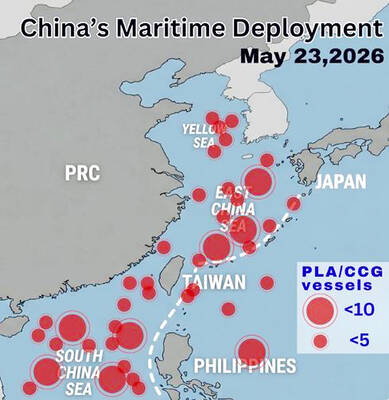
WARNING: China should stop engaging in actions that undermine regional peace and stability, as it would only build resentment among people across the Strait, the CGA said China has deployed more than 100 navy, coast guard and other vessels in waters from the Yellow Sea to the South China Sea and the western Pacific since US President Donald Trump and Chinese President Xi Jinping (習近平) met in Beijing, National Security Council Secretary-General Joseph Wu (吳釗燮) said yesterday. “In this part of the world, #China is the one & only PROBLEM wrecking the #StatusQuo & threatening regional peace & stability,” Wu wrote on X. In a separate post, he said Beijing was coercing Taiwan’s maritime domain, calling it illegal and provocative, after the Coast Guard Administration (CGA) expelled a


 RSS
RSS