


What was the population of Taiwan when the first Negritos arrived? In 500BC? The 1st century? The 18th? These questions are important, because they can contextualize the number of babies born last month, 6,523, to all the people on Taiwan, indigenous and colonial alike.
That figure represents a year on year drop of 3,884 babies, prefiguring total births under 90,000 for the year. It also represents the 26th straight month of deaths exceeding births. Why isn’t this a bigger crisis? Because we don’t experience it. Instead, what we experience is a growing and more diverse population.
POPULATION
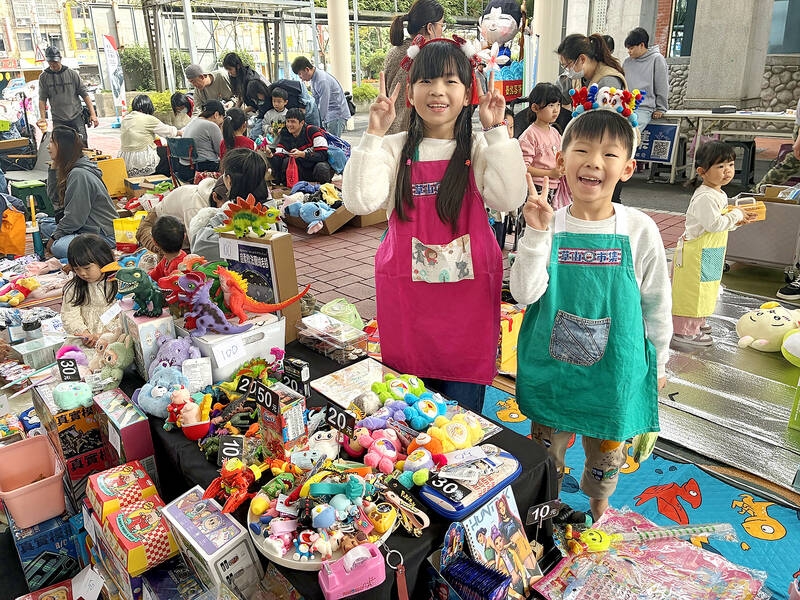
Photo courtesy of Eslite Bookstore
What is Taiwan’s actual population? According to the Directorate-General of Budget and Statistics (DGBAS) it is 23,280,273. To that total, however, must be added a varied collection of residents and visitors.
There were roughly 8.6 million tourism arrivals last year. That adds roughly 750,000 warm bodies a month. Of course, around 1.8 million Taiwanese leave each month, but we don’t notice who is gone, only who is here. Most of the tourists are from Japan, South Korea and other Asian states. They blend right in.
When we think of the foreigners working in Taiwan, migrant workers from southeast Asia, roughly 860,000, stand out. But there is also a growing group of professionals and international student workers, creating a total foreign workforce of well over a million. As of the end of last year, 74,000 students held work visas. Another 90,000 migrant workers are runaways, and they likely have over 10,000, perhaps as many as 20,000, children.
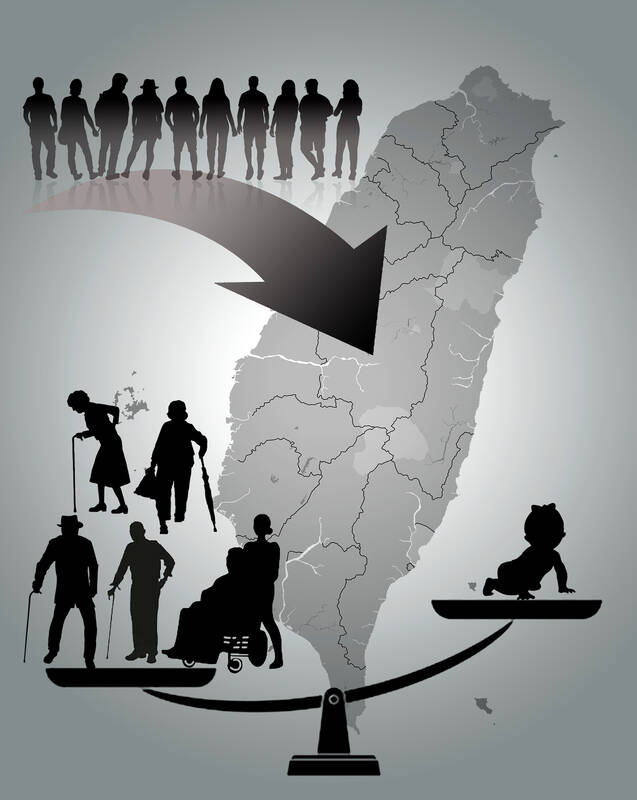
Graphic: Constance Chou
The missing children in Taiwan... are missing. We never saw them anyway, because they were either in school or in cram schools, six days a week. Especially in this last decade or so they are staying indoors playing on their computers and phones. We don’t notice their absence because we never experienced their presence.
Hence, at any given time, the total number of people in Taiwan probably exceeds the government’s population figure by a good million or so. This trend will continue as Taiwan ramps up its hiring of migrant workers. Permanent Taiwanese are being increasingly replaced by temporary foreigners. We don’t experience increasing emptiness, because the overall number of people is rising over time.
A recent report of labor shortages on the island of Matsu off the coast of the People’s Republic of China (PRC) is a glimpse into the future of Taiwan. A human resources survey by the local government showed that “workers aged 45 to 64 made up 51.43 percent of the workforce, while those aged 25 to 44 accounted for 37.19 percent.”
Young workers are extremely difficult to find at any price, and most would rather open up a business of their own than work for someone else. Since there is only a tiny supply of them, young people will have great leverage in future labor markets.
Matsu can attract workers because of its tourist potential, but what will happen to small towns in rural areas in southern Taiwan and similar? The Chinese Nationalist Party (KMT) in the early 90s floated proposals to bring in workers from the PRC to address labor issues. The idea was shelved, but it has reappeared from time to time, most recently in the effort by KMT Legislator Chen Yu-jen (陳玉珍) to have the laws of the offshore islands amended to turn them into a special trade zone for the PRC this year.
This effort to expand PRC influence over the offshore islands go back years. “In earlier versions,” Democratic Progressive Party (DPP) Legislator Puma Shen (沈伯洋) observed, “the bills sought to eliminate all central government authority over the islands, to empower the local governments to directly negotiate with China.”
People have forgotten all the labor proposals floated by the KMT during the years Ma Ying-jeou (馬英九) was president. Ma at one point suggested recognizing credentials from the PRC, a clear indicator that he was considering bringing in PRC workers. The proposed “free economic zones” and processing zones were obvious conduits for PRC goods and human smuggling, but they also appeared to target Taiwan’s cherished quality image. The KMT has returned again and again to these proposals, but as Taiwan ages and the supply of young people dries up, the pressure to implement some of them will only grow.
Consider the south. Ma proposed a “free economic pilot zone” for Kaohsiung. It never took off, but then-mayor Han Kuo-yu (韓國瑜) revived the issue under the DPP administration. Han wanted to expand the zones to include education, finance, international logistics and agricultural product processing. Those were all proposals of Ma, especially education and finance.
FLOODING TAIWAN WITH CHINESE LABOR
Last week I touched on the issue of state-owned land in Taiwan, with a focus on the incinerator project in Nantou County. For that project state-owned land was used, and the farmers leasing it booted off. The National Property Administration (NPA) gave permission for that project even before it had completed its environmental assessment. Its argument in support of this in-by-the-back-door administrative decision was that it had received permission by letter in 1993 to get around land use laws that tied proposed state land use to state land planning needs. The existence of such back doors suggests terrible possibilities.
Put all this together. At present the KMT legislature’s plans to flood Taiwan with PRC labor and goods are frustrated by a DPP administration. What does a KMT presidential win in 2028 augur? Among many things, a far stronger push to bring PRC labor and products into Taiwan. With so much land in government hands, so easily converted to other uses, and a shrinking, aging population that will free up much land as it dies off, especially in farming areas, a KMT administration may simply start designating free trade zones in areas away from the cities in the less densely populated, more pro-DPP south. Previous PRC/KMT policies, such as PRC purchases of Taiwan fruit production, have already targeted farmers in this manner.
In the mid-80s the Taiwan Sugar Corp (Taisugar, 台灣糖業), taking note of the growing wealth generated by niche floriculture enthusiasts in Taiwan, began investing in industrial flower production. It would later go on to create 16 floriculture parks around Taiwan, with cheap rents and imported greenhouse technology, including the massive 175 hectare Taiwan Orchid Plantation located in Tainan. Taiwan is dotted with such small single-industry, government-owned processing zones on state-owned land — effectively government islands — that could easily be re-designated “free economic zones” centered around the original industry, which could then be used as conduits for labor and goods from the PRC. The south, full of ailing traditional industries, could even be convinced that is a form of economic salvation.
Pressure to import labor is already strong, thanks to the government’s complete failure to make meaningful changes to the political economy. The KMT has long struggled to flood Taiwan with people from the PRC.
2028 is just two years away.
Notes from Central Taiwan is a column written by long-term resident Michael Turton, who provides incisive commentary informed by three decades of living in and writing about his adoptive country. The views expressed here are his own.

For many people, Bilingual Nation 2030 begins and ends in the classroom. Since the policy was launched in 2018, the debate has centered on students, teachers and the pressure placed on schools. Yet the policy was never solely about English education. The government’s official plan also calls for bilingualization in Taiwan’s government services, laws and regulations, and living environment. The goal is to make Taiwan more inclusive and accessible to international enterprises and talent and better prepared for global economic and trade conditions. After eight years, that grand vision is due for a pulse check. RULES THAT CAN BE READ For Harper Chen (陳虹宇), an adviser
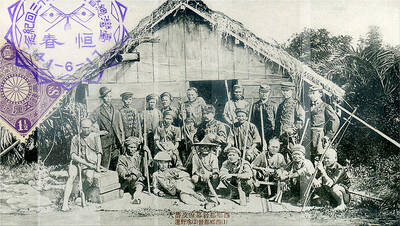
Traditionally, indigenous people in Taiwan’s mountains practice swidden cultivation, or “slash and burn” agriculture, a practice common in human history. According to a 2016 research article in the International Journal of Environmental Sustainability, among the Atayal people, this began with a search for suitable forested slopeland. The trees are burnt for fertilizer and the land cleared of stones. The stones and wood are then piled up to make fences, while both dead and standing trees are retained on the plot. The fences are used to grow climbing crops like squash and beans. The plot itself supports farming for three years.
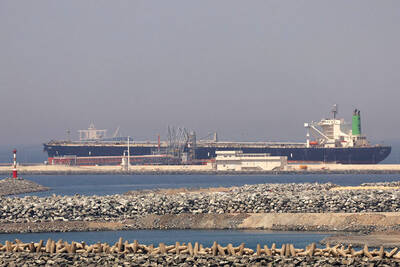
The breakwater stretches out to sea from the sprawling Kaohsiung port in southern Taiwan. Normally, it’s crowded with massive tankers ferrying liquefied natural gas from Qatar to be stored in the bulbous white tanks that dot the shoreline. These are not normal times, though, and not a single shipment from Qatar has docked at the Yongan terminal since early March after the Strait of Hormuz was shuttered. The suspension has provided a realistic preview of a potential Chinese blockade, a move that would throttle an economy anchored by the world’s most advanced and power-hungry semiconductor industry. It is a stark reminder of

May 4 to May 10 It was once said that if you hadn’t performed at the Sapphire Grand Cabaret (藍寶石大歌廳), you couldn’t truly be considered a star. Taking the stage at the legendary Kaohsiung club was more than just a concert. Performers were expected to entertain in every sense, wearing outlandish or revealing costumes and staying quick on their feet as sharp-tongued, over-the-top hosts asked questions and delivered jokes that would be seen as vulgar, even offensive, by today’s standards. Opening in May 1967 during a period of strict political and social control, Sapphire offered a rare outlet for audiences in


 RSS
RSS