


Low-slung buildings, blue huts and somber soldiers dot the border village of Panmunjom inside the DMZ, or demilitarized zone, the swath of land between North and South Korea where a US soldier on a tour crossed into the North under circumstances that remain unclear.
The soldier was on a tour of the storied border town, inside the heavily fortified 248-kilometer-long DMZ, when the crossing happened, US officials said Tuesday. It remained unknown what prompted the soldier’s actions or what the motivations might have been. The soldier was believed to be in North Korean custody.
The DMZ is lined with observation posts on both sides, whose soldiers watch the border and each other carefully for any signs of transgression. North and South Korea remain technically in a state of war since the hostilities in Korean War ended and an armistice was signed — at Panmunjom — in 1953. Neither nation has direct jurisdiction over Panmunjom, where a concrete slab divides the two nations.
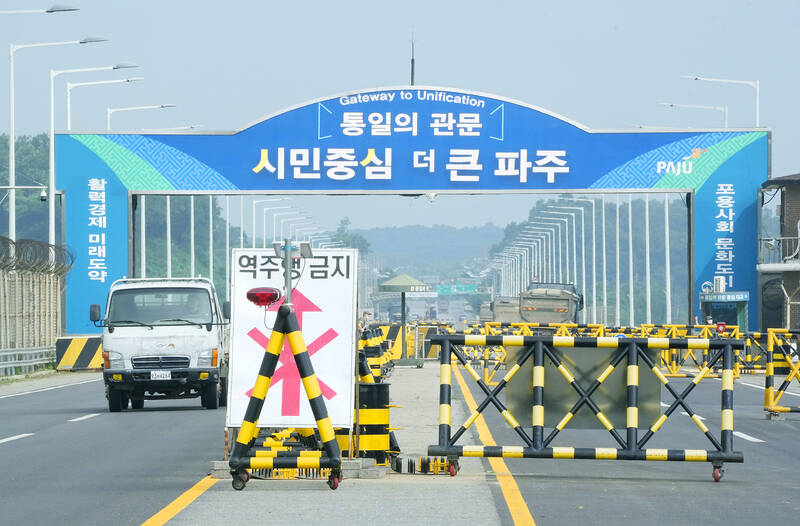
Photo: AP
North Korea, whose formal name is the DPRK, or the Democratic People’s Republic of Korea, maintains tight controls on entry and has been known to punish those who illegally cross the border from South Korea into its territory. Not all of the frontier with South Korea is as strictly patrolled as the DMZ around Panmunjom, though it is unclear how intensively the North patrols its side in more remote areas.
The North under the Kim family and the third-generation current leader, Kim Jong-un, is a tightly controlled society, and very few Americans are in the country at any given time; the two countries have no diplomatic relations and typically conduct any necessary diplomacy through third countries.
While the South Korean side of the DMZ brings in frequent tourists, few North Koreans have ever ventured either to or near their side of the heavily fortified DMZ. On the South Korean side, though, the different areas where tourists are welcomed sometimes take pains to put on a positive spin, with colorful ribbons tied to railings and the occasional ribbon-wielding dancer performing not far from barbed wire and stone-faced soldiers. Cameras are OK in some locations and prohibited in others.
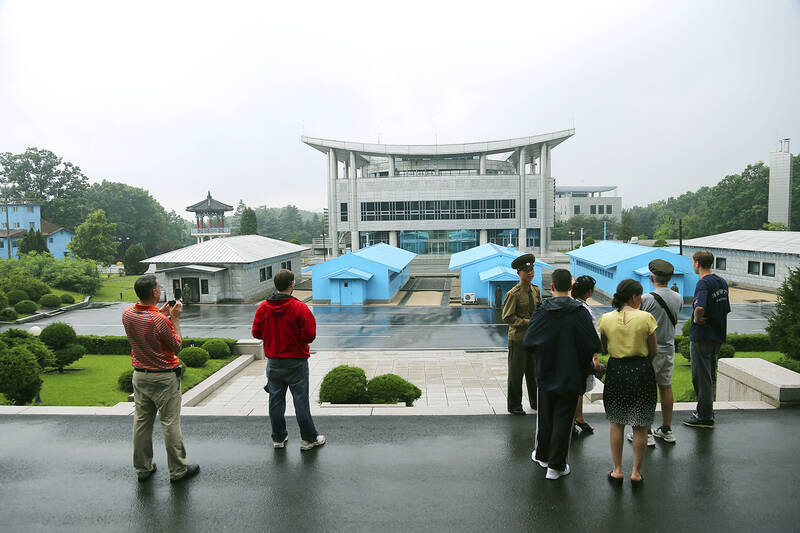
Photo: AP
During the politically inflected 2018 Olympics in the South Korean town of Pyeongchang, journalists were shown the baby blue-colored room in Panmunjom that’s the only spot where high-level talks are held between the two countries. In the room was a large wooden table where talks are held. The border runs right down the middle of it.
At one point during another 2018 visit at another site along the DMZ, an AP illustrator was sketching the view below when a South Korean soldier came over and tore four pages from his book.
Tours to the southern side of Panmunjom reportedly drew around 100,000 visitors a year before the pandemic, when South Korea restricted gatherings to slow the spread of COVID. The tours resumed fully last year.
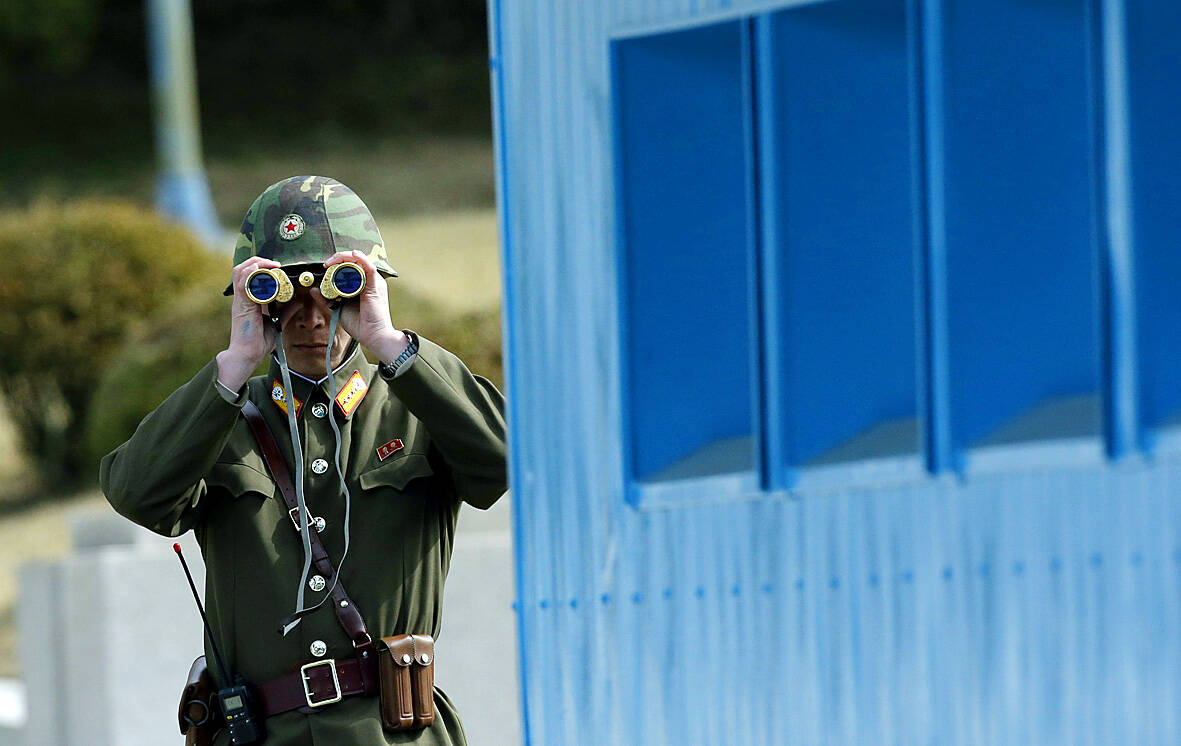
Photo: AP
There have been a small number of US soldiers who went to North Korea during the Cold War, including Charles Jenkins, who deserted his army post in South Korea in 1965 and fled across the DMZ. He appeared in North Korean propaganda films and married a Japanese nursing student who had been abducted from Japan by North Korean agents. He died in Japan in 2017.
May 18 to May 24 Gathered on Yangtou Mountain (羊頭山) on Dec. 5, 1972, Taiwan’s hiking enthusiasts formally declared the formation of the “100 Peaks Club” (百岳俱樂部) and unveiled the final list of mountains. Famed mountaineer Lin Wen-an (林文安) led this effort for the Chinese Alpine Association (中華山岳協會). Working with other experienced climbers, he chose 100 peaks above 10,000 feet (3,048m) that featured triangulation points and varied in difficulty and character. The list sparked an alpine hiking craze, inspiring many to take up mountaineering and competing to “conquer” the summits. A common misconception is that the 100 Peaks represent Taiwan’s 100 tallest

Yesterday, the Democratic Progressive Party (DPP) nominated legislator Puma Shen (沈伯洋) as their Taipei mayoral candidate, the Chinese Nationalist Party (KMT) put their stamp of approval on Wei Ping-cheng (魏平政) as their candidate for Changhua County commissioner and former legislator Tsai Pi-ru (蔡壁如) of the Taiwan People’s Party (TPP) has begun the process to also run in Changhua, though she has not yet been formally nominated. All three news items are bizarre. The DPP has struggled with settling on a Taipei nominee. The only candidate who declared interest was Enoch Wu (吳怡農), but the party seemed determined to nominate anyone

In a sudden move last week, opposition lawmakers of the Chinese Nationalist Party (KMT) and Taiwan People’s Party (TPP) passed a NT$780 billion special defense budget as a preemptive measure to stop either Chinese leader Xi Jinping (習近平) or US President Donald Trump from blocking US arms sales to Taiwan at their summit in Beijing, said KMT heavyweight Jaw Shaw-kong (趙少康), speaking to the Taipei Foreign Correspondents Club on Wednesday night in Taipei. The 76-year-old Jaw, a political talk show host who ran as the KMT’s vice presidential candidate in 2024, says that he personally brokered the deal to resolve
“China wants to unify with Taiwan at the lowest possible cost, and it currently believes that unification will become easier and less costly as time passes,” wrote Amanda Hsiao (蕭嫣然) and Bonnie Glaser in Foreign Affairs (“Why China Waits”) this month, describing how the People’s Republic of China (PRC) is playing the long game in its quest to seize Taiwan. This has been a favorite claim of many writers over the years, easy to argue because it is so trite. Very obviously, if the PRC isn’t attacking Taiwan, it is waiting. But for what? Hsiao and Glaser’s main point is trivial,


 RSS
RSS