


Producing the world’s meat has rarely been this expensive.
In southern Calgary, Don Lowe, who’s been a cattle rancher for 40 years, had hoped to expand his herd of 800 beef cows this year, but with feed prices skyrocketing, he’s struggling to hang on to the animals he has. Across the ocean in East Yorkshire, England, pig farmer Kate Moore says the upkeep of her 32,000-strong herd is becoming exceedingly hard.
“It’s horrendous,” said Moore, who is now is chalking up a loss of about £60 (US$75) per animal because of the soaring cost of feeding and taking care of them. “There’s no light at the end of the tunnel at the moment. The British pig industry will never be the same.”

Photo: EPA-EFE
Farmers across the world — with more than 40 billion pigs, cows, buffalo, sheep, goats and poultry — are contending with near-record prices for livestock feed as supplies of grains and soy shrink. Bills for everything from the electricity that keeps their barns well-lit and warm to truckers that haul their animals to abattoirs have also soared. Crop and energy costs surging in the wake of Russia’s war in Ukraine have compounded their woes even as they struggle with everything from droughts curbing grazing lands to bird-flu outbreaks from North America to Europe that wiped out millions of poultry.
Hit from all sides, many farmers are selling livestock or breeding fewer, showing output will be capped in the longer-term. The number of beef cows being slaughtered in the US is the highest since records started in 1986, and those cows not giving birth to calves will result in smaller herds. That means meat prices — already at record highs — won’t fade fast, further weighing on household budgets that are straining under higher costs for other staples and necessities.
The UNs’ Food and Agriculture Organization meat-price index has risen 10 percent since the beginning of the year, hitting a record in April. In the US, prices of bacon, chicken breasts and ground beef have never been higher.
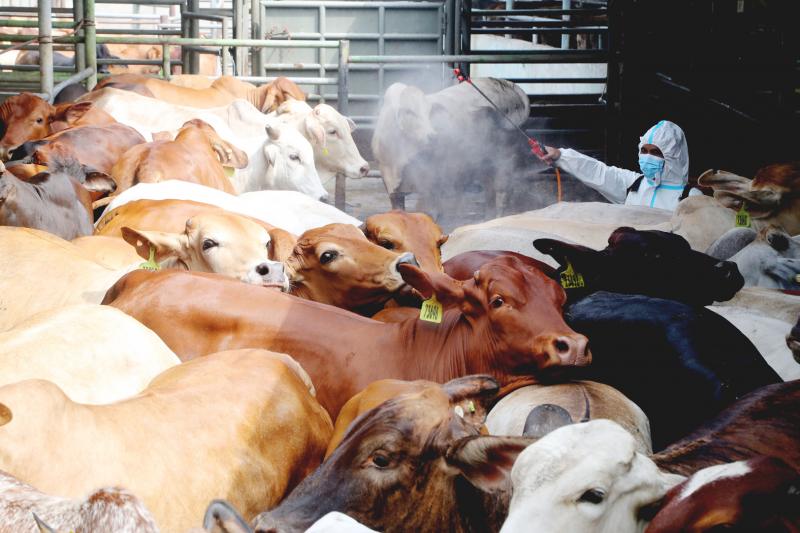
Photo: EPA-EFE
The global production of chicken, pork and beef will slow to a 1.4 percent advance in 2022, versus 5.4 percent last year, the US government forecasts.
“A lot of the pressures that we’re facing, the individual pressures themselves are not really new or unusual,” said Justin Sherrard, global animal-protein strategist at Rabobank. “It’s the combination of issue upon issue.”
RUSSIA’S WAR
Russia’s invasion has slowed Ukraine grain exports to a trickle, curbing corn supplies that major hog producers like Spain and China rely on. Feed makes up the bulk of the cost to raise livestock, and even for countries that produce their own, crop prices have scaled dizzying heights. Chicago corn futures have risen 31 percent this year; Paris corn futures are up 55 percent and UK feed-wheat futures climbed more than 50 percent.
“I’ve never seen anything like this,” said Jamie Wyllie, a Scottish pig farmer whose farm typically markets more than 70,000 pigs a year. “Things have been really bad in the pig industry since last year. That means that people, if they had any, have burnt through any reserves.” He’s cutting back his breeding herds to stem the blow. Feed now accounts for 70 percent of his pig-production costs, up from the usual 60 percent.
In China, home to half the world’s hogs, record feed expenses and a prolonged slump in pork prices have spurred staggering losses at top hog breeders. After just recovering from a lethal swine fever outbreak, that’s put growth in a downturn again, with sow numbers falling for eight straight months.
Tyson Foods Inc, the biggest US meat company, has warned of shrinking supplies.
“Heavy cattle liquidation year-to-date” will impact supplies for two to three years, Shane Miller, its president of fresh meats, said on an investor call.
“Producers can’t bear the entire cost,” said Upali Galketi Aratchilage at the FAO. “It’s very likely we see consumers paying more, at least for the foreseeable future.”
Ajay Verma, a consultant gastroenterologist at Kettering general hospital in Northamptonshire, says our gut is a “complex machine.” “It is constantly providing us with the nutrition we need, initially to grow and develop, and then for us to survive, thrive and repair from injury and illness.” How can we keep it functioning well? Put simply: “Make sure what you put into it is balanced, and that you clear out its waste products adequately,” Verma says. “In a general gastroenterology clinic, the most common conditions we see are irritable bowel syndrome (IBS), gastroesophageal reflux disease, inflammatory bowel disease and constipation,” says Nisha
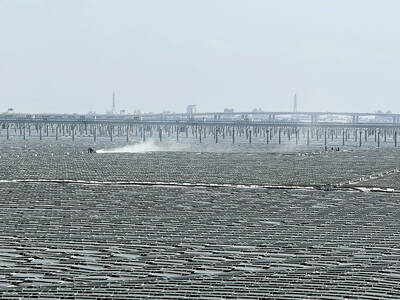
The arithmetic is straightforward and uncomfortable. By the end of 2025, Taiwan had committed itself to a 50-30-20 electricity mix — half natural gas, 30 per cent coal, 20 per cent renewables. The Ministry of Economic Affairs’s (MOEA) own monthly energy reports tell a different story. Natural gas reached 47.8 per cent of generation last year. Coal stood at 35.4 per cent, comfortably above its target ceiling. Renewables came in at 13.1 per cent, well short of the 20 per cent Taipei had pledged a decade earlier. Installed renewable capacity reached roughly half of the 12 gigawatts (GW) the government

Last week US President Donald Trump was asked by a reporter whether he would speak on the phone to the President of Taiwan. “l’ll speak to him. I speak to everybody. We have that situation very well in hand,” Trump said. This marked the second time in a couple of weeks he had said he would talk to the President of Taiwan. In 2016 he famously took a call from then-president Tsai Ing-wen (蔡英文), when he was president-elect. Despite warnings that the apocalypse was nigh because of a phone call, the world quickly forgot about the conversation between two democratically-elected presidents.
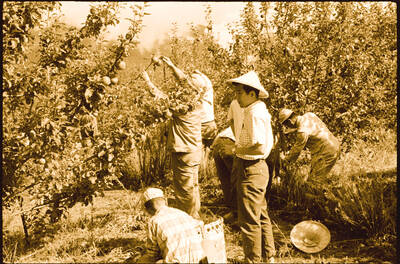
May 25 to May 31 Few believed that apples could be cultivated on a commercial scale in Taiwan’s high mountains. When horticulturalist Cheng Chao-hsiung (程兆熊) first proposed the idea in 1955, both American and Taiwanese colleagues dismissed it as implausible, arguing that temperate fruit could not be reliably grown on a subtropical island, especially on rugged terrain. However, it was this terrain in the Central Mountain Range where many Chinese Civil War veterans were resettled in the late 1950s. With limited job prospects and no family in Taiwan, they were placed on cooperative farms aimed toward self-sufficiency. Some say the conditions


 RSS
RSS