


There is no mention of holiday or Christmas in lyrics to the song, White Winter Hymnal. Or winter, for that matter. There is a reference to snow, turned “red as strawberries in the summertime” — presumably, by blood.
Nonetheless, the song has become a modern holiday standard, sung by children’s choirs in countless school assemblies. Its plays on Spotify — more than 180 million for the two most popular versions — spike on Christmas Eve.
The story of White Winter Hymnal is a reminder of how songs can take journeys in the public consciousness that even their composers can’t fathom.

Photo: AP
“The universe has a sense of humor. Sometimes there’s just these little cosmic flukes,” said Robin Pecknold, who wrote it when he was 20 years old, sitting on a couch at his parents’ house as The Simpsons played on TV in the background. He was trying to wrap up music for the debut album of his band, Fleet Foxes.
Pecknold estimates it took about 20 minutes.
The result is a composition of simple, ethereal beauty. It consists of a single verse, sung three times in a round or perpetual canon style, with multiple voices repeating the same melody at a different starting point (“I was following the...”)
The melody ascends to a peak then tumbles down, much like the song’s character, Michael, falls in the snow. In less than two and a half minutes, it’s done.
NOT ABOUT THE HOLIDAYS
White Winter Hymnal received some notice in the alternative rock world when released in the summer of 2008. Pitchfork magazine named the song its No. 2 favorite track of the year, with critic Stephen Deusner writing, “its meaning may remain unclear after so many listens — something about the passage of seasons — but its spell remains as strong as ever.”
An aspiring actor, John Frank Lyke, was so obsessed with White Winter Hymnal that he made a homemade video featuring a couple walking in the woods through a newly-fallen snow. They come to a clearing overlooking Lake Champlain and when Pecknold sings the word “summertime,” the scene abruptly switches seasons. Bathed in warm sun, the couple leap into the lake.
The song “has this kind of magic winter wonderland feeling,” Lyke said. “It reminded me of midnight mass when I would go with my family.”
Pecknold didn’t have the holidays in mind when writing. But other artists began covering White Winter Hymnal and one, Kim Wilde, put her version on a 2013 holiday-themed album. Pentatonix did the same a year later for their album, That’s Christmas to Me.
That’s when the song really took on a new life. Pentatonix’s video of White Winter Hymnal has been seen more than 96 million times on YouTube; Fleet Foxes’ own video, a claymation scene made by Robin’s brother, Sean, has 23 million views.
In some respects, the song changed both context and ownership: Google “White Winter Hymnal lyrics” and it’s described as “a Pentatonix song.”
The performance by a vocal band with a young following led to its notice by choir directors around the world.
“When choir groups do it, it’s so charming to me,” Pecknold said. “It is kind of heartwarming when someone will say to me, `I’m at my kid’s recital and they’re doing your song,’ and they’ll send me a video. That’s really sweet, to think it’s living in that world. Nothing beats that.”
When Pecknold checks the Spotify metrics for his song, the plays tend to increase with the onset of autumn, building to the outsized Christmas Eve peak then falling off dramatically.
WHAT IS IT ABOUT, THEN?
“Holiday songs tend to lean into a certain kind of musical nostalgia, referencing the acoustic timbral palette of the holiday recorded canon, from Bing Crosby to Eartha Kitt,” said Nathaniel Sloan, musicologist at the University of Southern California and co-host of the “Switched on Pop” podcast. “The acoustic-folk sound of Fleet Foxes is well-suited to these nostalgic tones.
“In addition, the song reaches back to deeper Christmas traditions in its carol-like vocal approach, with its layered melodies that stack upon one another,” Sloan said.
Then you listen closely to the lyrics:
“I was following the pack, all swallowed in their coats with scarves of red tied round their throats to keep their little heads from fallin’ in the snow, and I turned ‘round and there you go, and Michael you would fall and turn the white snow red as strawberries in the summertime.”
One theory on the Internet is that White Winter Hymnal is about decapitation, with the red scarf a supposed reference to the French Revolution. Michael is being led to the guillotine.
Could that be true? What is the song about anyway?
Pecknold pauses at the question.
“That’s another funny aspect of it,” he said, “is that it’s kind of vaguely not about anything.”
One common theme of songs on Fleet Foxes’ debut was keeping family and friends together as people grew and changed, and that was in his mind as he wrote. While he concedes that the most literal image may be a boy falling down a hill and dying, Pecknold said the song is definitely NOT about decapitation.
“The words being vaguely dark was kind of cutting the sweetness of the melody,” he said. “That dissonance was interesting. At this point, I’m writing songs with the expectation that I’ll have to defend them in some way. But at the time, I definitely was not.”
‘JOY TO PERFORM’
The ambiguity and potential darkness certainly make it a stark departure, Sloan said. While heartache is a common theme for some holiday standards, most evoke a warm sense of family and good cheer.
He expects “White Winter Hymnal” to have staying power, though.
“Not only is it a joy to listen to, it’s a joy to perform — the chord structure is relatively simple and easy to learn, the unique vocal lines lend themselves to group singing and the lyrical repetition makes it easy for anyone to join in and sing along,” Sloan said.
The song gets more attention each year; Spotify said it was streamed 30 percent more this September and October than last year, almost at previous December levels. The Pentatonix recording provided Pecknold a windfall as a songwriter that he largely plowed back into music. This season it’s being used in commercials for the Spanish lottery. The potential for earnings only figures to increase.
Pecknold marvels at the randomness of it all.
“That’s the funny thing about this — spending years making music, writing songs, thinking it’s all about hard work and putting the hours in,” he said. “To a large degree it is, but then you’ll get this random scratch card one day and find the song that ends up, kind of accidentally, being your most well-known.” Fleet Foxes just released a new album, A Very Lonely Solstice, a live recording that features songs meant to evoke a seasonal feel without being explicitly about the holidays.
White Winter Hymnal, however, is not included.
“That’s a Christmas song at this point,” Pecknold said with a laugh.
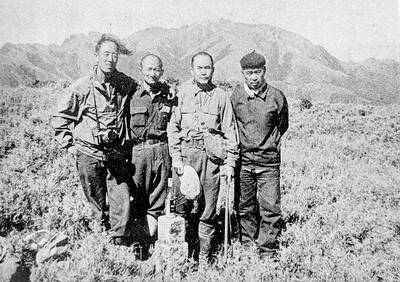
May 18 to May 24 Gathered on Yangtou Mountain (羊頭山) on Dec. 5, 1972, Taiwan’s hiking enthusiasts formally declared the formation of the “100 Peaks Club” (百岳俱樂部) and unveiled the final list of mountains. Famed mountaineer Lin Wen-an (林文安) led this effort for the Chinese Alpine Association (中華山岳協會). Working with other experienced climbers, he chose 100 peaks above 10,000 feet (3,048m) that featured triangulation points and varied in difficulty and character. The list sparked an alpine hiking craze, inspiring many to take up mountaineering and competing to “conquer” the summits. A common misconception is that the 100 Peaks represent Taiwan’s 100 tallest

Yesterday, the Democratic Progressive Party (DPP) nominated legislator Puma Shen (沈伯洋) as their Taipei mayoral candidate, the Chinese Nationalist Party (KMT) put their stamp of approval on Wei Ping-cheng (魏平政) as their candidate for Changhua County commissioner and former legislator Tsai Pi-ru (蔡壁如) of the Taiwan People’s Party (TPP) has begun the process to also run in Changhua, though she has not yet been formally nominated. All three news items are bizarre. The DPP has struggled with settling on a Taipei nominee. The only candidate who declared interest was Enoch Wu (吳怡農), but the party seemed determined to nominate anyone

In a sudden move last week, opposition lawmakers of the Chinese Nationalist Party (KMT) and Taiwan People’s Party (TPP) passed a NT$780 billion special defense budget as a preemptive measure to stop either Chinese leader Xi Jinping (習近平) or US President Donald Trump from blocking US arms sales to Taiwan at their summit in Beijing, said KMT heavyweight Jaw Shaw-kong (趙少康), speaking to the Taipei Foreign Correspondents Club on Wednesday night in Taipei. The 76-year-old Jaw, a political talk show host who ran as the KMT’s vice presidential candidate in 2024, says that he personally brokered the deal to resolve

“China wants to unify with Taiwan at the lowest possible cost, and it currently believes that unification will become easier and less costly as time passes,” wrote Amanda Hsiao (蕭嫣然) and Bonnie Glaser in Foreign Affairs (“Why China Waits”) this month, describing how the People’s Republic of China (PRC) is playing the long game in its quest to seize Taiwan. This has been a favorite claim of many writers over the years, easy to argue because it is so trite. Very obviously, if the PRC isn’t attacking Taiwan, it is waiting. But for what? Hsiao and Glaser’s main point is trivial,


 RSS
RSS