


Robotic landers and rovers have been touching down on Mars since the 1970s, but when will humanity finally set foot on the Red Planet? Experts believe the technical challenges are nearly resolved, but political considerations make the future of any crewed mission uncertain.
NASA’s human lunar exploration program, Artemis, envisions sending people back to the Moon by 2024 and using the experience gained there to prepare for Mars.
Plans have been proposed for a crewed exploratory mission of our neighboring planet since before NASA was created in 1958, but have never taken off.
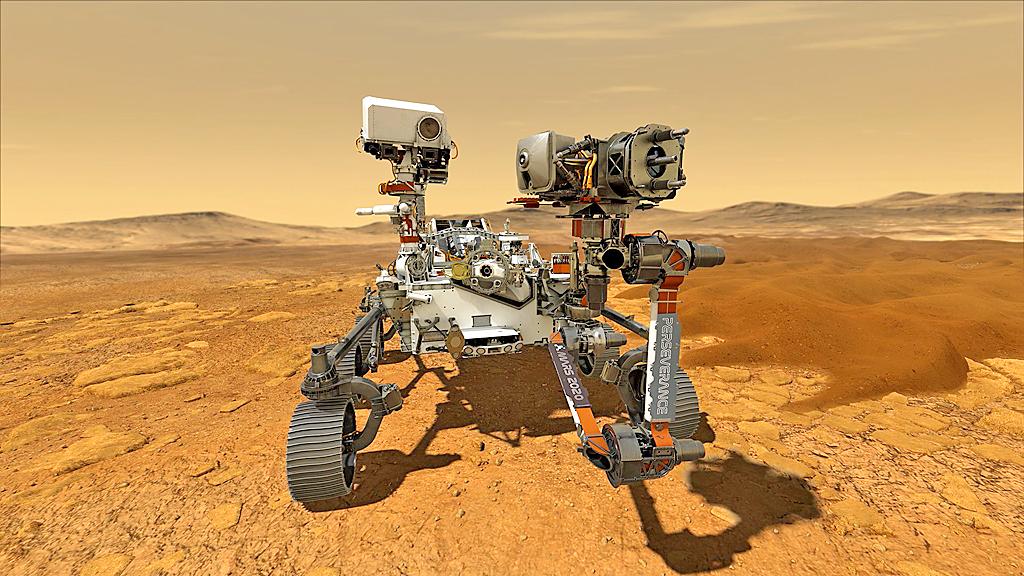
Photo: AFP
In the spring of 1990, then-president George Bush announced the most audacious promise to date — a man on Mars before July 20, 2019, the fiftieth anniversary of the first lunar landing. The commitment clearly never came to pass, and similar goals articulated by presidents George W Bush, Barack Obama and Donald Trump have not led to concrete programs.
“I have seen maybe 10,000 graphs, charts, proposing various ideas about how to get to Mars, for humans,” Scott Hubbard, an adjunct professor at Stanford and former senior NASA official, said.
“But putting the money behind it to make it a reality has not occurred.”
The mission itself would last two or three years.
Today, Elon Musk’s SpaceX and Jeff Bezos’ Blue Origin are building heavy rockets capable of sending tens of tons toward Mars.
ALONE, AND FAR
For the seven-month journey, 20 years of living and working in the International Space Station (ISS) has reassured scientists about the dangers posed by radiation and by weightlessness, such as muscle atrophy.
The body does not emerge unscathed, but the risks are deemed acceptable.
Then there is the stay on Mars itself, which would last 15 months so that the planets are once more on the same side of the Sun.
The surface temperature will average -63 degrees Celsius, and though radiation is a factor, suits and shelters exist that would shield astronauts.
In case of medical emergencies, distance would make an evacuation impossible.
What mishaps should astronauts anticipate? First of all fractures, but plaster casts would often suffice, says Dan Buckland, an engineer and emergency room doctor at Duke University, who is developing a robotic intravenous needle with support from NASA.
Diarrhoea, kidney stones and appendicitis are generally treatable, except for 30 percent of appendicitis cases which must be operated and could therefore be fatal. With extensive screening of astronauts’ genetics and family history, you can greatly reduce the probability of having a crew member who develops cancer over the course of a three-year mission.
“I have not found a showstopper for going to Mars, in terms of a health condition,” said Buckland.
One major issue would be protecting the habitats and vehicles from the ravages of the fine dust that covers the surface.
“Mars is unique in that there’s also a concern about dust storms,” said Robert Howard of the NASA Johnson Center.
These hellish planet-wide tempests can block out the Sun for months, rendering solar panels useless.
Small nuclear reactors would therefore be needed.
In 2018, NASA and the Department of Energy successfully completed a demonstration project, the Kilopower Project.
Ultimately, the goal will be to manufacture materials on site using mined resources, probably with 3D printing machines. Development is embryonic, but the Artemis program will be a testing ground.
COLONIES?
Musk has proposed colonizing Mars, with a first expedition to build a factory that converts Martian water and carbon dioxide from the atmosphere into oxygen and methane fuel.
“Becoming a multi-planet species,” he said in a 2017 speech, “beats the hell out of being a single-planet species.”
Robert Zubrin, president of the Mars Society, likewise advocates for the creation of “new branches of human civilization.”
That no progress has been made since humanity last walked on the Moon in 1972 is, to him, shameful.
“It was as if Columbus had come back from the New World the first time and then [king and queen] Ferdinand and Isabella had said, ‘so what, we’re not interested,’” he said.
Not everyone is convinced.
“Enough of the nonsense!” said exobiologist Michel Viso from CNES, the French space agency.
“We have an amazing planet with an atmosphere, with oxygen, with water... It’s criminal, you don’t have the right to fool people into thinking there is a ‘Plan B,’ a ‘Planet B,’ that we will have a Martian civilization.”
Whether humanity installs a colony or permanent bases, the most important obstacle, for a lasting human presence on Mars, will be to convince people to accept a higher level of risk than for the Moon or the ISS, argues Buckland. In the long run, not everyone will return.


The US war on Iran has illuminated the deep interdependence of Asia on flows of oil and related items as raw materials that become the basis of modern human civilization. Australians and New Zealanders had a wake up call. The crisis also emphasizes how the Philippines is a swatch of islands linked by jet fuel. These revelations have deep implications for an invasion of Taiwan. Much of the commentary on the Taiwan scenario has looked at the disruptions to world trade, which will be in the trillions. However, the Iran war offers additional specific lessons for a Taiwan scenario. An insightful

The problem with Marx’s famous remark that history repeats itself, first as tragedy, the second time as farce, is that the first time is usually farce as well. This week Chinese Nationalist Party (KMT) Chair Cheng Li-wun (鄭麗文) made a pilgrimage to the People’s Republic of China (PRC) “to confer, converse and otherwise hob-nob” with Chinese Communist Party (CCP) officials. The visit was an instant international media hit, with major media reporting almost entirely shorn of context. “Taiwan’s main opposition leader landed in China Tuesday for a rare visit aimed at cross-strait ‘peace’”, crowed Agence-France Presse (AFP) from Shanghai. Rare!

April 6 to April 13 Few expected a Japanese manga adaptation featuring four tall, long-haired heartthrobs and a plucky heroine to transform Taiwan’s television industry. But Meteor Garden (流星花園) took the nation by storm after premiering on April 12, 2001, single-handedly creating the “idol drama” (偶像劇) craze that captivated young viewers across Asia. The show was so successful that Japan produced its own remake in 2005, followed by South Korea, China and Thailand. Other channels quickly followed suit, with more than 50 such shows appearing over the following two years. Departing from the melodramatic

Sunflower movement superstar Lin Fei-fan (林飛帆) once quipped that the Democratic Progressive Party (DPP) could nominate a watermelon to run for Tainan mayor and win. Conversely, the DPP could run a living saint for mayor in Taipei and still lose. In 2022, the DPP ran with the closest thing to a living saint they could find: former Minister of Health and Welfare Chen Shih-chung (陳時中). During the pandemic, his polling was astronomically high, with the approval of his performance reaching as high as 91 percent in one TVBS poll. He was such a phenomenon that people printed out pop-up cartoon


 RSS
RSS