


June 22 to June 28
The residents of Kaohsiung’s Dalinpu (大林蒲) panicked as a white, malodorous mist enveloped the town. With four borough wardens leading the charge, they surrounded an oil refinery operated by China Petroleum Corp Taiwan (CPC, 台灣中油) and demanded answers.
Unhappy with the official response that it was harmless steam, more than 100 locals set up a protest camp around the facility on May 3, 1994. On the 23rd day, clashes erupted when the police tried to forcefully disperse the crowd. Both sides suffered injuries and seven people were arrested. This was the second time they besieged the plant after a power outage in 1989 caused loud explosions and thick smoke.

Photo courtesy of Wikimedia Commons
Just a decade earlier, Dalinpu was still a bustling fishing town in an area known as the “Prawn Kingdom” (草蝦王國), which had prospered for over 400 years. Today it is a sleepy hamlet surrounded by over 800 billowing smoke stacks. A government study last year found that local residents have a higher risk of contracting cancer due to the existing pollutants. A 70-year-old in Dalinpu, for example, is 1.5 to 5.5 times more likely to develop cancer than those living elsewhere.
Discussions over relocating the villagers due to heavy pollution began in 1992, but the government didn’t apologize to the community until 2016, and last year it finally approved a NT$100.47 billion (US$2.36 billion) relocation budget. Discussions suffered a setback last week after residents complained that they have yet to see a concrete plan.
Historians Chang Shou-chen (張守真) and Yang Yu-tzu (楊玉姿) last year published the book Settlement by the port: The Development History of Dalinpu (臨港聚落: 大林蒲開發史) detailing the area’s halcyon days and how it arrived at its current predicament.
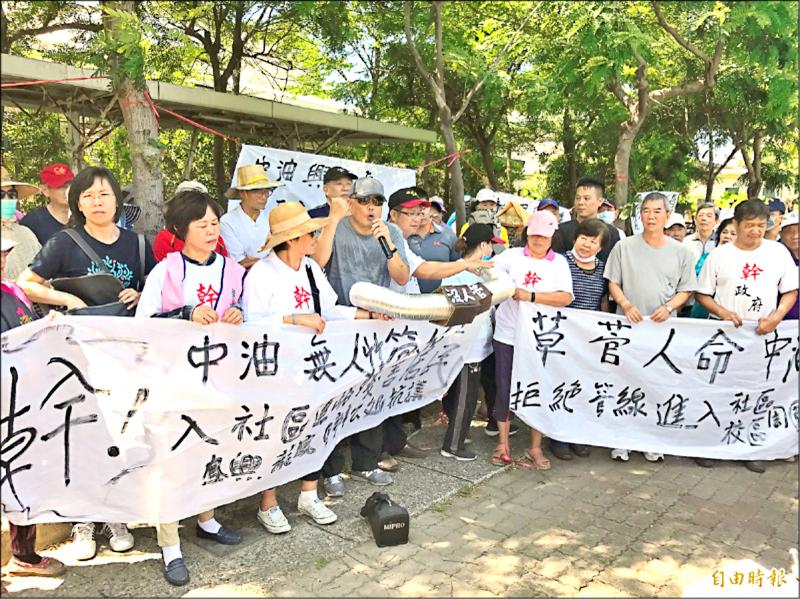
Photo: Hung Chen-hung, Taipei Times
DAYS OF PROSPERITY
The Dalinpu area fell under Dutch control when they colonized southern Taiwan in 1624. The colonizers taxed Chinese fishermen to operate seasonally in the area, and by the 1660s, some had settled along the coast. The Ming (明) Dynasty loyalist and military commander Cheng Cheng-kung (鄭成功), also known as Koxinga, expelled the Dutch in 1661 and encouraged his soldiers to fan out from Tainan and establish homesteads. One of them, Wu Yen-shan (吳燕山), arrived in the Dalinpu area later that year. Wu remains a common surname in the village.
The settlement grew into a prosperous fishing port known for its mullet. The Qing (清) Empire established a salt field in 1756, which attracted more residents. By 1764, the government had stationed troops in the area and established a military outpost in 1809. Qing annals make several records of the productivity of the local industries.

Photo courtesy of Kaohsiung Environmental Protection Bureau
The rebel Lin Kung (林恭) clashed with government troops in Dalinpu in 1836, and in 1898, the Dalinpu police station sent reinforcements to help quell a nearby anti-Japanese uprising. Its population shot up over the course of Japanese rule, from 1,780 in 1905 to 3,032 in 1939.
The area was used for military training after the Chinese Nationalist Party (KMT) arrived. A November 1954 United Daily News (聯合報) report told residents not to be startled when the army held live-fire exercises later that month.
In the 1950s, Dalinpu was designated by the government as part of a heavy industry zone. They established the Linhai Industrial Park (臨海工業園區) in the area in 1963, expanding over four phases until it reached 1,582 hectares in 1977, making it one of the largest of its kind in the nation. China Steel and state-run Taipower and CPC also built plants in the zone, transforming Prawn Kingdom into Steel City.

Photo courtesy of Wikimedia Commons
In addition to the worsening pollution, Dalinpu’s fortunes dramatically fell when Kaohsiung’s second port opened in 1975, as ships began to bypass the area. In its heyday, Dalinpu was a bustling pit stop for ships heading to and from Kaohsiung, boasting six hotels and numerous coffee shops, movie theaters and other entertainment venues. The aquaculture industry also declined after the new port caused Dalinpu’s coast to erode, while the waters became polluted by the government’s nearby offshore landfill.
ROAD TO RELOCATION
Dalinpu did not benefit from Kaohsiung’s massive real estate boom in the late 1980s due to its remote location and tainted environment completely surrounded by heavy industries.
The industrial wastewater treatment plants in the area did not work properly when they were first installed and the water supply became increasingly contaminated, leading to many protests and clashes over the issue throughout the 1980s.
Those running the Taipower plant were notorious for environmental negligence, garnering hundreds of government fines. An explosion in 1996 led to a huge fire that fortunately resulted in no casualties and did not damage the village. The CPC facility was also accident prone.
A serious incident took place on June 24, 1992, when large swathes of rust-colored water appeared in the ocean, ruining hundreds of shrimp farms. And resident outrage boiled over when three medical waste incinerators were constructed nearby in 2001, as protesters chanted the slogan: “waiting to relocate, waiting for work, waiting for more pollution and waiting to die.”
Finally, the fed-up Dalinpu residents decided either the factories or the village would have to move, refusing all other offers.
In 1997, over 200 residents marched to the CPC plant, demanding that it cease operations until it came up with a relocation plan for either the plant or the village. Surveys conducted throughout the 2000s show that the majority of villagers were willing to relocate, but the issue still drags on.
An earlier relocation occurred in 2007, when 2,000 residents from Hongmaogang (紅毛港) were relocated to Dalinpu, after their village was converted into part of Kaohsiung’s second port. These residents now face the same ordeal all over again.
Resistance against the corporations continues. In 2015, residents fumed as Taipower construction caused serious subsidence on a village street, which the corporation was slow to repair. And last year, Dalinpu residents railed against the construction of an underground CPC pipeline through their community.
The current goal is to complete the relocation by the end of 2023 — but the two sides seem far from reaching an agreement.
Taiwan in Time, a column about Taiwan’s history that is published every Sunday, spotlights important or interesting events around the nation that have anniversaries this week.

Taiwan’s English education system is being pulled apart by three opposing forces. Bilingual Nation 2030 pulls students toward English and global communication. Artificial Intelligence (AI) readiness pulls them toward digital judgment, verification and AI-mediated work. But Taiwan’s old exam culture pulls them back toward memorization, grammar drills, timed reading and correct answers. If the education system keeps using old exams to define success, it risks producing graduates who are neither genuinely bilingual nor genuinely AI-ready, but trained for tasks machines can already perform. The first force is Bilingual Nation 2030. Launched in 2018, the policy aimed to “help Taiwan’s workforce connect
It seems every few days one bumps into one of those “real man” comments in which Taiwan is urged to “face reality” or similar, and “make a deal,” with the speaker implying that soon it will be too late. “Deal” advocates always present themselves as having a superior grip on reality, and the manly ability to make the “hard choice.” Their testosterone-laden language often echoes that of Taiwan sellout advocates. Note that such commentary always specifies a process (“make a deal, work with, make progress”), never the end state of what occupation by a violent authoritarian colonialist state will entail. In
There are shadowy cabals plotting to sell out Taiwan to be annexed by China, by invasion if necessary. Fortunately, they are buffoons. In 2019, former Bamboo Union gangster and founder of the China Unification Promotion Party (CUPP), Chang An-le (張安樂, colorfully known as “White Wolf”), led a protest at the Legislative Yuan against comments made by then-premier Su Tseng-chang (蘇貞昌) that in the event of an attack by China, he would never surrender, but would protect the nation by fighting to the end, even if he only had a broom. Chang had party members bring a wooden casket that they
June 1 to June 7 "If all Taiwanese were as afraid of dying as you, then what would happen?” Physician Shih Chiang-nan (施江南) reportedly said this to his wife Chen Chiao-tung (陳焦桐) after she urged him to stop intervening on behalf of Taiwanese soldiers stranded overseas after serving in the Japanese Army during World War II. Shih had clashed with high-ranking officials over the issue, engaged in several heated arguments with Taiwan governor-general Chen Yi (陳儀) and allegedly shouted at general Ko Yuan-fen (柯遠芬), chief of staff of the Taiwan Garrison Command, over


 RSS
RSS