


April 27 to May 3
Thousands of passengers arrived at train stations across Taiwan on May 1, 1988, only to find that the nation’s railroad system had been shut down. Signs were posted at the entrances and ticket counters stating, “The drivers have taken the day off, no trains will be running today.”
People then flooded the bus stations. The now-defunct Taiwan Motor Transport added 82 departures from Yilan to Taipei, but it still wasn’t enough to accommodate all the customers. Private vans and taxis swooped in, making a quick buck by charging up to three times the normal rate.
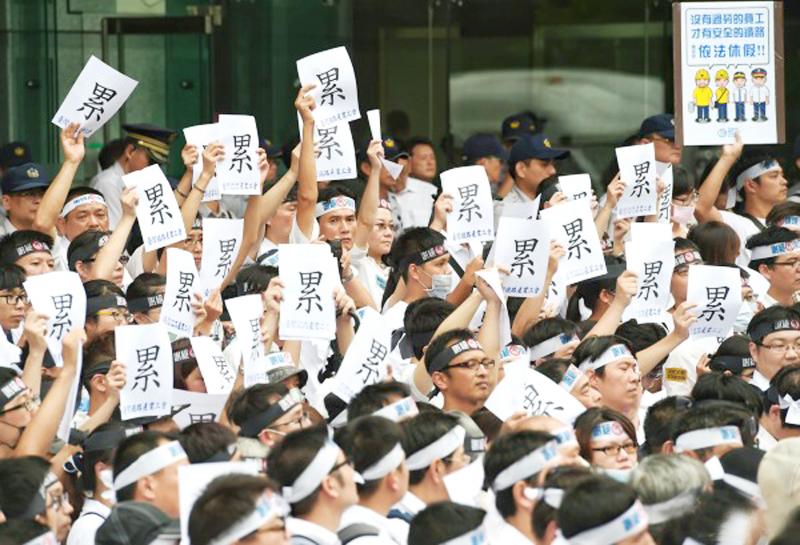
Photo: Chu Pei-hsiung, Taipei Times
Banciao station master Chien Ching-chi (簡清期) called it the longest day of his career. He spent the entire day apologizing to customers and issuing ticket refunds. Chien told the Liberty Times (sister newspaper of the Taipei Times) that he spent the previous evening trying to convince the drivers to come to work, but only three showed up.
The passengers were understandably angry, but there were also those who spoke up for the drivers.
“The Taiwan Railway Administration (TRA) did not compensate them according to the Labor Standards Act … of course they would be upset,” a student told the Liberty Times.
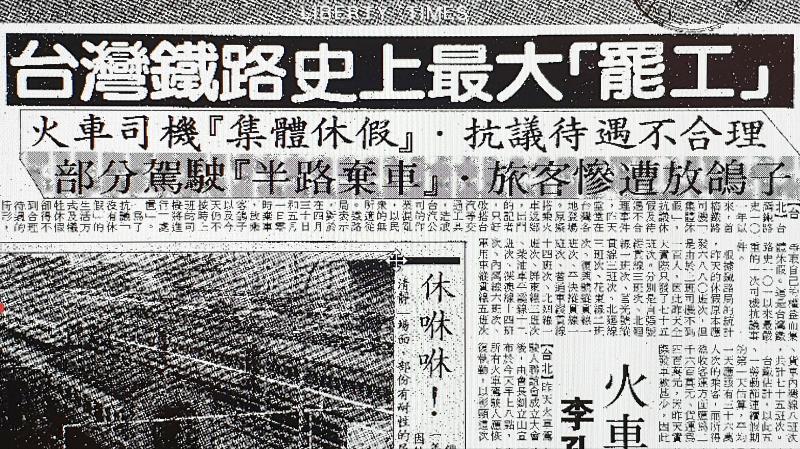
Photo courtesy of National Central Library
About 1,400 overworked and undercompensated train drivers took leave that day, an unprecedented move that was only made possible with the lifting of Martial Law 10 months earlier. All sorts of political and social movements exploded after decades of iron rule.
Academia Sinica research fellow Wu Nai-teh (吳乃德) called the labor movement a “new social force in Taiwan” in a United Daily News (聯合報) editorial.
The first post-martial law Labor Day proved to be an eventful one. In addition to the train drivers, about 200 bus drivers and several hundred highway gas station workers also stayed home that day. And the newly-established Labor Party (工黨) led over 1,000 protesters through the streets of downtown Taipei, blocking traffic for several hours as they advocated for independent unions and chanted, “Long live the laborer!”
Photo courtesy of Wikimedia Commons
LABOR AWAKENING
Jane Kaufmann Winn sums up the condition of the nation’s labor rights up to that point in her 1987 study, “There Are No Strikes in Taiwan: an Analysis of Labor Law in the Republic of China on Taiwan.”
“Unlike in neighbor[ing] South Korea, industrialization in Taiwan has not been accompanied by violent repression of labor movements or clashes between workers and the authorities,” Winn writes.
Photo courtesy of Horace Ya via Flickr
Winn added that the ruling Chinese Nationalist Party (KMT) “has relied on authoritarian, paternalistic industrial policies to exclude workers from the political process. As a result, workers are denied the opportunity to form free trade unions.”
Official unions did exist, but they were closely affiliated with the KMT and did not provide much protection to its members. After a decade of debate and pushback by employers, the Labor Standards Act was passed in August 1984, finally giving workers a legal basis to fight for their rights, although Winn writes that enforcement was spotty and penalties were light.
As public employees, the provisions did not apply to railroad workers at first. It took two years before the Taiwan Railway Union managed to convince the government to include its members in the act, leaving many workers disgruntled with both the union, whose power to help its members was limited by its ties to the government, and the TRA.
But the TRA still failed to meet the act’s stipulations regarding hours and overtime pay, citing budget deficits and losses as well as a lack of authority. After months of haggling, the TRA refused to budge, even berating Lin Fu-jung (林福榮), who represented the train drivers. On March 29, 1988, a portion of the drivers went on strike for the first time, although there weren’t enough participants to impact the train schedules.
That same day, about 500 drivers held a conference in Taipei announcing their intent to form the Train Drivers’ Association (火車駕駛人聯誼會), and with of opposition politicians and labor activists, they announced their demands and threatened to strike. The talks continued unsuccessfully over the following month, and on April 26 it was agreed that they would all meet three days later at the Taiwan Provincial Assembly for a final decision.
The drivers arrived on time, but no assembly members or TRA representatives showed up. That was the last straw.
NATIONWIDE SHUTDOWN
The association had made up its mind to launch a debilitating strike. But many older drivers were afraid that they would lose their retirement benefits or be punished in other ways, so they ended up all taking the day off so technically no rules would be broken. The number of participants ranged from 1,200 to 1,400 out of about 1,600 drivers, according to different reports.
Labor activist and former legislator Lin Hui-kuan (林惠官) was one of the drivers who spearheaded the effort. Still worried that some drivers wouldn’t come through, he headed to the train depot early in the morning and made sure that the first 8:30am train did not depart. At least two drivers abandoned their cars when the clock struck midnight, stranding the passengers who had to take TRA-provided buses.
That afternoon, The Train Drivers’ Association was officially inaugurated in the TRA banquet hall, with Lin Fu-jung swearing in as deputy president.
“I am also saddened for what happened, but I hope that while society is shocked and angered, they also consider the fact that we long-suffering train drivers only chose to do this because our rights have been trampled on,” he told the Independent Evening Post (自立晚報).
Lin said that if the TRA continued to refuse to follow the Labor Standard Act, they would strike again a month later on Dragon Boat Festival and again on every subsequent holiday.
Taipei Main Station ended the day in the red for the first time in almost 100 years, and the TRA lost an estimated NT$30 million, with more than 360,000 passengers affected. Chien said he didn’t sell any tickets for the next day because he didn’t know how long the strike would go on for. And to make things worse, the Labor Party protest on Zhongxiao East Road exacerbated the already congested traffic.
The officials responded quickly and met all of the drivers’ demands. By around 11am the next day, all trains were running again.
The events triggered the transformation of the Taiwan Railway Union into a more independent, aggressive organization that would soon launch a campaign to reclaim the overtime pay owed to workers over the previous four years.
Although the chairman was still essentially hand-picked by the KMT, the organization became more attentive to worker rights under pressure from members. They also learned how to use various tactics to gain leverage against the government as well as the media to gain public support. Government influence over the union further waned as Lin Hui-kuan was elected president in 1991.
The next TRA strike would take place in 2003 as employees opposed the company’s privatization. They agreed this time to keep the trains running, and still got their wish. The TRA remains state-owned.
Taiwan in Time, a column about Taiwan’s history that is published every Sunday, spotlights important or interesting events around the nation that have anniversaries this week.
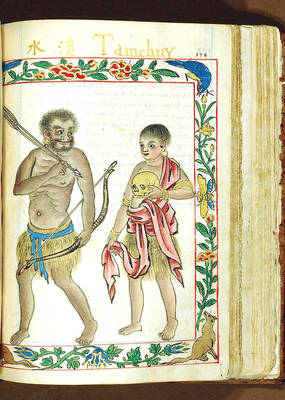
The Portuguese never established a presence on Taiwan, but they must have traded with the indigenous people because later traders reported that the locals referred to parts of deer using Portuguese words. What goods might the Portuguese have offered their indigenous trade partners? Among them must have been slaves, for the Portuguese dealt slaves across Asia. Though we often speak of “Portuguese” ships, imagining them as picturesque vessels manned by pointy-bearded Iberians, in Asia Portuguese shipping between local destinations was crewed by Asian seamen, with a handful of white or Eurasian officers. “Even the great carracks of 1,000-2,000 tons which plied

It’s only half the size of its more famous counterpart in Taipei, but the Botanical Garden of the National Museum of Nature Science (NMNS, 國立自然科學博物館植物園) is surely one of urban Taiwan’s most inviting green spaces. Covering 4.5 hectares immediately northeast of the government-run museum in Taichung’s North District (北區), the garden features more than 700 plant species, many of which are labeled in Chinese but not in English. Since its establishment in 1999, the site’s managers have done their best to replicate a number of native ecosystems, dividing the site into eight areas. The name of the Coral Atoll Zone might

On Monday morning, in quick succession, the Chinese Communist Party (CCP) and the Chinese Nationalist Party (KMT) released statements announcing “that the Central Committee of the Communist Party of China and General Secretary Xi Jinping (習近平) have invited KMT Chairwoman Cheng Li-wun (鄭麗文) to lead a delegation on a visit to the mainland” as the KMT’s press release worded it. The KMT’s press release added “Chairwoman Cheng expressed her gratitude for the invitation and has gladly accepted it.” Beijing’s official Xinhua news release described Song Tao (宋濤), head of the Taiwan Work Office of the CCP Central Committee, as
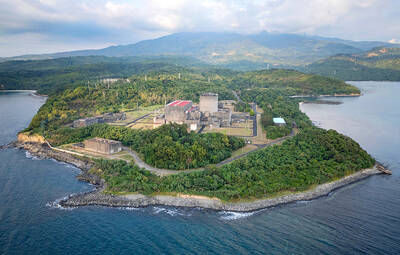
Nuclear power is getting a second look in Southeast Asia as countries prepare to meet surging energy demand as they vie for artificial intelligence-focused data centers. Several Southeast Asian nations are reviving mothballed nuclear plans and setting ambitious targets and nearly half of the region could, if they pursue those goals, have nuclear energy in the 2030s. Even countries without current plans have signaled their interest. Southeast Asia has never produced a single watt of nuclear energy, despite long-held atomic ambitions. But that may soon change as pressure mounts to reduce emissions that contribute to climate change, while meeting growing power needs. The


 RSS
RSS