


The foreign powers that occupied, invaded or traded with Taiwan have left their imprint in Kaohsiung as in other parts of country. The Former British Consulate at Takow (打狗英國領事館文化園區) is one of the southern city’s most popular tourist attractions, but for those who prefer military history to civilian affairs, another site, about 11km to the east, is more engrossing.
The Imperial Japanese Navy Wireless Communications Station (原日本海軍鳳山無線電信所) is located just east of the Chienchen River (前鎮河). On the other side of that waterway, visitors can find the photogenic remains of gun emplacements and fortified gates that once kept the administrative center of Fengshan County (鳳山縣) safe from rebels, irate Aborigines and other enemies.
The county, established in 1684 by the Qing Empire then ruling the China and Taiwan, covered much of today’s Kaohsiung City and Pingtung County. Its borders shifted, but as a local government division, Fengshan County didn’t disappear until 1909. Its core is now Kaohsiung City’s Fengshan District (鳳山區).
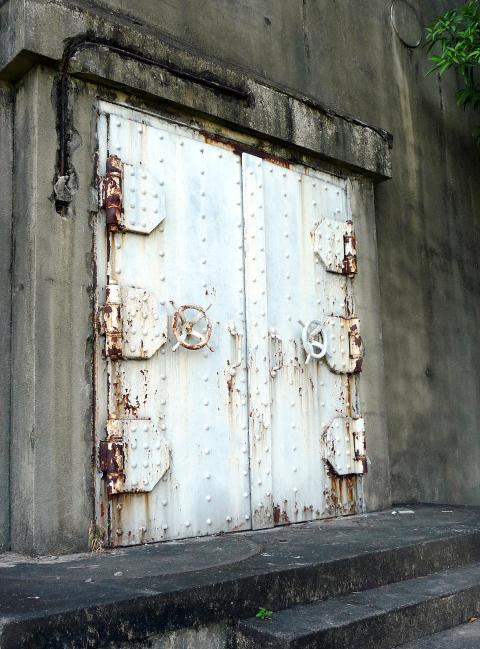
Photo: Steven Crook
Few travelers bother with this corner of the municipality, even though it’s well served by the Orange Line of the Kaohsiung Mass Rapid Transit (MRT) in addition to various bus routes. And within Fengshan, the IJN Wireless Communications Station isn’t the first destination for tourists. The leading attraction is perhaps the 200-year-old Fongyi Academy (鳳儀書院), where local youths were given a traditional Confucian education.
More than a decade ago, the Republic of China military moved out and the IJN Wireless Communications Station was designated a national relic. The significance of this landmark goes beyond its age — construction began in 1917 and was completed in 1919 — and its role in World War II. Having facilitated communication between the Japanese high command and naval units in Southeast Asia, it was turned over to the ROC Navy in late 1945. Then, after the KMT retreated to Taiwan, it became a place where Chiang Kai-shek’s (蔣介石) dictatorship imprisoned suspected dissidents.
For a good part of the postwar period, part of the base was a detention-and-interrogation facility known euphemistically as Fengshan Guest House (鳳山招待所). At the same time, staying true to the site’s original purpose, a navy communications detachment was also based here.
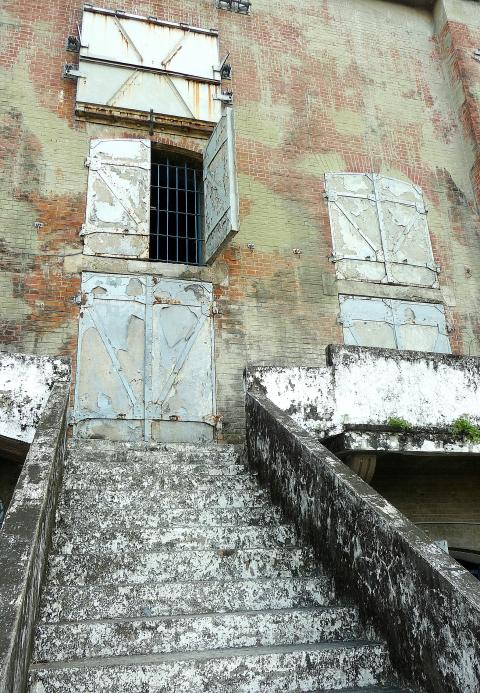
Photo: Steven Crook
The wireless station (open Tuesday to Sunday, 9am to 5pm; free admission) occupies a strangely-shaped plot of land, a perfect circle almost 300m in diameter with a rectangle attached to the southeast. Looking at a map, it resembles nothing so much as a tape measure.
The edifice nearest the center of the circle is known simply as the Big Bunker (大碉堡). The east and west ends of this building are buttressed by earthen ramparts. These — along with the exceptionally thick walls — were intended to ensure that, if the munitions stored within exploded, the blast wave would go upward, instead of decimating the surrounding structures.
Between 1976 and 1995, this bunker was the location of the ROC Navy’s Mingde Training Class (明德訓練班), where “stubborn” members of the armed forces were disciplined and re-educated. The large chamber in the center of the building was apparently subdivided into cells.
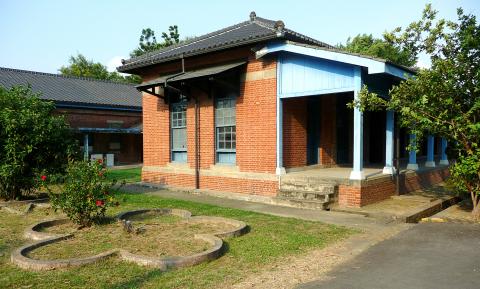
Photo: Steven Crook
The southernmost building within the site is almost as imposing as the Big Bunker, and like the bunker it has a flat roof on which long grass now grows. Known variously as the Cross-Shaped Radio Station (十字電台) or the Navy Radio Station (海軍電台), this housed much of the wireless apparatus and the personnel who operated it. The thick reinforced-concrete walls and heavy doors (cement and gravel clad in iron) were designed to protect the occupants and their equipment from external attack, rather than contain the effects of a catastrophe within.
The radio equipment is long gone, but large pipes remain in place. They were presumably installed for air circulation and to prevent the electronics from overheating. (Another function may have been to filter out poisonous gases; the first international agreement to ban chemical weapons wasn’t signed until 1925.)
A notice inside the Cross-Shaped Radio Station tells visitors not to go down into the basement, but there’s nothing to stop you exploring every nook and cranny. It isn’t difficult to imagine where cypher clerks might have sat, keeping their heads down as a commanding officer gave orders. There’s broken masonry here and there, but the environment seems quite safe.
Photo: Steven Crook
Elsewhere in the complex there’s a cylindrical red-brick water tank, a few single-story buildings that obviously date from the Japanese period, and three two-story structures that look more recent. The radio mast looks fairly modern, as does one of the air-raid shelters. Nine buildings once stood in the closed-off northern part of the base, but some of them have partly collapsed.
Around the site nothing is labeled, so do take the leaflet that the volunteer at the gate offers when you sign in; I wasn’t asked to show any kind of identification. The leaflet was bilingual — Chinese and Japanese — suggesting that Japanese tourists sometimes make the trek out to Fengshan to see this place.
The housing for military personnel and their dependents that used to crowd the northern and western sides of the base has been cleared and replaced by tall apartment blocks. The land to the east has never been built on, presumably to ensure there would be no interference with radio signals. Divided into dozens of small plots on which vegetables are cultivated, it’s a welcome patch of greenness in this densely-populated suburb.
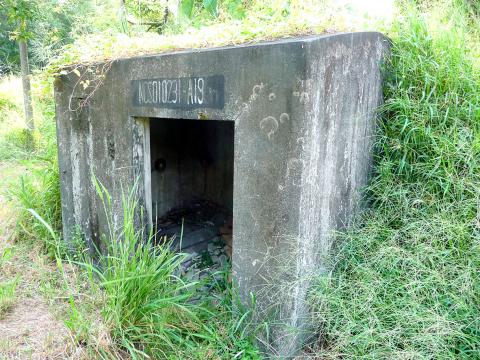
Photo: Steven Crook
Steven Crook has been writing about travel, culture, and business in Taiwan since 1996. Having recently co-authored A Culinary History of Taipei: Beyond Pork and Ponlai, he is now updating Taiwan: The Bradt Travel Guide.


The US war on Iran has illuminated the deep interdependence of Asia on flows of oil and related items as raw materials that become the basis of modern human civilization. Australians and New Zealanders had a wake up call. The crisis also emphasizes how the Philippines is a swatch of islands linked by jet fuel. These revelations have deep implications for an invasion of Taiwan. Much of the commentary on the Taiwan scenario has looked at the disruptions to world trade, which will be in the trillions. However, the Iran war offers additional specific lessons for a Taiwan scenario. An insightful
The problem with Marx’s famous remark that history repeats itself, first as tragedy, the second time as farce, is that the first time is usually farce as well. This week Chinese Nationalist Party (KMT) Chair Cheng Li-wun (鄭麗文) made a pilgrimage to the People’s Republic of China (PRC) “to confer, converse and otherwise hob-nob” with Chinese Communist Party (CCP) officials. The visit was an instant international media hit, with major media reporting almost entirely shorn of context. “Taiwan’s main opposition leader landed in China Tuesday for a rare visit aimed at cross-strait ‘peace’”, crowed Agence-France Presse (AFP) from Shanghai. Rare!

April 6 to April 13 Few expected a Japanese manga adaptation featuring four tall, long-haired heartthrobs and a plucky heroine to transform Taiwan’s television industry. But Meteor Garden (流星花園) took the nation by storm after premiering on April 12, 2001, single-handedly creating the “idol drama” (偶像劇) craze that captivated young viewers across Asia. The show was so successful that Japan produced its own remake in 2005, followed by South Korea, China and Thailand. Other channels quickly followed suit, with more than 50 such shows appearing over the following two years. Departing from the melodramatic

Sunflower movement superstar Lin Fei-fan (林飛帆) once quipped that the Democratic Progressive Party (DPP) could nominate a watermelon to run for Tainan mayor and win. Conversely, the DPP could run a living saint for mayor in Taipei and still lose. In 2022, the DPP ran with the closest thing to a living saint they could find: former Minister of Health and Welfare Chen Shih-chung (陳時中). During the pandemic, his polling was astronomically high, with the approval of his performance reaching as high as 91 percent in one TVBS poll. He was such a phenomenon that people printed out pop-up cartoon


 RSS
RSS