


Oct. 1 to Oct. 7
Kuo Pai-nian (郭百年) and his fellow Han Chinese settlers were locked in a stalemate with the Aboriginal warriors of Shuishalian (水沙連, the area around today’s Puli Township) for over a month until they decided to revert to trickery. Kuo offered to leave the area in exchange for deer antlers. When the Aboriginal men went to hunt for the antlers, Kuo and his cohorts invaded the village, burning, slaughtering and stealing. They even overturned all of the community’s graves and took the weapons inside to bolster their forces. The Aborigines had no choice but to flee. This was the beginning of the Kuo Pai-nian Incident of 1814.
As Chung You-lan (鍾幼蘭) shows in a study, Pingpu Peoples and the Puli Basin (平埔族群與埔里盆地), such instances of Han Chinese brutality toward Aborigines were not uncommon, and that the incident was a microcosm of the way in which Han Chinese violently expanded into Aboriginal territory. This expansion would in turn cause the affected Aboriginal group to encroach on the land of others.
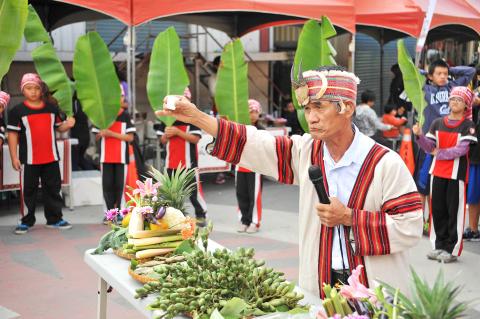
Photo: Chen Feng-li, Taipei Times
What makes this incident unique, however, is that despite Kuo’s success in driving out the area’s inhabitants, the result of this conflict was not Han Chinese domination, but a mass migration of Aboriginal groups from the west coast into Puli. Many of whose descendants still live there today.
BLOOD IN THE MOUNTAINS
Chung writes that various Aboriginal groups lived in Shuishalian during the 17th and 18th centuries, but the exact ethnic composition isn’t clear because Han Chinese and even the coastal Siraya Aborigines were unable to enter the area.
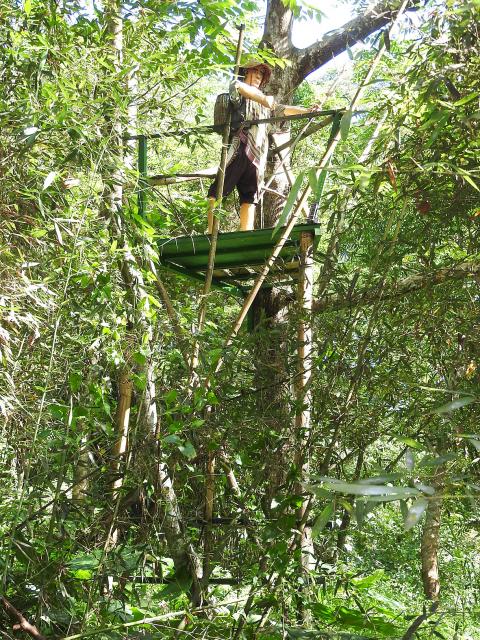
Photo: Tung Chen-kuo, Taipei Times
At the turn of the 19th century, the Puli basin, which was a part of Shuishalian, was still considered an “untouched paradise” by the Han Chinese settlers of the western plains of Taiwan. In fact, the Qing Empire forbade Han Chinese to enter these mountain areas, and employed shou (熟) — “civilized” Aborigines who lived on the plains and largely cooperated with the Qing and had a high degree of contact with Han Chinese — to guard the border. The ones beyond the border were sheng (生), “uncivilized” Aborigines who were often hostile. This policy officially began in 1791.
However, since these “civilized” guards often did not farm land close to the border, they would rent it to Han settlers, who then became aware of the valuable land controlled by the “uncivilized” Aborigines. Consequently, illegal border crossings were common.
Additionally, the Qing court awarded Shuishalian Aborigines border guard positions because they had helped pacify an earlier Han Chinese rebellion.
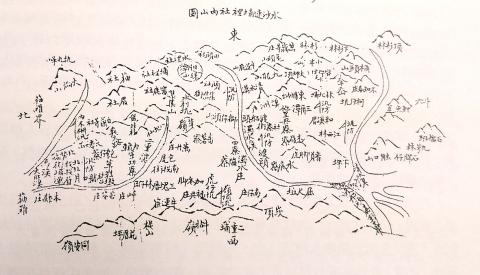
Photo courtesy of National Central Library
By 1800, the Han Chinese settlers around today’s Changhua County were running out of land to cultivate; newcomers could only look towards the mountainous area to the east. So when a Shuishalian border guard approached Kuo and told him that his community had valuable land to farm, they devised a plan to obtain a permit from Qing officials to cultivate it. The pair applied for and received the permit in the name of a dead local chief, claiming that he wanted to rent the land to Han Chinese settlers.
Using this permit, Kuo and about 1,000 followers entered the area and immediately started encroaching on Aboriginal land, farming way beyond what they were allowed to.
Finally, Kuo and company pushed their way towards today’s Puli. The Aborigines there were powerful enough to resist him, leading to the stalemate that finally ended with the massacre.
Qing officials in Tainan sent agents to investigate, but Kuo bribed them off. It was only a matter of time, however, before officials caught on, immediately revoking his permit, sentencing him to a beating, evicting all Han Chinese and threatening to decapitate any non-Aborigines who dared to enter the area. It was clear that officials not only wanted to avoid any conflict with the Aborigines, but were also concerned that Han Chinese rebellions would be harder to quell if they gained access to the rugged mountains.
PINGPU MIGRATION
While the Puli Aborigines were now free to return home, they were greatly weakened by the ordeal. This not only rendered them vulnerable to encroachment from the west, they also suffered attacks by Atayal tribes from the north.
In January 1823, they invited Pingpu settlers from the west coast, who were also facing pressure from the ever-increasing numbers of Han Chinese, to move to Puli to farm and help defend the territory. This was a highly organized migration as the two sides signed agreements and the newcomers had to give presents to the original inhabitants upon arrival. This process took place in several waves over the next few decades.
There were some Han Chinese who pretended to be Aborigines and took Aboriginal names so as to settle in the area. Records show, however, that the numbers remained low for a few decades.
Ironically, the influx of Pingpu settlers — whether legally or illegally — eventually led to the demise of the original inhabitants, who were either assimilated or pushed out. By 1847, Qing records show there were more than 2,000 immigrant Aborigines in Puli compared to 150 or so natives. A Japanese survey in 1900 shows that only eight remained, with their mother tongue completely lost.
Meanwhile, the Qing realized that they could not stop Han Chinese from illegally crossing the borders as arable land became increasingly scarce, and abolished the demarcations in 1875. In 1887, the Qing set up an Aboriginal affairs office in Puli, officially taking the area under control. Just eight years later, the Qing ceded Taiwan to Japan.
Today, the descendants of these settlers trace their lineage back to six tribes who are fighting for recognition today: Taokas, Pazeh, Kahabu, Papora, Babuza and Hoanya.
Taiwan in Time, a column about Taiwan’s history that is published every Sunday, spotlights important or interesting events around the nation that have anniversaries this week.

Ajay Verma, a consultant gastroenterologist at Kettering general hospital in Northamptonshire, says our gut is a “complex machine.” “It is constantly providing us with the nutrition we need, initially to grow and develop, and then for us to survive, thrive and repair from injury and illness.” How can we keep it functioning well? Put simply: “Make sure what you put into it is balanced, and that you clear out its waste products adequately,” Verma says. “In a general gastroenterology clinic, the most common conditions we see are irritable bowel syndrome (IBS), gastroesophageal reflux disease, inflammatory bowel disease and constipation,” says Nisha

And so, in the wake of US President Donald Trump’s trip to the People’s Republic of China (PRC), all the experts on the Strait of Hormuz suddenly became experts on US-China-Taiwan relations. The Internet has certainly expanded human knowledge. Lots of these sudden experts made noise this week about Trump’s words after the meeting with PRC dictator Xi Jin-ping (習近平). Trump is going to sell out Taiwan! Longtime Taiwan commentator J. Michael Cole summed the situation up neatly in the Guardian: “We need to keep in mind that he has a tendency to say many things — sometimes contradicting himself within

Last week US President Donald Trump was asked by a reporter whether he would speak on the phone to the President of Taiwan. “l’ll speak to him. I speak to everybody. We have that situation very well in hand,” Trump said. This marked the second time in a couple of weeks he had said he would talk to the President of Taiwan. In 2016 he famously took a call from then-president Tsai Ing-wen (蔡英文), when he was president-elect. Despite warnings that the apocalypse was nigh because of a phone call, the world quickly forgot about the conversation between two democratically-elected presidents.
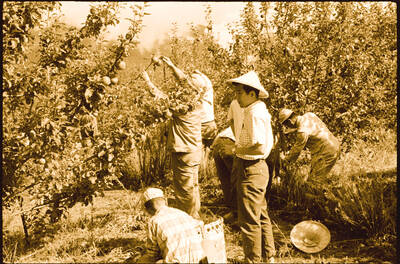
May 25 to May 31 Few believed that apples could be cultivated on a commercial scale in Taiwan’s high mountains. When horticulturalist Cheng Chao-hsiung (程兆熊) first proposed the idea in 1955, both American and Taiwanese colleagues dismissed it as implausible, arguing that temperate fruit could not be reliably grown on a subtropical island, especially on rugged terrain. However, it was this terrain in the Central Mountain Range where many Chinese Civil War veterans were resettled in the late 1950s. With limited job prospects and no family in Taiwan, they were placed on cooperative farms aimed toward self-sufficiency. Some say the conditions


 RSS
RSS