


The search for fresh local green things to put on a plate continues at our home in Hualien and it is an endless surprise what can be discovered with just a little exploration along the fringes of local traditional markets. Talinum (土人蔘, 巴蔘), my most recent discovery, has proved a great success and has become part of the family diet. Like tetragon, which we looked at early this month, it is sometimes regarded as a substitute for spinach, but really, it doesn’t need to be a substitute for anything and has many interesting applications in the kitchen.
Talinum is certainly not a name with which most cooks will be familiar. Its common names are even more exotic, including fameflower and Jewels of Opar, and it makes a very pretty display in the market. But as with many of these unconventional vegetables, unfamiliarity can make them off-putting. Trying to work out exactly what species the vague Chinese term refers to is confusing, and I have seen it linked with Talinum panticulatum, Talinum fruticosum, and Talinum triangulare, plants that can be found throughout Latin America, the Caribbean and West Africa. Talinum features occasionally in Southeast Asian cuisine, and is present in Thai cuisine under the name som kon and in Malay food as genseng halus. It is said to be used extensively as a vegetable in West Africa, particularly Nigeria.
While I am not enough of a botanist to work out exactly which kind of talinum is being sold by my regular “unusual veg” lady at the local market, these different species do seem to have similar traits and various cross references see them all appear under the Chinese name of “wild ginseng” (土人蔘). This name clearly has substantial appeal in Taiwan, and while talinum is not in any way, shape or form a relation to the medicinal root, it is thought to have some of its tonic effects. Talinum does have a slight taste of ginseng, and even if it only has a fraction of its potency as a medicine, at NT$20 a bunch there is really not much to complain about.
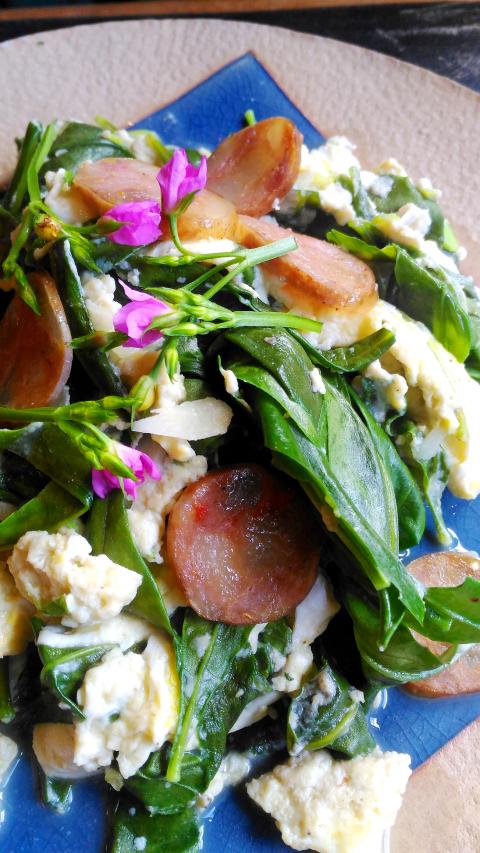
Photo: Ian Bartholomew
My “unusual veg” lady emphasized that it was excellent for brain function and a real boon for the memory, and other sources laud its benefits to the gastrointestinal tract and as an anti-inflammatory. Anecdotal sources praise it as everything from an aphrodisiac to a hangover cure (the former using a decoction of the soft woody stem — just in case you are interested).
Talinum is one of those plants in which nothing is wasted. The leaves can be eaten raw, and the tender shoots are especially delicious tossed into a salad. The more mature leaves can be fried quickly with a bit of ginger and chili for an excellent vegetable side dish, or it can be added to soups and broths. The leaves have a mucinous quality rather like okra, but this can be minimized through very rapid cooking. On the other hand, soups can benefit from this quality if you regard a viscous broth as something to be savored. Once the leaves have been removed, the stems can be used to make soup (definitely preferable to using the leaves for this purpose) or infuse tea. The roots can be steamed and dried before being stored for long periods. Aged roots command a premium for their enhanced medicinal properties.
Apart from the slight bitterness of ginseng, which makes me want to pair it indiscriminately with goji berries, talinum is balanced with a subtle sweetness of its own, particularly in the tender shoots and flowers, which are a readymade garnish. Its texture is similar to Madeira vine (Anredera cordifolia, 川七), though less assertive, making it amenable to winter preparations such as Madeira vine in sesame oil — though it probably wouldn’t look as attractive with its thin, elongated leaves.
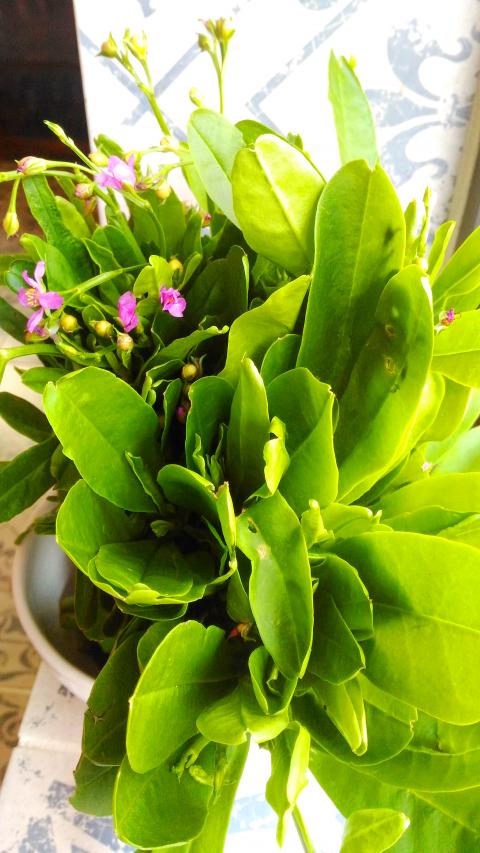
Photo: Ian Bartholomew
For those looking to prepare talinum in a more Western style, inspiration can be taken from the use of purslane, which though widely used in Middle Eastern and Eastern European cuisine, has largely been banished from the menus of America and Western Europe. Perhaps its time to bring this versatile vegetable back as well?
Talinum offers great prospects for culinary exploration and has all the advantages of “foraged” vegetables, with much reduced danger from chemical residues. It should be noted, though, that because of its high oxalic acid content, talinum is not recommended for those suffering from kidney disorders, gout and rheumatoid arthritis.
Talinum Omelet with Spicy Sausage
Recipe
(serves two)
It’s a bit of a cheat to offer an omelet as a recipe, as who doesn’t know how to toss some eggs into a pan with a few bits and pieces. That said, through various experiments in the kitchen, I have found that talinum is a perfect example for the old adage that “less is more.” The less you mess with it, the better it tastes, making for a skillet meal that comes together in minutes. The egg also seems to mitigate the talinum’s mucinous quality, making the dish more acceptable to children (in very limited home testing). The addition of thin slices of spicy Hunan sausage completed this dish for me, and some robust chorizo would probably prove just as effective.
Ingredients
4 eggs
1 stem scallion, finely chopped
1 tsp light soy
1/8 tsp light sesame oil
pinch of white pepper
2 tbsp chicken or vegetable stock
1 small bunch talinum
1 tbsp olive oil
salt
steamed spicy Hunan sausage (optional)
Directions
1. Wash the talinum thoroughly then remove the leaves from the stems. Set the flowers and tenderest shoots aside.
2. Lightly beat the eggs together with the scallions, soy, sesame oil, stock and pepper.
3. Heat a non-stick skillet and add the olive oil. Over medium heat, add the egg mixture.
4. Cook for 30 seconds until the mixture begins to firm up, then add the talinum, mixing roughly to break up the egg. Season lightly with salt and top with slices of steamed Hunan sausage (if using).
Ian Bartholomew runs Ian’s Table,a small guesthouse in Hualien. He has lived in Taiwan for many years writing about the food scene and has decided that until you look at farming, you know nothing about the food you eat. He can be contacted at Hualien202@gmail.com.
May 18 to May 24 Gathered on Yangtou Mountain (羊頭山) on Dec. 5, 1972, Taiwan’s hiking enthusiasts formally declared the formation of the “100 Peaks Club” (百岳俱樂部) and unveiled the final list of mountains. Famed mountaineer Lin Wen-an (林文安) led this effort for the Chinese Alpine Association (中華山岳協會). Working with other experienced climbers, he chose 100 peaks above 10,000 feet (3,048m) that featured triangulation points and varied in difficulty and character. The list sparked an alpine hiking craze, inspiring many to take up mountaineering and competing to “conquer” the summits. A common misconception is that the 100 Peaks represent Taiwan’s 100 tallest

Yesterday, the Democratic Progressive Party (DPP) nominated legislator Puma Shen (沈伯洋) as their Taipei mayoral candidate, the Chinese Nationalist Party (KMT) put their stamp of approval on Wei Ping-cheng (魏平政) as their candidate for Changhua County commissioner and former legislator Tsai Pi-ru (蔡壁如) of the Taiwan People’s Party (TPP) has begun the process to also run in Changhua, though she has not yet been formally nominated. All three news items are bizarre. The DPP has struggled with settling on a Taipei nominee. The only candidate who declared interest was Enoch Wu (吳怡農), but the party seemed determined to nominate anyone

In a sudden move last week, opposition lawmakers of the Chinese Nationalist Party (KMT) and Taiwan People’s Party (TPP) passed a NT$780 billion special defense budget as a preemptive measure to stop either Chinese leader Xi Jinping (習近平) or US President Donald Trump from blocking US arms sales to Taiwan at their summit in Beijing, said KMT heavyweight Jaw Shaw-kong (趙少康), speaking to the Taipei Foreign Correspondents Club on Wednesday night in Taipei. The 76-year-old Jaw, a political talk show host who ran as the KMT’s vice presidential candidate in 2024, says that he personally brokered the deal to resolve

“China wants to unify with Taiwan at the lowest possible cost, and it currently believes that unification will become easier and less costly as time passes,” wrote Amanda Hsiao (蕭嫣然) and Bonnie Glaser in Foreign Affairs (“Why China Waits”) this month, describing how the People’s Republic of China (PRC) is playing the long game in its quest to seize Taiwan. This has been a favorite claim of many writers over the years, easy to argue because it is so trite. Very obviously, if the PRC isn’t attacking Taiwan, it is waiting. But for what? Hsiao and Glaser’s main point is trivial,


 RSS
RSS