


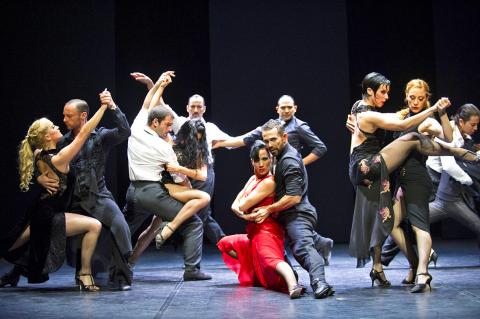
Belgian choreographer Sidi Larbi Cherkaoui returns to Taipei with his highly praised exploration of the world of tango, Milonga (米隆加), which opens at the National Theater for a three-show run tomorrow night.
Taipei audiences caught their first glimpse of Cherkaoui in September 2007, when he and British choreographer Akram Kham performed their stunning Zero Degrees as part of the Novel Hall Dance series. Since then a lot has happened for the now 40-year-old Cherkaoui.
In 2008, he followed Khan in being named an associate artist of Sadler’s Wells, the London theater that is a leading proponent and promoter of contemporary dance. In 2010, he established his own company, Eastman, in his hometown of Antwerp, and became the artistic director of the Festival Equilibrio in Rome. In September last year, he became artistic director of the Royal Ballet Flanders.
Credit: Courtesy of Sadler’s Wells
MULTI-TALENTED
It has been an interesting journey for a man who only took up dancing at age 15, inspired by the music videos he saw on television. He threw himself into learning a wide variety of genres — ballet, hip-hop, tap, jazz, flamenco — as well as acrobatics, and within a few years, he was dancing on TV himself.
Cherkaoui enrolled at Anne Teresa de Keersmaeker’s contemporary dance school, PARTS (Performing Arts Research and Training Studios) in Brussels while continuing to perform with both a hip-hop and a jazz dance company. He joined the dance collective Les Ballets C de la B in 1997 and two years later choreographed an award-winning musical.
However, his choreographic career really took off with Rien de Rien in 2000, his first full-length work, and he has never looked back. He continued to choreograph for Les Ballets C de la B for six more years before leaving to join the Toneelhuis theater in his hometown.
Two of most consistent elements of Cherkaoui’s works are that their themes and styles vary widely, as do the artists he collaborates with. In addition to Khan, he has worked with fellow Belgian Wim Vandekeybus, Theater Stap’s mentally disabled actors, Shaolin Temple monks — for Sutra, which he brought to Kaohsiung in March last year — and flamenco dancer Maria Pages, to name a few.
Cherkaoui has said that his works are about relationships and how people handle each other.
Milonga, created for Sadler’s Wells, premiered in 2013 and was the first large-scale tango production to be directed by a non-Argentine artist, although the Argentine tango dancers and musicians involved in the project are credited as co-creators, such as tango superstar Nelida Rodriguez, who served as consultant and rehearsal director.
PASSION FOR TANGO
Cherkaoui has said that he had long been moved by tango.
“In tango I saw some sort of magic happening, some sort of communication going on that was completely without any sign of even almost visual contact or words, and somehow through touch they could tell each other a lot of things and we could follow that conversation from outside,” he said in a Sadler’s Wells video about the show.
For his cast, he chose 10 tango dancers from Buenos Aires who had been working with each other for a long time, including German Cornejo and Gisela Galeassi, and then added two contemporary dancers, Jason Kittelberger and Jennifer White.
In Cherkaoui’s highly charged production, the dancers’ feet and legs move with razor-like precision, pelvises swivel and eyes smolder; even on video the electricity is palpable. Yet the show is more than just an homage to tango’s traditions, for the choreographer’s love of mixing things up provides some alternative realities for 21st century tango enthusiasts.
Eugenio Szwarcer designed the set and video projections, which aim to convey the atmosphere of both Buenos Aires and the late-night tango parties for which the show is named, while the score features new music from Argentinean composer Fernando Marzan and frequent Cherkaoui collaborator Szymon Brzoska with tango classics, performed live by five musicians.
The show should prove as popular with local audiences as it has with those in Europe and the US since tango has a fast-growing fan base in Taiwan, which boasts a handful of tango orchestras and several regular “milongas” in Taipei and Tainan, while the annual Taipei Tango Festival marked its 13th anniversary last year.
Cherkaoui’s Milongo runs 85 minutes, without intermission. There is a pre-show talk in the theater lobby starting a half-hour before each show and a post-show talk after Sunday’s matinee.

This is the year that the demographic crisis will begin to impact people’s lives. This will create pressures on treatment and hiring of foreigners. Regardless of whatever technological breakthroughs happen, the real value will come from digesting and productively applying existing technologies in new and creative ways. INTRODUCING BASIC SERVICES BREAKDOWNS At some point soon, we will begin to witness a breakdown in basic services. Initially, it will be limited and sporadic, but the frequency and newsworthiness of the incidents will only continue to accelerate dramatically in the coming years. Here in central Taiwan, many basic services are severely understaffed, and
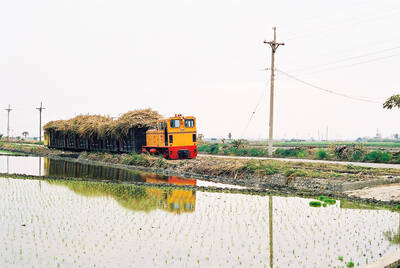
Jan. 5 to Jan. 11 Of the more than 3,000km of sugar railway that once criss-crossed central and southern Taiwan, just 16.1km remain in operation today. By the time Dafydd Fell began photographing the network in earnest in 1994, it was already well past its heyday. The system had been significantly cut back, leaving behind abandoned stations, rusting rolling stock and crumbling facilities. This reduction continued during the five years of his documentation, adding urgency to his task. As passenger services had already ceased by then, Fell had to wait for the sugarcane harvest season each year, which typically ran from
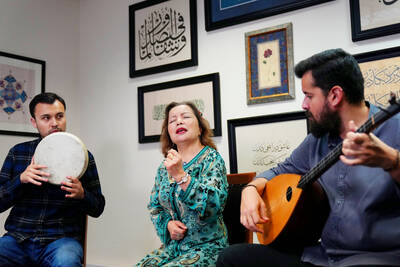
It is a soulful folk song, filled with feeling and history: A love-stricken young man tells God about his hopes and dreams of happiness. Generations of Uighurs, the Turkic ethnic minority in China’s Xinjiang region, have played it at parties and weddings. But today, if they download it, play it or share it online, they risk ending up in prison. Besh pede, a popular Uighur folk ballad, is among dozens of Uighur-language songs that have been deemed “problematic” by Xinjiang authorities, according to a recording of a meeting held by police and other local officials in the historic city of Kashgar in

It’s a good thing that 2025 is over. Yes, I fully expect we will look back on the year with nostalgia, once we have experienced this year and 2027. Traditionally at New Years much discourse is devoted to discussing what happened the previous year. Let’s have a look at what didn’t happen. Many bad things did not happen. The People’s Republic of China (PRC) did not attack Taiwan. We didn’t have a massive, destructive earthquake or drought. We didn’t have a major human pandemic. No widespread unemployment or other destructive social events. Nothing serious was done about Taiwan’s swelling birth rate catastrophe.


 RSS
RSS