


As most of us mortals returned to work this week, the “godly dragons” of Miaoli County began a week-long mission on Tuesday morning.
Nine motionless dragons sat in the square of Yuching Temple (玉清宮) as a large contingent of temple personnel, government officials and civic leaders call on the Jade Emperor (玉皇大帝) and other deities to animate the beasts.
Officials consecrate the dragons by painting on the eyes, ears, mouths, bodies and tails with a sacred liquid consisting of cinnabar, rice wine and rooster blood.
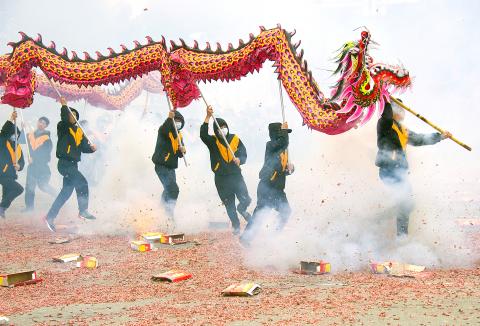
Photo: Han Cheung, Taipei Times
“The dragons are now ready to come to life,” ceremony host Chung Chun-hui (鐘椿輝) announces.
The dragons begin to stir as the deities enter their bodies, ready to spread good luck and bless the community with a peaceful and prosperous year.
This Hakka ceremony is the second of six stages in Miaoli’s Bombing the Dragon (火旁龍) tradition. The first, which took place before the Lunar New Year, involved the construction of the dragons, which are traditionally made from bamboo and cloth.
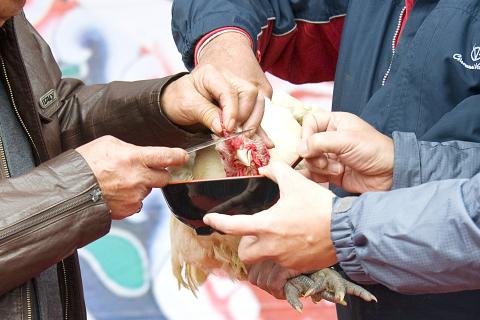
Photo: Han Cheung, Taipei Times
During the third stage, locals invite the dragons into their homes and businesses between the 9th and 17th days of the Lunar New Year (Tuesday until Feb. 24) for blessings in exchange for red envelopes.
The public can get a taste of the fourth and fifth stages this weekend at Miaoli Riverside Park (苗栗市河濱公園): following the dragon in a procession and bombing the dragon, where people throw massive amounts of firecrackers at the dragons for good fortune. Friday’s event also includes a family-friendly cultural carnival with crafts, games and performances. Finally, the dragons are burned as the gods return to the sky on Feb. 24.
DRAGON DANCEOFF
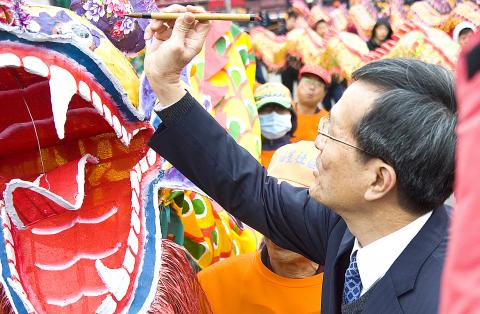
Photo: Han Cheung, Taipei Times
Back at the Yuching Temple square, the dragons are now lively, brandishing their fangs in the wind. The ceremony isn’t over yet — eight of the nine teams will compete in a dragon dance competition for cash and prestige.
Chung explains the five elements of dragons based on their color: yellow represents gold and wealth, green is for wood and growth, blue for water and peace, red for fire and prosperity. All other colors are considered earth — symbolizing a good harvest.
Thirty percent of the contest scoring is based on the dragon’s appearance. Though traditional materials are the most popular when fashioning the beasts, Chung says with printing technology, nowadays only the head and tail are painted by hand.
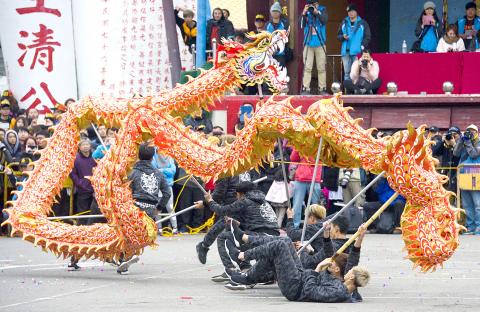
Photo: Han Cheung, Taipei Times
“We look at whether the dragon’s shape and construction method resembles the original flavor of our folk customs,” he says. “But since young people like to be creative, teams are allowed to add other elements as long as the dragon doesn’t lose its original character. We even award points for creativity.”
The first group uses a traditional gong and drum approach, but the second, an all-female group with a bright pink dragon adorned with Hakka floral patterns, begins their routine by slinking into the arena to the tune of Pink Panther which segues into fast-paced dance music followed by the Dragon Ball theme. Another group grooves to a rap song filled with f-bombs, then breaks out the Gangnam Style horse dance.
Chung says judges prefer the gongs and drums but they didn’t want to exclude groups that didn’t have traditional musicians — though the judges will give them a lower score.
The second-to-last team entered with gusto, consisting of young men wearing all black with dyed hair and carrying a noble red dragon that was longer than the others. This group shouted louder, moved more vigorously and performed acrobatic stunts such as human pyramids and group jump rope with the dragon body.
“That is Taolue Dragon Team (韜略),” event planner Chung Chi-ming (鍾志明) says. “They took a break last year after winning three championships in a row. Their return was big news, and they’ve already received countless invitations [to perform] from residents and businesses.”
BOMBS AWAY
As expected, Taolue wins. The top three teams put on a final performance, and the bombing begins as men toss boxes of lit firecrackers into the arena. The dragon bearers are unfazed, hopping around the debris and carrying on through the smoke.
Chung Chi-ming says the dragons like fire, so the more intense the explosions, the happier they are and the more prosperity they will bring. The dragons will continuously be bombed this week as they travel through the city.
“You can still see their colors today, but by Saturday, they will probably be black from firecracker ash,” he laughs.
Chung adds that bombings are also a way for businesses to promote themselves, as people gather in front of the store and watch the proceedings. In the old days, businesses announced bombings by launching rocket fireworks into the sky, but now it is done through Facebook.
Even though parents are somewhat reluctant to let their children participate in such a dangerous activity, Chung says it is still considered a rite of passage into adulthood for young Hakka men.
In the old days, each Hakka village would sponsor a dragon to visit other villages as a symbol of good will as well as to show their enemies that they have many young men. Chung Chun-hui, who grew up in a farming village, recalls that firecrackers were only used to liven the atmosphere back then, but it became a commercial activity as Taiwan’s economy took off.
Chung says he started out holding torches to illuminate the way for the dragons as a small child, later becoming involved in almost every facet of dragon bombing. It was tougher back then, he says, as he had to carry on his back a 20kg battery for the lights inside the dragon and walk between villages until morning.
“Now people use LED lights,” he says.
The bombing continues, and it is pretty loud and violent even from the sidelines. When asked if this is what to expect on Saturday, Chung Chi-ming shakes his head.
“This is nothing,” he says. “Saturday will be hundreds of times more intense than this.”
Ajay Verma, a consultant gastroenterologist at Kettering general hospital in Northamptonshire, says our gut is a “complex machine.” “It is constantly providing us with the nutrition we need, initially to grow and develop, and then for us to survive, thrive and repair from injury and illness.” How can we keep it functioning well? Put simply: “Make sure what you put into it is balanced, and that you clear out its waste products adequately,” Verma says. “In a general gastroenterology clinic, the most common conditions we see are irritable bowel syndrome (IBS), gastroesophageal reflux disease, inflammatory bowel disease and constipation,” says Nisha

And so, in the wake of US President Donald Trump’s trip to the People’s Republic of China (PRC), all the experts on the Strait of Hormuz suddenly became experts on US-China-Taiwan relations. The Internet has certainly expanded human knowledge. Lots of these sudden experts made noise this week about Trump’s words after the meeting with PRC dictator Xi Jin-ping (習近平). Trump is going to sell out Taiwan! Longtime Taiwan commentator J. Michael Cole summed the situation up neatly in the Guardian: “We need to keep in mind that he has a tendency to say many things — sometimes contradicting himself within

Last week US President Donald Trump was asked by a reporter whether he would speak on the phone to the President of Taiwan. “l’ll speak to him. I speak to everybody. We have that situation very well in hand,” Trump said. This marked the second time in a couple of weeks he had said he would talk to the President of Taiwan. In 2016 he famously took a call from then-president Tsai Ing-wen (蔡英文), when he was president-elect. Despite warnings that the apocalypse was nigh because of a phone call, the world quickly forgot about the conversation between two democratically-elected presidents.
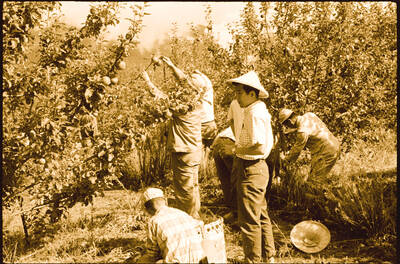
May 25 to May 31 Few believed that apples could be cultivated on a commercial scale in Taiwan’s high mountains. When horticulturalist Cheng Chao-hsiung (程兆熊) first proposed the idea in 1955, both American and Taiwanese colleagues dismissed it as implausible, arguing that temperate fruit could not be reliably grown on a subtropical island, especially on rugged terrain. However, it was this terrain in the Central Mountain Range where many Chinese Civil War veterans were resettled in the late 1950s. With limited job prospects and no family in Taiwan, they were placed on cooperative farms aimed toward self-sufficiency. Some say the conditions


 RSS
RSS