


Members of the Gade family proudly show off a stash of Indian rupees kept in an unlocked tin barrel in their bedroom, despite their home not having a front door.
In Shani Shingnapur village in western India, residents see little need for such security, thanks to their belief in special protection from the Hindu deity Shani.
As farmers trundle the roads in bullock carts piled high with sugarcane, they pass rows of homes bearing empty door frames — a village tradition that goes back for generations.
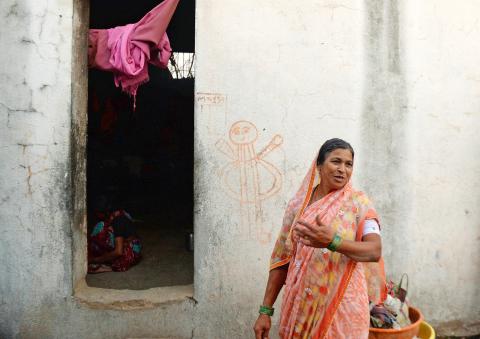
Photo: AFP
“Years ago, Shani came in the dreams of devotees and told them you don’t need to put any doors on your homes,” housewife Jayashree Gade told AFP.
“He said: ‘I will protect you’. That’s why we don’t have any doors.”
According to legend, an iron and stone slab washed up in a nearby river during a flood more than 300 years ago, and began oozing blood when cattle herders poked it with a stick.
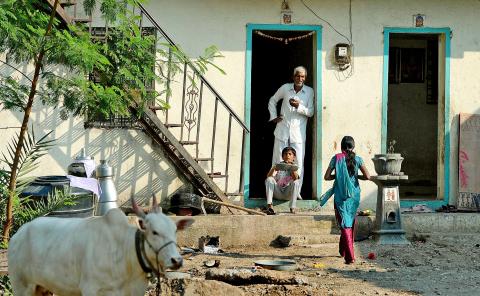
Photo: AFP
In a vision to a villager later that night, the slab was revealed to be an idol of Shani, and today it stands in an open square adorned with garlands of flowers, drawing crowds of pilgrims.
Shani, who is believed to be manifested in the planet Saturn, is considered so mighty that his shrine cannot be kept under a shelter — and he will not let thieves in the village of open homes go unpunished.
“The power of Shani is such that if someone steals, he will keep walking all night and think he has left the village, but when the sun comes up he will still be there,” said mill worker Balasaheb Borude.
Some villagers said they put loose panels against their door frames at night, but only to keep out wild animals.
Similarly, the local branch of state-owned UCO Bank prides itself on its “lockless” status. Although money is kept in a strongroom, the front of the building has just a glass door with no lock, to avert stray dogs.
“We have no trouble,” said bank official Nagender Sehrawat, gesturing to the queue of customers when asked if they were happy with the arrangement.
DEVOTEES POURING IN
Today the center of the village, which lies in Maharashtra state, has the feel of bustling small town, with stalls lining the dusty main road selling souvenirs and flowers to religious tourists.
Home to about 5,000 people, Shani Shingnapur rose to fame across the country after appearing in a devotional Hindi film about its deity in the 90s.
“The whole world got to know that there is a place called Shani Shingnapur, where houses have no doors, there are trees but no shadows, there are gods but no temples,” said Sayaram Bankar, a trustee at the shrine.
“Devotees from across the state and across India started pouring in to see this unusual village.”
Shani Shingnapur’s reputation has been somewhat dented in recent years by reports of a few thefts. In 2010, a visitor from northern India complained that cash and valuables worth US$553 were taken from a vehicle. Bankar dismissed reports of stealing, saying it only happened outside the village. Skeptics of the Shani legend remain unconvinced by the area’s appeal.
“When you have a place in the middle of nowhere where no one goes and you have a legend like that — then people will go there,” said Narendra Nayak, a leading Indian rationalist who works to expose fraudulent gurus and challenge superstitions. According to a pamphlet handed out at the shrine, Shani Shingnapur is not just free from theft but from all sinful behavior, a “model village” in contrast to the corrupt outside world.
“Professional robbers, thieves, dacoits, non-vegetarians, drunkards, never come here,” the pamphlet confidently stated.
“If they come, they behave like gentlemen.”
As for doors, a few have popped up over the years, but villagers were sure their tradition would continue — much to the envy of visiting devotees.
“This is something special about this god. He is a guardian of this place,” said Amit Sharma, a hotel manager, after paying his respects at the shrine.
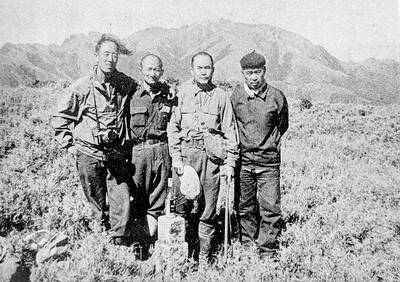
May 18 to May 24 Gathered on Yangtou Mountain (羊頭山) on Dec. 5, 1972, Taiwan’s hiking enthusiasts formally declared the formation of the “100 Peaks Club” (百岳俱樂部) and unveiled the final list of mountains. Famed mountaineer Lin Wen-an (林文安) led this effort for the Chinese Alpine Association (中華山岳協會). Working with other experienced climbers, he chose 100 peaks above 10,000 feet (3,048m) that featured triangulation points and varied in difficulty and character. The list sparked an alpine hiking craze, inspiring many to take up mountaineering and competing to “conquer” the summits. A common misconception is that the 100 Peaks represent Taiwan’s 100 tallest

Yesterday, the Democratic Progressive Party (DPP) nominated legislator Puma Shen (沈伯洋) as their Taipei mayoral candidate, the Chinese Nationalist Party (KMT) put their stamp of approval on Wei Ping-cheng (魏平政) as their candidate for Changhua County commissioner and former legislator Tsai Pi-ru (蔡壁如) of the Taiwan People’s Party (TPP) has begun the process to also run in Changhua, though she has not yet been formally nominated. All three news items are bizarre. The DPP has struggled with settling on a Taipei nominee. The only candidate who declared interest was Enoch Wu (吳怡農), but the party seemed determined to nominate anyone

In a sudden move last week, opposition lawmakers of the Chinese Nationalist Party (KMT) and Taiwan People’s Party (TPP) passed a NT$780 billion special defense budget as a preemptive measure to stop either Chinese leader Xi Jinping (習近平) or US President Donald Trump from blocking US arms sales to Taiwan at their summit in Beijing, said KMT heavyweight Jaw Shaw-kong (趙少康), speaking to the Taipei Foreign Correspondents Club on Wednesday night in Taipei. The 76-year-old Jaw, a political talk show host who ran as the KMT’s vice presidential candidate in 2024, says that he personally brokered the deal to resolve

“China wants to unify with Taiwan at the lowest possible cost, and it currently believes that unification will become easier and less costly as time passes,” wrote Amanda Hsiao (蕭嫣然) and Bonnie Glaser in Foreign Affairs (“Why China Waits”) this month, describing how the People’s Republic of China (PRC) is playing the long game in its quest to seize Taiwan. This has been a favorite claim of many writers over the years, easy to argue because it is so trite. Very obviously, if the PRC isn’t attacking Taiwan, it is waiting. But for what? Hsiao and Glaser’s main point is trivial,


 RSS
RSS