


Chrisdien Deny, a retail chain with more than 500 locations across China, sells belts, shoes and clothing with an “Italian style” — and a logo with the same font as Christian Dior’s.
Helen Keller, named for the deaf-blind US humanitarian, offers trendy sunglasses and classic spectacles at over 80 stores, with the motto “You see the world, the world sees you.”
Frognie Zila, a clothing brand sold in 120 stores in China, boasts that its “international” selection is “one of the first choices of successful politicians and businessmen” and features pictures on its Web site of the Leaning Tower of Pisa and Venetian canals.
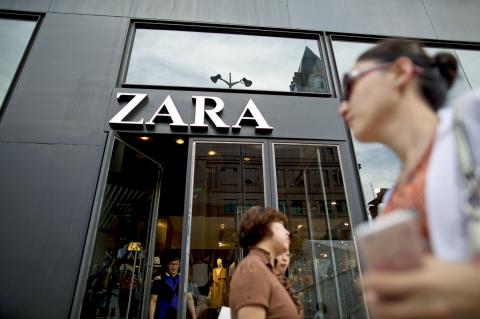
Photo: Bloomberg
INTERNATIONAL VENEER
Eager to glaze their products with the sheen of international sophistication, many homegrown retail brands have hit upon a similar formula: Choose a non-Chinese name that gives the impression of being foreign.
“You could call it fawning on foreign powers,” said Cheng Wei, 37, who was recently at a Beijing mall buying winter clothes at Chocoolate, a Hong Kong casual wear outlet, where Chinese characters were absent from all but one store logo.
At a time when manufacturing is cooling and real estate is slumping, consumption is a bright spot in the Chinese economy. In the first 11 months of 2014, retail sales grew by 12 percent over the previous year to US$3.8 trillion, according to the National Bureau of Statistics.
The government considers consumer spending so vital that Prime Minister Li Keqiang (李克強 ) in November declared, “Let the people be able to consume, dare to consume and be willing to consume,” according to the state news agency Xinhua.
But some Chinese appear loath to spend their disposable income on locally produced fashions.
MADE IN CHINA
“Buy Chinese brands? Never,” said Fu Rao, 20, a university student, who was browsing the clothes at the Japanese outlet store Snidel in an upscale Beijing mall one recent evening. Fu complained that Chinese products were shoddily made and lacking in style. “Foreign stuff is so much better,” she said.
As Chinese retail companies try to attract consumers, mystifying maladaptations of English have spread across the country’s storefronts, shopping bags and clothing labels. Wanko, Hotwind, Scat, Orgee and Marisfrolg (the L is silent) all sell clothing. A sponsor of China’s national golf team is the apparel chain Biemlfdlkk.
If Chinese companies have stumbled in the branding race, that is because few ever gave it much thought. For years, as China’s economic growth soared into the double digits, branding was largely considered a low-priority marketing decision left to top executives far more concerned with the next product introduction than with building long-term value, said Joel Backaler, author of China Goes West, a book that charts the efforts of Chinese companies seeking to build international brands.
In China, many Western brands have chosen a Mandarin-language name that will convey relevant qualities to consumers, like Coca-Cola, whose Chinese brand name — Kekoukele (可口可樂) — translates as “tasty fun”. Other foreign brands such as Cadillac, or Kadilake (凱迪拉克) in Chinese characters, stick with a phonetic transliteration that has no Chinese meaning, thus signaling their foreign cachet.
Some local companies have gone the same route, employing phonetic if meaningless brand names to obtain a foreign-sounding flair, even though they are actually homegrown.
The golf apparel brand Biemlfdlkk, sold in over 450 Chinese stores, goes by Biyinlefen (比音勒芬). in Mandarin, using four characters that translate literally as “compare music rein fragrant.” While the name may be ambiguous by design, it can make creating a uniform brand identity difficult. A Biemlfdlkk saleswoman in the southern city of Guangzhou explained, “It’s a German name.” An employee at another Biemlfdlkk shop had a different explanation: “It’s the name of a French designer.”
COPYCAT BRANDS, KINDA
Rather than create distinct branding, other local companies have chosen simply to mimic well-known foreign brands. “Chinese brands copy because they believe it enables them to get an easy, quick win,” said Vladimir Djurovic, president of Labbrand Consulting Co in Shanghai. “They play on the confusion.”
The knockoff casual wear brand Clio Coddle has a green crocodile logo reminiscent of Lacoste. Across China, sneakers are emblazoned with Adidos, Hike, Cnoverse and Fuma — featuring a smoking puma — and there are SQNY batteries and Johnnie Worker Red Labial whiskey.
Reached by phone, a Chrisdien Deny representative denied that the brand was trying to piggyback on the reputation of Christian Dior, which has dozens of stores in China. “I’ve never heard of that company,” said the representative, who declined to give her name. Christian Dior declined to comment.
Chrisdien Deny has no Chinese-language brand name and is a subsidiary of Huayu Group Holdings Ltd., based in Guangzhou. Huayu claims to be the Far East distributor of the “century-old European brand” Chrisdien Deny, according to its employee recruiting materials.
Chinese brand names have stoked international controversy in the past. One of China’s most popular toothpaste brands is known as Darlie in English but Hei ren (黑人), or “black people” in Mandarin. In 1985, Colgate-Palmolive bought 50 percent of the Hong Kong company that owned the brand, which was then called Darkie in English. Its logo was a grinning minstrel in blackface wearing a top hat, tuxedo and bow tie.
After three years of pressure by African-Americans, religious groups and shareholders who found the brand derogatory, Colgate made the logo more racially ambiguous and changed the English name to Darlie, though the Mandarin remains unchanged. “Colgate is committed to demonstrating respect to all people,” the company has said in a statement on its website. “We understand that there are different perspectives on the Chinese language brand, and we continue to consider these perspectives in our discussions” with the Hong Kong founders.
Helen Keller glasses would probably have a hard time selling overseas, too. Though the company’s website includes a lengthy biography of Helen Keller, it omits all mention of the disabilities she worked hard to overcome.
Reached by phone, a brand manager found nothing problematic about the omission. “So she’s blind and deaf — her personal shortcomings are not related to the spirit of our brand,” said the woman, who gave only her surname, Jiang. “These products help you love and protect your eyes. Why would that be offensive?”
Facing rising labor costs and increased competition, businesses are now thinking more carefully about brand identity, analysts say. “Yesterday’s strategy is no longer effective,” said Backaler, the China Goes West author.
Labbrand has developed over 200 brand names for Western companies entering the Chinese market and Chinese companies looking to build global brands. Labbrand’s president, Djurovic, said the company’s work creating brand names in the Latin alphabet has increased significantly in recent years, suggesting that Chinese companies are beginning to realize they cannot just transliterate their Mandarin brand names or mimic Western ones if they hope to win the loyalties of customers, not just in China but also around the world.
So far, only a few domestic brands have succeeded abroad, mostly in high tech. One notable exception is Haier, the world’s top electronic home appliance brand for the last five years, according to the market research firm Euromonitor International.
The Chinese sportswear maker Li Ning, based in Beijing, has not been as fortunate. Despite opening stores in the United States and spending heavily on US advertising, the company reported net losses of US$75 million in the first half of the year, three times as much as its net loss in 2013.
At home, one of the toughest challenges for local brands is Chinese consumers themselves. Suby Zhou, 27, a property rights manager, said she did not see much difference between local and foreign brands. “Everything’s so international now,” she said while shopping at a Uniqlo outlet in Beijing.
Still, the power of foreign branding has left an indelible impression. Zhou could easily rattle off foreign brands she liked, among them Zara and H&M, but when asked about favored Chinese brands, she drew a blank. “I can’t think of any,” she said.
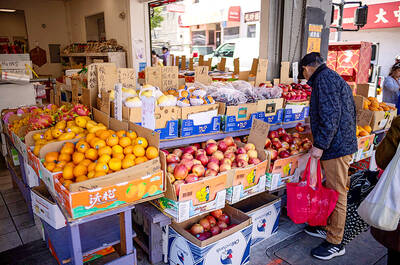
Ajay Verma, a consultant gastroenterologist at Kettering general hospital in Northamptonshire, says our gut is a “complex machine.” “It is constantly providing us with the nutrition we need, initially to grow and develop, and then for us to survive, thrive and repair from injury and illness.” How can we keep it functioning well? Put simply: “Make sure what you put into it is balanced, and that you clear out its waste products adequately,” Verma says. “In a general gastroenterology clinic, the most common conditions we see are irritable bowel syndrome (IBS), gastroesophageal reflux disease, inflammatory bowel disease and constipation,” says Nisha
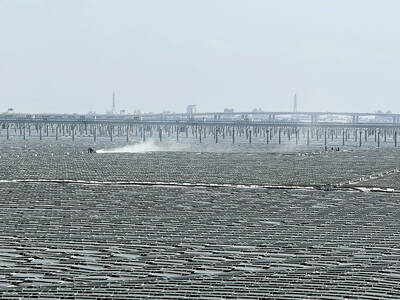
The arithmetic is straightforward and uncomfortable. By the end of 2025, Taiwan had committed itself to a 50-30-20 electricity mix — half natural gas, 30 per cent coal, 20 per cent renewables. The Ministry of Economic Affairs’s (MOEA) own monthly energy reports tell a different story. Natural gas reached 47.8 per cent of generation last year. Coal stood at 35.4 per cent, comfortably above its target ceiling. Renewables came in at 13.1 per cent, well short of the 20 per cent Taipei had pledged a decade earlier. Installed renewable capacity reached roughly half of the 12 gigawatts (GW) the government
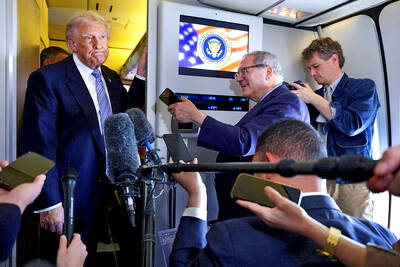
Last week US President Donald Trump was asked by a reporter whether he would speak on the phone to the President of Taiwan. “l’ll speak to him. I speak to everybody. We have that situation very well in hand,” Trump said. This marked the second time in a couple of weeks he had said he would talk to the President of Taiwan. In 2016 he famously took a call from then-president Tsai Ing-wen (蔡英文), when he was president-elect. Despite warnings that the apocalypse was nigh because of a phone call, the world quickly forgot about the conversation between two democratically-elected presidents.
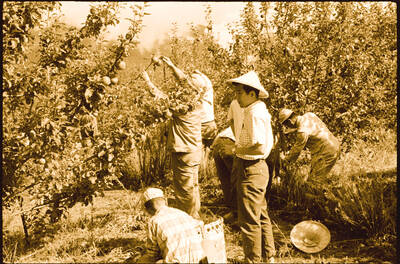
May 25 to May 31 Few believed that apples could be cultivated on a commercial scale in Taiwan’s high mountains. When horticulturalist Cheng Chao-hsiung (程兆熊) first proposed the idea in 1955, both American and Taiwanese colleagues dismissed it as implausible, arguing that temperate fruit could not be reliably grown on a subtropical island, especially on rugged terrain. However, it was this terrain in the Central Mountain Range where many Chinese Civil War veterans were resettled in the late 1950s. With limited job prospects and no family in Taiwan, they were placed on cooperative farms aimed toward self-sufficiency. Some say the conditions


 RSS
RSS