


Blind Massage (推拿), the award-winning new film by the enfant terrible of Chinese cinema Lou Ye (婁燁), throws a rare spotlight on those who cannot see for themselves in a country where the disabled are often marginalized.
Lou has previous tackled a slew of forbidden subjects, including gay sex and the 1989 Tiananmen protests, and his latest work went on general release in China last Friday.
Based on Bi Feiyu’s (畢飛宇) wildly popular novel Massage (推拿), the low-budget feature tells the story of a small blind community working in a therapeutic massage parlor in the eastern city of Nanjing.
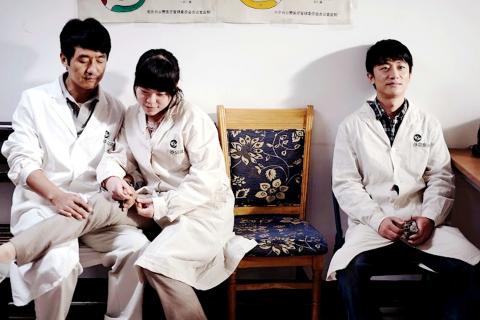
Photo: AFP
In China, home to some 85 million disabled people according to state media, the stigma surrounding disability is marked. Schools often deny admission to disabled pupils, contributing to an estimated 40 percent illiteracy rate in the community.
For the 17 million blind, massage offers an escape from poverty and ostracism, and several hundred thousand work in salons and parlors across the country.
“It was a taboo subject — but not anymore, it seems to me,” Lou told AFP at his film’s premiere in Beijing last week.
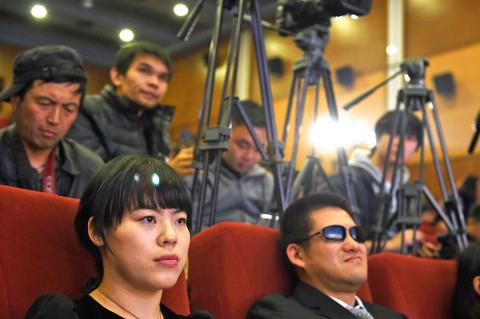
Photo: AFP
Even so, he still had to contend with China’s state censors, who have repeatedly banned his previous works.
“We managed to get it through after four or five months of discussions,” he said.
“The version that the [Chinese] audience will see is a bit different from the original. We had to take out the most sexual and violent images. I can understand why we had to do that, because Chinese cinema doesn’t have an age classification system,” he added carefully.
ON THE FRINGE
Starring both sighted and unsighted actors, Blind Massage explores the lives and loves of the masseurs, with some scenes deliberately blurred to give the viewer a sense of having poor vision.
Desperation is never far from their lives, and some parts of the film — including mutilations — are undoubtedly shocking.
The blind see themselves as outsiders to mainstream society, a narrator explains in a voice-over, and their own community is divided between those who had the ability to see and gradually lost it and those born without sight.
The question of who is beautiful becomes a matter of huge curiosity even as they spend their lives in the dark. One character is taken to a brothel where he becomes infatuated with a prostitute, but their dynamic shifts dramatically when his sight begins to return. Corrupt officials, loan sharks and callous family members who abandon their blind kin also get an airing.
It has echoes in the life of Fu Chiyou, who expertly pummels his customers’ feet while perched on a tiny stool in a Beijing hairdressing salon.
The 38-year-old was born blind into a family of farmers in Heilongjiang, China’s northernmost province. Forced into a relatively solitary existence because of his disability, he spent his childhood and adolescence in the company of just his family and two friends. Few blind manage to marry or secure stable employment, he says.
“I never had anything to do, and my parents worried about my future,” Fu told AFP.
“So I thought of going to a massage school for the blind.”
It took Fu five years to perfect the art of massage under the traditional principles of Chinese medicine, learning the secrets of the human form and its pressure points.
“The blind have a more developed sense of hearing, as well as a more developed sense of touch,” he said.
He works from 3pm until midnight every day, with the salon owner providing his lodgings as well as his modest salary.
BEHIND CLOSED DOORS
Lou, a Shanghai native, has faced repeated bans on his work in China and is used to having to screen it behind closed doors.
He was banned from directing for five years after making Summer Palace (2006), which depicts relationships against a backdrop of the Tiananmen protests and has never been released in China.
His other films include Spring Fever (2009), which portrays a clandestine gay affair and was shot in secret in defiance of his film-making ban.
But the Beijing premiere for Blind Massage was packed after the film scooped top honors at last month’s Golden Horse film awards in Taiwan, touted as the Chinese-language Oscars.
It also fared well at the Berlin film festival earlier this year, winning the Silver Bear prize for Outstanding Artistic Contribution.
Fu will never see the movie, but is very much aware of it.
“For the first time there’s a film that talks about our lives,” he said as he dug his thumb into the sole of a customer’s foot.
“That can only be a good thing.”
Ajay Verma, a consultant gastroenterologist at Kettering general hospital in Northamptonshire, says our gut is a “complex machine.” “It is constantly providing us with the nutrition we need, initially to grow and develop, and then for us to survive, thrive and repair from injury and illness.” How can we keep it functioning well? Put simply: “Make sure what you put into it is balanced, and that you clear out its waste products adequately,” Verma says. “In a general gastroenterology clinic, the most common conditions we see are irritable bowel syndrome (IBS), gastroesophageal reflux disease, inflammatory bowel disease and constipation,” says Nisha
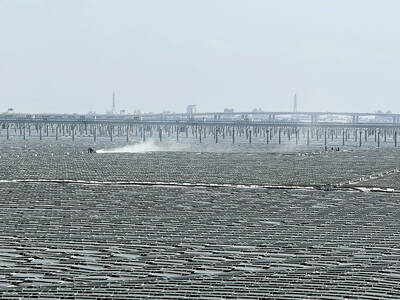
The arithmetic is straightforward and uncomfortable. By the end of 2025, Taiwan had committed itself to a 50-30-20 electricity mix — half natural gas, 30 per cent coal, 20 per cent renewables. The Ministry of Economic Affairs’s (MOEA) own monthly energy reports tell a different story. Natural gas reached 47.8 per cent of generation last year. Coal stood at 35.4 per cent, comfortably above its target ceiling. Renewables came in at 13.1 per cent, well short of the 20 per cent Taipei had pledged a decade earlier. Installed renewable capacity reached roughly half of the 12 gigawatts (GW) the government

Last week US President Donald Trump was asked by a reporter whether he would speak on the phone to the President of Taiwan. “l’ll speak to him. I speak to everybody. We have that situation very well in hand,” Trump said. This marked the second time in a couple of weeks he had said he would talk to the President of Taiwan. In 2016 he famously took a call from then-president Tsai Ing-wen (蔡英文), when he was president-elect. Despite warnings that the apocalypse was nigh because of a phone call, the world quickly forgot about the conversation between two democratically-elected presidents.
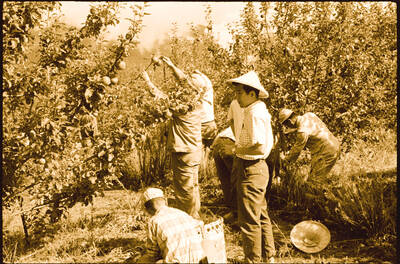
May 25 to May 31 Few believed that apples could be cultivated on a commercial scale in Taiwan’s high mountains. When horticulturalist Cheng Chao-hsiung (程兆熊) first proposed the idea in 1955, both American and Taiwanese colleagues dismissed it as implausible, arguing that temperate fruit could not be reliably grown on a subtropical island, especially on rugged terrain. However, it was this terrain in the Central Mountain Range where many Chinese Civil War veterans were resettled in the late 1950s. With limited job prospects and no family in Taiwan, they were placed on cooperative farms aimed toward self-sufficiency. Some say the conditions


 RSS
RSS