


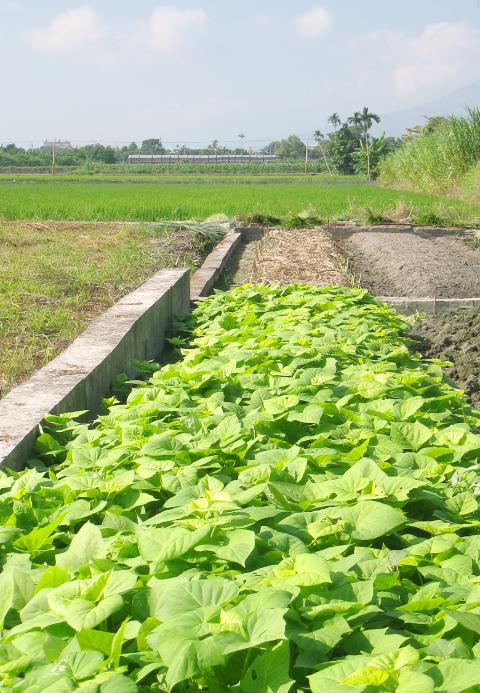
In Taiwan, vegetables don’t get much more humble than sweet potato greens (地瓜葉). Until quite recently, they were regarded as food for pigs, and many among Taiwan’s older generation have memories of resorting to sweet potato leaves has a last bastion against hunger in the day’s before the island’s economic miracle.
After years of media reports about the excessive use (and harmful residues) of pesticides, herbicides and chemical fertilizers of more upmarket vegetables, the health-conscious are beginning to rediscover sweet potato greens as a relatively uncontaminated vegetable. And the very reason for its new appeal is the fact that this low cost vegetable is robust enough to survive the pestilential Taiwan summers with little aid for modern agricultural science, and is much too cheap to warrant the use of expensive chemical aids.
In fact, sweet potato greens often don’t even warrant display space in the larger stalls of traditional markets, and are sold by old ladies with a small harvest of vegetables from their own plots on the fringes of the more established grocers.
According to a study by the University of Arkansas, “sweet potato leaves are comparable to spinach in nutrient content,” with “levels of iron, calcium, and carotene rank[ing] among the top as compared to other major vegetables.” (https://www.uaex.edu/publications/PDF/FSA-6135.pdf) There is also considerable literature on the antioxidant and chronic disease prevention benefits of the vegetable.
That said, it is important to point out at this point that eating sweet potato greens is not just some concession to faddish ideas of healthy eating. They taste delicious, and are not at all difficult to prepare. No less a figure than Mark Bittman, food writer and New York Times columnist has extolled the virtues of this vegetable, only lamenting the difficulty of obtaining it in North America (http://www.thebittenword.com/thebittenword/2010/10/saut%C3%A9ed-sweet-potato-greens.html). In Taiwan, it can probably be found at any traditional market for next to nothing, but to those who have not encountered it before, an unknown vegetable can be a little intimidating.
Sweet potato greens can be stir fried with garlic in conventional Chinese fashion and will taste pretty good, but the leaves may express a dark liquid that makes the dish look unappealing. One way around this problem is suggested by Taiwan’s favorite TV chef, Cheng Yen-chi (鄭衍基), better known as Ah-chi-shih (阿基師), is to use lemon juice, to counter the oxidizing tendencies of the vegetable. My own favorite method is to sauté very quickly with shallot confit (油蔥酥) and thick soy sauce, making for a simple dish that can be prepared in three or four minutes (for both shallot confit and soy sauce, which are both integral flavoring agents, a high quality artisanal brand is highly recommended).
This preparation of a humble vegetable makes a perfect accompaniment to white rice and can be enjoyed as a simple meal in itself, but it can also be used as a wonderful (and insanely cheap) replacement for spinach in many recipes. It should be noted that sweet potato greens cook down considerably, and unlike spinach, they don’t have the same degree of oxalic acid that can often produce an unpleasant astringent taste in spinach dishes. Sweet potato greens, despite their lowly origins, can provide both nutrition and flavor at a minimal financial and environmental cost.
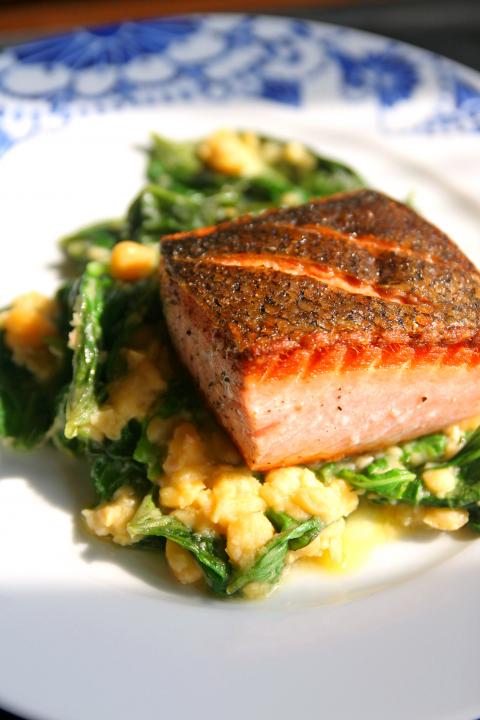
Crispy-skin Salmon with Chickpeas and Sweet Potato Greens
Recipe
(serves two)
Ingredients
Fish
2 pieces salmon fillets (approx. 200g each)
2 tbsp olive oil
salt
pepper
Chickpea
80g dried chickpeas (soaked overnight and cooked; the dried chickpeas can be prepared a day in advance and refrigerated)
2 tbsp olive oil
4 cloves garlic, minced
80ml vegetable stock (or water)
Juice of half a lemon
150g sweet potato leaves (stems removed)
Process 1
1. Score the skin of the salmon with a sharp knife.
2. Clean and dry the salmon with kitchen paper and season with salt and pepper (approx. 20 minutes before cooking).
3. Heat olive oil until almost smoking and then place the salmon skin-side down into the pan. (It is important both that the oil is hot and the fish is dry to ensure that it does not stick; the use of non-stick pans allow a greater degree of latitude.)
4. Cook the fish (with a thickness of about 5cm) for about 5 minutes, pressing down to ensure full contact of the skin with the pan. When the skin is crisp, flip the fish and cook for another 2 minutes for color.
5. Set aside on a sheet of kitchen paper to remove excess oil.
Process 2
1. While the fish is frying, add olive oil to a separate large saute pan. Fry garlic over a low flame until fragrant but without coloring.
2. Add the cooked chickpeas. Season with salt and pepper.
3. Add vegetable stock and bring to a simmer. Lightly crush the chickpeas. Add sweet potato greens. Don’t worry if they seem to almost overflow the pan, as they will cook down rapidly. Stir and allow the leaves to wilt. Add lemon juice. Check seasoning.
4. Place the salmon on a bed of chickpea and greens. Serve with lemon wedges.
Ian Bartholomew runs Ian’s Table, a small guesthouse in Hualien. He has lived in Taiwan for many years writing about the food scene and has decided that until you look at farming, you know nothing about the food you eat. He can be contacted at Hualien202@gmail.com.
Ajay Verma, a consultant gastroenterologist at Kettering general hospital in Northamptonshire, says our gut is a “complex machine.” “It is constantly providing us with the nutrition we need, initially to grow and develop, and then for us to survive, thrive and repair from injury and illness.” How can we keep it functioning well? Put simply: “Make sure what you put into it is balanced, and that you clear out its waste products adequately,” Verma says. “In a general gastroenterology clinic, the most common conditions we see are irritable bowel syndrome (IBS), gastroesophageal reflux disease, inflammatory bowel disease and constipation,” says Nisha
The arithmetic is straightforward and uncomfortable. By the end of 2025, Taiwan had committed itself to a 50-30-20 electricity mix — half natural gas, 30 per cent coal, 20 per cent renewables. The Ministry of Economic Affairs’s (MOEA) own monthly energy reports tell a different story. Natural gas reached 47.8 per cent of generation last year. Coal stood at 35.4 per cent, comfortably above its target ceiling. Renewables came in at 13.1 per cent, well short of the 20 per cent Taipei had pledged a decade earlier. Installed renewable capacity reached roughly half of the 12 gigawatts (GW) the government

Last week US President Donald Trump was asked by a reporter whether he would speak on the phone to the President of Taiwan. “l’ll speak to him. I speak to everybody. We have that situation very well in hand,” Trump said. This marked the second time in a couple of weeks he had said he would talk to the President of Taiwan. In 2016 he famously took a call from then-president Tsai Ing-wen (蔡英文), when he was president-elect. Despite warnings that the apocalypse was nigh because of a phone call, the world quickly forgot about the conversation between two democratically-elected presidents.
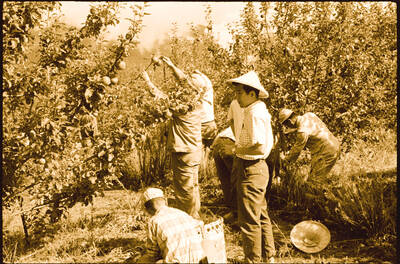
May 25 to May 31 Few believed that apples could be cultivated on a commercial scale in Taiwan’s high mountains. When horticulturalist Cheng Chao-hsiung (程兆熊) first proposed the idea in 1955, both American and Taiwanese colleagues dismissed it as implausible, arguing that temperate fruit could not be reliably grown on a subtropical island, especially on rugged terrain. However, it was this terrain in the Central Mountain Range where many Chinese Civil War veterans were resettled in the late 1950s. With limited job prospects and no family in Taiwan, they were placed on cooperative farms aimed toward self-sufficiency. Some say the conditions


 RSS
RSS