


Within the debates and national soul-searching over Taiwanese identity, the history and culture of the Pingpu, or Plains Indigenous Peoples, have received much attention over the past decade.
To understand Taiwan’s ethno-linguistic composition and the origin of the country’s many cultural traditions, it is impossible to ignore this group of Aborigines. With this in mind, the National Museum of Taiwan History in Greater Tainan (臺灣歷史博物館) has put together a special exhibition, Seeing Pingpu: The History and Culture of the Plains Indigenous Peoples in Taiwan (台灣平埔族群 歷史與文化特展), which runs until Aug. 4.
Museum Director Lu Li-cheng (呂理政) said that it required considerable effort to borrow objects from the collections in Japan and from other overseas institutions.
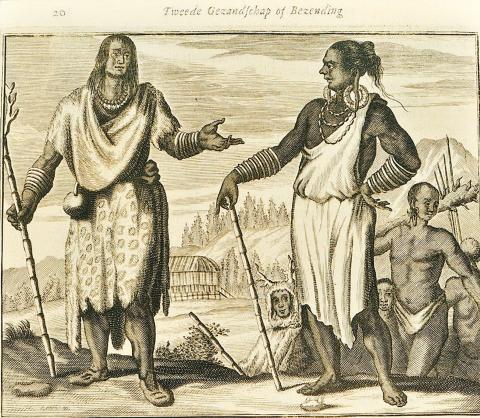
Photo Courtesy of National Museum of Taiwan History in Greater Tainan
“Through this exhibition we present the diverse cultures of the Pingpu peoples, raise and reflect on past viewpoints and interpretations about them and discuss methods to preserve their ethnic identity and culture,” Lu said.
The exhibition is the result of an international collaboration between the museum and Japan’s National Museum of Ethnology (NME日本國立民族學博物館) in Osaka, and the Tenri University Sankokan Museum (天理大學附屬天理參考館).
Of the over 300 items on display, 43 are from overseas, mainly from the two collaborating Japanese museums. A number of the priceless cultural artifacts are returning to Taiwan for the first time in over a century. Many of these objects have great historic and cultural significance to researchers — and especially to their original owners.
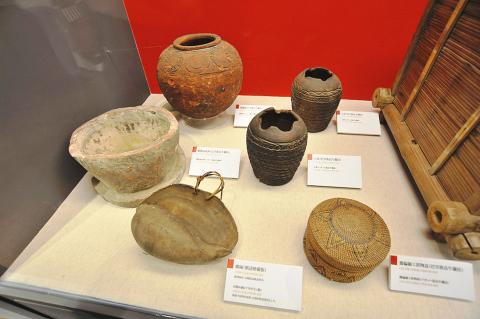
Photo Courtesy of National Museum of Taiwan History in Greater Tainan
The exhibition is divided into four sections: Who Are the Pingpu Peoples? Where Are They?; Plains Indigenous Peoples in the Grand History; Seeing Pingpu; and We Have Always Been Here.
Two items serve as the exhibition’s centerpiece. The first is a wall-sized color photograph snapped in February 2009 in front of the Legislative Yuan. It depicts members from each of the Pingpu’s 10 groups demanding official recognition of their ethnic status, and is meant to remind visitors that although Taiwan has come a long way with Aboriginal rights, there is still much work to be done.
The other centerpiece is a five-meter long canoe. Hand-carved by members of the Kavalan community of Hualien County and fashioned with decorative carvings on its sides, it is a reminder of their ocean culture and sea-faring lifestyle.
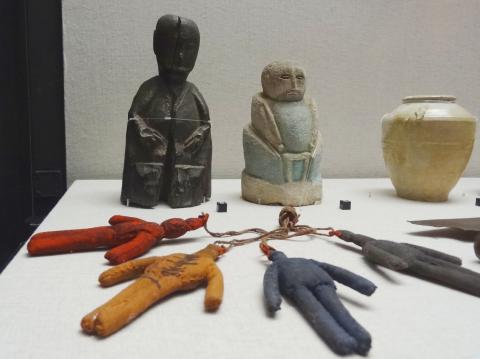
Photo Courtesy of National Museum of Taiwan History in Greater Tainan
But for this reviewer, the textiles are the star attraction of the exhibition. Crafted mostly by women, these exquisite fabrics include hand-weaved embroidered garments, ceremonial dresses and traditional headwear.
The fine craftsmanship and the detailed design are a testament to the creative aesthetics and weaving skills of the flourishing Pingpu communities which were the dominant culture in the plains and coastal regions of Taiwan in pre-modern times.
Also on display are woodcarvings and handicrafts, historic documents and black-and-white photographs dating back to the 19th century taken by anthropologists and Western explorers when they first came to Taiwan.
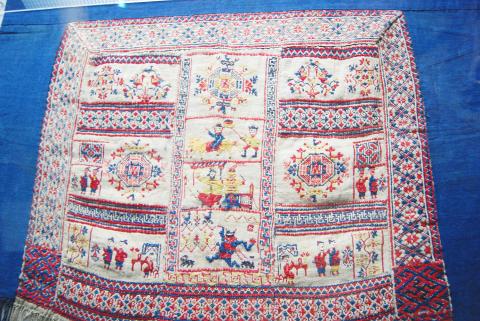
Photo Courtesy of National Museum of Taiwan History in Greater Tainan
The final section examines the fight for equality and ethnic status by Pingpu peoples over the past two decades, providing solid historical background and the socio-political context to their current struggle to gain recognition by the government of Taiwan.
Seeing Pingpu has mostly achieved the goals it sets out for itself. It provides solid explanations for the objects on display, and goes beyond superficial explanations when discussing the struggles of the Pingpu peoples, past and present. In so doing, it raises the issue of the ethno-cultural origins of Taiwanese and issues of Taiwanese identity.
One drawback of the exhibition is its limited space. Consequently, the museum focuses on the larger, more populous groups while the smaller ones and their cultural heritage receive less attention.
Prior to the arrival of Han Chinese settlers (and European explorers) starting in the 16th century, the Pingpu groups were the main Aboriginal peoples inhabiting the plains, lowlands and coastal areas on the western half of Taiwan proper.
Taiwan’s 10 Pingpu groups include: Ketagalan, Taokas, Pazeh, Kahabu, Papora, Babuza, Hoanya, Siraya, Makatao and Tavorlong. Of these, the languages of Pazeh and Kahabu are still alive and spoken by village elders. The Siraya people have been reviving their mother tongue with language textbooks and education programs in recent years.
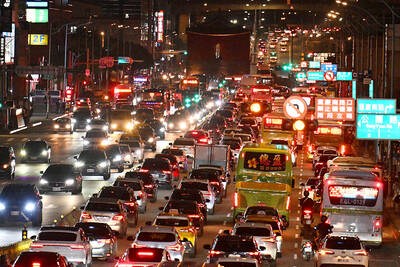
By global standards, the traffic congestion that afflicts Taiwan’s urban areas isn’t horrific. But nor is it something the country can be proud of. According to TomTom, a Dutch developer of location and navigation technologies, last year Taiwan was the sixth most congested country in Asia. Of the 492 towns and cities included in its rankings last year, Taipei was the 74th most congested. Taoyuan ranked 105th, while Hsinchu County (121st), Taichung (142nd), Tainan (173rd), New Taipei City (227th), Kaohsiung (241st) and Keelung (302nd) also featured on the list. Four Japanese cities have slower traffic than Taipei. (Seoul, which has some
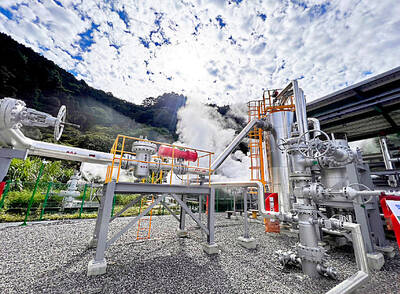
Taiwan’s semiconductor industry consumes electricity at rates that would strain most national grids. Taiwan Semiconductor Manufacturing Co (TSMC) alone accounted for more than 9 percent, or 2,590 megawatts (MW), of the nation’s power demand last year. The factories that produce chips for the world’s phones and servers run around the clock. They cannot tolerate blackouts. Yet Taiwan imports 97 percent of its energy, with liquefied natural gas reserves measured in days. Underground, Taiwan has options. Studies from National Taiwan University estimate recoverable geothermal resources at more than 33,000 MW. Current installed capacity stands below 10 MW. OBSTACLES Despite Taiwan’s significant geothermal potential, the

In our discussions of tourism in Taiwan we often criticize the government’s addiction to promoting food and shopping, while ignoring Taiwan’s underdeveloped trekking and adventure travel opportunities. This discussion, however, is decidedly land-focused. When was the last time a port entered into it? Last week I encountered journalist and travel writer Cameron Dueck, who had sailed to Taiwan in 2023-24, and was full of tales. Like everyone who visits, he and his partner Fiona Ching loved our island nation and had nothing but wonderful experiences on land. But he had little positive to say about the way Taiwan has organized its

The entire Li Zhenxiu (李貞秀) saga has been an ugly, complicated mess. Born in China’s Hunan Province, she moved to work in Shenzhen, where she met her future Taiwanese husband. Most accounts have her arriving in Taiwan and marrying somewhere between 1993 and 1999. She built a successful career in Taiwan in the tech industry before founding her own company. She also served in high-ranking positions on various environmentally-focused tech associations. She says she was inspired by the founding of the Taiwan People’s Party (TPP) in 2019 by Ko Wen-je (柯文哲), and began volunteering for the party soon after. Ko


 RSS
RSS