


Before Petra Nemcova was a supermodel, TV presenter and global philanthropist, she was a Czech schoolgirl too timid to talk. “I was so afraid to even read a paper in front of my classmates,” she says. “It is very funny because at that point my teachers would never have believed that I could speak in front of an audience of over 2,000 people.”
They’d be even more incredulous if they knew what Nemcova had been through. When she speaks at the Observer/TEDx festival of ideas in London on Saturday, it will, in part, be to revisit the emotionally and physically devastating experience of the Dec. 26 tsunami of 2004.
She was on holiday in Thailand with Simon Atlee, then her fiance, when the Indian Ocean earthquake caused a wave so forceful that it blasted away her clothes and swept her and Atlee from their hotel. Naked, and with a shattered pelvis and multiple internal injuries, she managed to cling to a palm tree for eight hours until she was rescued by air. Atlee’s body was found months later.

Photo: Bloomberg
Nemcova, now 31, has not only recovered but has founded a charity, the Happy Hearts Fund, which improves the lives of children living in natural disaster areas. She doesn’t think of her ordeal as a tragedy. Instead “it is about overcoming adversity and how the tragedy can bring lots of light to the person who’s experienced it and to many others around them.
“Wanting to help and not being able to — that was the hardest,” she says of her experience. “Because you hear children screaming on the next tree and then after a while you don’t hear them any more. You can’t get to them because of the debris and the injuries and that’s horrifying, knowing that.”
She talks about all this with remarkable peace and credits meditation with helping her survive. While holding on to the palm tree, “I was able to stay very calm and focused, aware very much of everything that was happening. I guess I was more prepared because of it.”
She was in intensive care in Thailand for two months and then in hospital in the Czech Republic for another two, learning to walk. From the start, though, she wanted to go back to help. “I had broken bones everywhere, it was impossible, but I think the vision that was so strong of me going back helped with my healing process. Some of the doctors said that some people heal from the same injuries in two years but I healed in four months.”
In April 2005, she returned to Thailand with her sister and, while they handed out food and blankets, she began mentally creating a charity. By 2006, the Happy Hearts Fund had become a reality. It has grown, she says, “from a two-person team doing everything on our knees, literally, to rebuilding 47 schools and having a presence in nine countries.”
It differs from other charities in three ways, she says. First, it focuses on what’s known as “the gap period” — the time between the initial response after a natural disaster and the rebuilding.
“It’s usually when the cameras leave that the support leaves as well,” she says. It can take up to a decade for government rebuilding to happen: “Sometimes a whole generation skips their education. And in areas where it’s so poor already, they go even more down the spiral and extreme poverty is there for so many more years.
“But if you’re able to rebuild the school, it’s not just children who get opportunities for a better future, the whole community gets excited and uplifted. So that one school can bring the whole village to incredible opportunity and growth.”
The second difference is the emphasis on sustainability. The charity has partnerships with the model agency IMG and others that help communities establish small businesses around schools, meaning they don’t have to rely on government. Finally, the charity has zero administration costs: they’re underwritten by its board members which means “100 percent of our donations go straight to children.”
The charity isn’t the only thing in her life. This year she became engaged to British actor Jamie Belman and says she wants a family, “but not that soon — there’s still so much to do.” Not least looking after the 31,000 children whom, she jokes, she already has.
Nemcova speaks very fast, with still-accented English that can’t keep up with the force and feeling of her thoughts. When she watched speeches at the original TED conference in Oxford she says she could feel her brain “radiating out excitement” but it’s easy to see her having that effect on other people. It goes some way in explaining her commitment to the charity; so too does her own experience of education.
She was born in 1979 in what is now the Czech Republic and had what she calls “a very simple but loving background”: her father built houses and her mother is a teacher.
“I grew up under Communism so we could only learn Russian, and then when Communism fell in 1989 we could learn a few more things and have the freedom to travel and the freedom of speech — and the freedom of dreaming, really.”
Nemcova places most importance on the practical power of knowledge. She cites, as an example, the story of the British girl Tilly Smith, then 10, who in 2004 recognized the warning signs of the impending tsunami on a beach on the Thai island of Phuket and raised the alarm. As Nemcova puts it: “A little girl who had a great teacher in geography saved over a hundred people.”
Nemcova and the foundation are based in New York, and traveling between the city and poor disaster zones is, she concedes, “quite strange.”
Modelling, I suggest, must seem inconsequential in comparison.
“I had a hard time after the tsunami to find the purpose in it,” she says. “The first few jobs I found it very hard to find a deeper meaning. But I’ve realized that people in the fashion industry want to help. Because they focus a lot on bringing the glamour, bringing the beauty, they search and strive for depth and meaning. You strive for it because you need it in your life.”

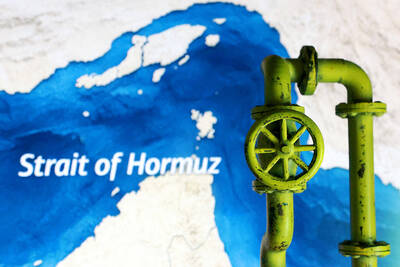
The US war on Iran has illuminated the deep interdependence of Asia on flows of oil and related items as raw materials that become the basis of modern human civilization. Australians and New Zealanders had a wake up call. The crisis also emphasizes how the Philippines is a swatch of islands linked by jet fuel. These revelations have deep implications for an invasion of Taiwan. Much of the commentary on the Taiwan scenario has looked at the disruptions to world trade, which will be in the trillions. However, the Iran war offers additional specific lessons for a Taiwan scenario. An insightful
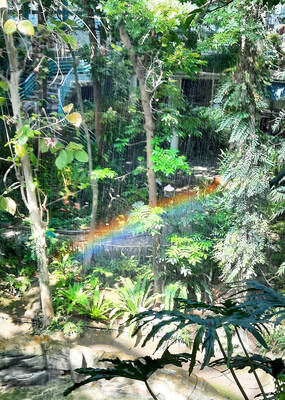
It’s only half the size of its more famous counterpart in Taipei, but the Botanical Garden of the National Museum of Nature Science (NMNS, 國立自然科學博物館植物園) is surely one of urban Taiwan’s most inviting green spaces. Covering 4.5 hectares immediately northeast of the government-run museum in Taichung’s North District (北區), the garden features more than 700 plant species, many of which are labeled in Chinese but not in English. Since its establishment in 1999, the site’s managers have done their best to replicate a number of native ecosystems, dividing the site into eight areas. The name of the Coral Atoll Zone might
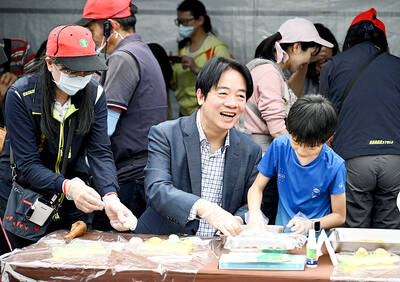
Polling data often confirms what we expect, but sometimes it throws up surprises. When examined over time, some patterns appear that speak to something bigger going on. In this column, whenever possible, Formosa’s polls are used. Despite the sometimes cringeworthy antics of Formosa’s Chairman, Wu Tzu-Chia (吳子嘉), the data produced includes detailed breakdowns crucial for analysis. It has also been conducted monthly 11-12 times a year for many years with many of the same questions, allowing for analysis over time. When big shifts do occur between one month and the next it is usually in response to some event in
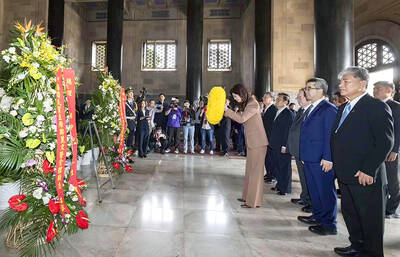
The problem with Marx’s famous remark that history repeats itself, first as tragedy, the second time as farce, is that the first time is usually farce as well. This week Chinese Nationalist Party (KMT) Chair Cheng Li-wun (鄭麗文) made a pilgrimage to the People’s Republic of China (PRC) “to confer, converse and otherwise hob-nob” with Chinese Communist Party (CCP) officials. The visit was an instant international media hit, with major media reporting almost entirely shorn of context. “Taiwan’s main opposition leader landed in China Tuesday for a rare visit aimed at cross-strait ‘peace’”, crowed Agence-France Presse (AFP) from Shanghai. Rare!


 RSS
RSS