


Shangching Sheep Hot Pot Restaurant (尚青ㄟ羊肉爐), located in the depths of Sanchong (三重), likes to flaunt a hard-core image. It’s tactic, which involves hanging whole sheep carcasses outside the main entrance next to a slab so that diners can view the butchering of the raw meat, has certainly generated a hearty response. Some are disgusted by the spectacle, and have expatiated at length on various food blogs, even going so far as to draw a parallel with the public slaughter and the skinning of snakes that was once a popular attraction at the Huaxi Street (華西街) night market. There are others, myself included, who are attracted by the offer of fresh mutton that these carcasses promise.
There are many factors that distinguish Shangching from run-of-the-mill mutton hot pot establishments, which often use frozen meat taken from goats rather than sheep. The management emphasizes that it uses local sheep that are killed and delivered to the restaurant daily. Another factor is the absence of a broth heavy with Chinese medicinal herbs. Shangching uses a clear broth made from bones, rice wine and very little else.
Walking into Shangching is more like walking into a butcher’s shop than a restaurant, which is a deliberate move that gives the meat pride of place. Customers place orders before a display of a huge variety of meats and animal parts. This process can be a bit bewildering for those unable to recognize the various cuts of meat and unfamiliar with how they should be incorporated into the meal. The servers are not particularly helpful in this regard, and given that often there are queues for a table, they probably feel little need to go out of their way to explain things to first-timers.
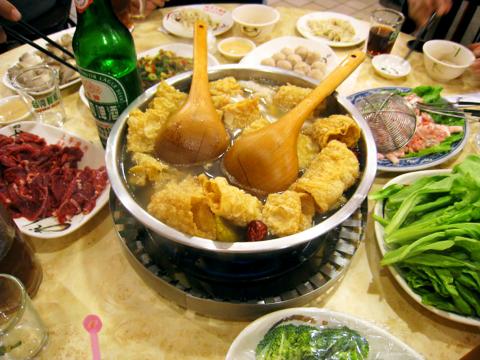
Photo: Ian Bartholomew, Taipei Times
It is largely up to the customer to determine the flavor of the broth through the selection of meat. A good start is a plate of head meat (鍋底嘴邊肉, NT$450), and for those who want to enrich the broth further, a sheep’s tail (羊尾巴, NT$250) or foot (羊腳, NT$250) can be recommended. A wide range of vegetables are available to add a little sweetness, and these are sold at NT$50 a plate. For those willing to splash out, a 300g plate of top quality loin (涮腰內肉, NT$700) provides some of the most tender mutton you’re likely to find. Cartilage (軟骨肉, NT$500) and shank (腱子肉, NT$600) provide contrasting textures. For those who want to push the boundaries, sheep brains (羊腦, NT$150) and eyes (羊眼睛, NT$100 each) can be recommended both for their culinary interest and relative absence from conventional hot pot menus. Attention needs to be paid to developing the broth with judicious ordering, otherwise it will remain bland and unappealing.
Not everything on offer goes into the hot pot, and Shangching has a number of other methods of preparation. The fat belly meat (三層白切肉, NT$450), thinly sliced, is delicious, as is the intestine fried with ginger (炒薑絲羊腸, NT$150).
The hot pot and other dishes should be enjoyed with a plate of vermicelli in sheep’s oil (羊油麵線), which is very tasty, but certainly not for those who don’t like the smell of mutton.
Fans of British culinary legend Fergus Henderson, a man who has spent his career advocating the use of “the whole beast,” rather than the few prize cuts available in the supermarket, are likely to find great interest in what Shangching has to offer.
With its roadside-stall atmosphere and commensurate level of comfort, Shangching will seem expensive for anyone who is not there specifically for the food, but as a destination for culinary adventure, it’s hard to beat.

Taiwan’s English education system is being pulled apart by three opposing forces. Bilingual Nation 2030 pulls students toward English and global communication. Artificial Intelligence (AI) readiness pulls them toward digital judgment, verification and AI-mediated work. But Taiwan’s old exam culture pulls them back toward memorization, grammar drills, timed reading and correct answers. If the education system keeps using old exams to define success, it risks producing graduates who are neither genuinely bilingual nor genuinely AI-ready, but trained for tasks machines can already perform. The first force is Bilingual Nation 2030. Launched in 2018, the policy aimed to “help Taiwan’s workforce connect

“Taiwan’s Opposition Leader Comes to US With a Message Straight Out of Beijing” read a May 31 headline in the Wall Street Journal. Top US administration officials and members of Congress almost certainly read the WSJ, and if there was a bullet point takeaway that people in Washington should absorb ahead of Chinese Nationalist Party (KMT) Chair Cheng Li-wun’s (鄭麗文) arrival in DC on June 9, that headline is it. The last few columns have discussed this very topic, and the timing is not coincidental. While those top officials likely do not read the Taipei Times, judging by the number

With weighty, anxiety-inducing geopolitical topics dominating the headlines, checking in on the wild and weird state of local politics can take some of the edge off. This November’s elections will determine who will be in charge of fixing potholes in your neighborhood, not the potholes in Taiwan’s complicated geopolitical space. Recently, after an online interview with a Taipei-based journalist, I commented that Taipei journalists never go further than the MRT can take them. He laughed and agreed. Naturally, the Taipei mayoral race is eating up much of the press attention. TAIPEI CITY Democratic Progressive Party (DPP) candidate Puma Shen (沈伯洋) has
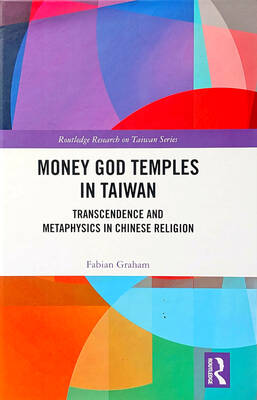
As someone who normally steers clear of books with “transcendence” or “metaphysics” in their subtitles, this reviewer — a casual observer of local belief systems since the 1990s — found Fabian Graham’s Money God Temples in Taiwan a challenging read. Those who’ve only dipped their toes into temple culture will likely need to parse several sections with special care if they’re to keep up with the author, a British ethnographic researcher whose previous books have investigated religious practices among ethnic Chinese in Southeast Asia. This scholarly volume examines a facet of Taiwan’s religious landscape that didn’t exist a century ago, and


 RSS
RSS